Evaluation of Amikacin Regimens, Cmax/MIC Ratios, and Clinical Outcomes in a Hospital at Yogyakarta, Indonesia

Article Sidebar
-
Amikacin, dosage regimen, Cmax/MIC ratio, Clinical outcomes
Abstract
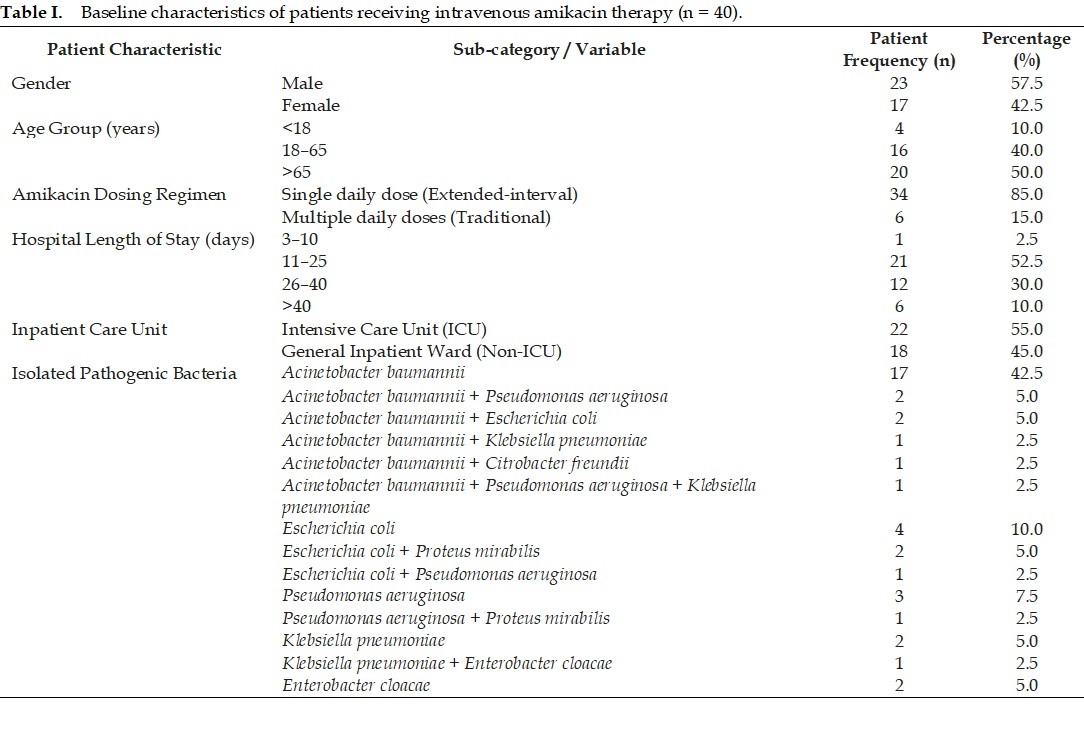
Amikacin is widely used to treat infections caused by Gram-negative bacteria. Its narrow therapeutic range necessitates plasma concentration monitoring through Therapeutic Drug Monitoring (TDM). However, limited infrastructure has restricted TDM implementation in many Indonesian healthcare settings. This study aims to evaluate amikacin dosing, estimate blood concentrations using pharmacokinetic equations, assess the pharmacokinetic/pharmacodynamic (PK/PD) profile, and analyze clinical outcomes. This descriptive-analytic study employed a retrospective cross-sectional design. It was conducted at a hospital in Yogyakarta by collecting data on amikacin dosing regimens, patient clinical outcomes, serum creatinine levels, and antibiotic sensitivity test results. The study subjects were hospitalized patients with infections who received amikacin therapy. Descriptive analysis was performed on patient characteristics, while estimated blood drug levels and PK/PD profiles were calculated using pharmacokinetic formulas and analyzed descriptively. A total of 44 amikacin dosing regimens from 40 patients met the inclusion and exclusion criteria. Of these, 39 regimens were appropriate according to dosing guidelines, and 26 (66.7%) resulted in favorable clinical outcomes. In contrast, five inappropriate regimens were associated with poor clinical outcomes. Among the 39 appropriate regimens, only 18 (46.2%) achieved the target peak plasma concentration (Cmax). Furthermore, of these 18 regimens, only two (11.1%) achieved the target Cmax/MIC ratio, with one associated with a favorable clinical outcome and one without improvement. These findings suggest that, despite appropriate dosing, most amikacin regimens failed to achieve the optimal Cmax/MIC ratio required for effective clinical outcomes, highlighting the potential value of TDM and individualized dosing strategies to optimize amikacin therapy.
Full text article
References
2. Muteeb G, Rehman MT, Shahwan M, Aatif M. Origin of Antibiotics and Antibiotic Resistance, and Their Impacts on Drug Development: A Narrative Review. Pharmaceuticals. 2023;16(11):1615. DOI: 10.3390/ph16111615; PMID: 38004480; PMCID: PMC10675245.
3. Serio AW, Keepers T, Andrews L, Krause KM. Aminoglycoside Revival: Review of a Historically Important Class of Antimicrobials Undergoing Rejuvenation. EcoSal Plus. 2018;8(1):10.1128/ecosalplus.ESP-0002-2018. DOI: 10.1128/ecosalplus.ESP-0002-2018; PMID: 30447062; PMCID: PMC11575671.
4. Thy M, Timsit JF, de Montmollin E. Aminoglycosides for the Treatment of Severe Infection Due to Resistant Gram-Negative Pathogens. Antibiotics. 2023;12(5):860. DOI: 10.3390/antibiotics12050860; PMID: 37237763; PMCID: PMC10215420.
5. Oliveira JF, Silva CA, Barbieri CD, Oliveira GM, Zanetta DM, Burdmann EA. Prevalence and risk factors for aminoglycoside nephrotoxicity in intensive care units. Antimicrob Agents Chemother. 2009;53(7):2887-91. DOI: 10.1128/AAC.01430-08; PMID: 19364846; PMCID: PMC2704674.
6. Logre E, Enser M, Tanaka S, Dubert M, Claudinon A, Grall N, Mentec H, Montravers P, Pajot O. Amikacin pharmacokinetic/pharmacodynamic in intensive care unit: a prospective database. Ann Intensive Care. 2020;10(1):75. DOI: 10.1186/s13613-020-00685-5; PMID: 32514769; PMCID: PMC7276966.
7. Jaiswal S, Agarwal A, Singh SP, Mohan P. Therapeutic drug monitoring of Amikacin in hospitalized patients: A pilot study. Med J Armed Forces India. 2023;79(Suppl 1):S119-S124. DOI: 10.1016/j.mjafi.2022.02.006; PMID: 38144659; PMCID: PMC10746789.
8. Rouchmana S, Wahyono D, Rahmawati F. Evaluasi Regimen Dosis Amikasin dan Kejadian Efek Nefrotoksik Pada Penggunaan Antibiotik Amikasin di Rumah Sakit Yogyakarta. Majalah Farmaseutik. 2021;17(3):355-64. DOI: 10.22146/farmaseutik.v1i1.60590.
9. Abdul-Aziz MH, Alffenaar JC, Bassetti M, Bracht H, Dimopoulos G, Marriott D, et al. Antimicrobial therapeutic drug monitoring in critically ill adult patients: a Position Paper. Intensive Care Med. 2020;46(6):1127-53. DOI: 10.1007/s00134-020-06050-1; PMID: 32383061; PMCID: PMC7223855.
10. Kato H, Hagihara M, Hirai J, Sakanashi D, Suematsu H, Nishiyama N, et al. Evaluation of Amikacin Pharmacokinetics and Pharmacodynamics for Optimal Initial Dosing Regimen. Drugs R D. 2017;17(1):177-87. DOI: 10.1007/s40268-016-0165-5; PMID: 28063020; PMCID: PMC5318333.
11. Suryoputri MW, Ilma DL, Endriastuti NE. Hubungan Kadar Obat Gentamisin Dalam Darah Terhadap Outcome Clinic Pada Pasien Anak Yang Menderita Pneumonia Di RSUD Ajibarang. JPSCR J Pharm Sci Clin Res. 2023;8(3):410-25. DOI: 10.20961/jpscr.v8i3.61849.
12. Nabila NA, Puspitasari I, Laksanawati IS. Evaluasi Kesesuaian Dosis dan Clinical Outcome Amikasin dan Gentamisin di Picu (Pediatric Intensive Care Unit) RSUP Dr. Sardjito Yogyakarta. Majalah Farmaseutik. 2022;18(2):133-49. DOI: 10.22146/farmaseutik.v1i1.59233.
13. Pramono ZD, Puspitasari I, Laksanawati IS. Evaluasi Kesesuaian Dosis dan Clinical Outcome Amikasin dan Gentamisin di Bangsal Nicu (Neonatal Intensive Care Unit) RSUP Dr. Sardjito Yogyakarta. Majalah Farmaseutik. 2021;17(3):334-42. DOI: 10.22146/farmaseutik.v1i1.58243.
14. Clinical and Laboratory Standards Institute. 2024. Methods for Dilution Antimicrobial Susceptibility Tests for Bacteria That Grow Aerobically; Approved Standard. 12th ed, M07–A11. Wayne, PA: Clinical and Laboratory Standards Institute.
15. Dupont V, Mourvillier B, Barbe C, Legros V, Jozwiak M, Merdji H, et al. Amikacin use in critically ill patients requiring renal replacement therapy: the AMIDIAL-ICU study. Ann Intensive Care. 2025;15(1):42. DOI: 10.1186/s13613-025-01461-z; PMID: 40133728; PMCID: PMC11937451.
16. Gay L, Melenotte C, Lakbar I, Mezouar S, Devaux C, Raoult D, et al. Sexual Dimorphism and Gender in Infectious Diseases. Front Immunol. 2021;12:698121. DOI: 10.3389/fimmu.2021.698121; PMID: 34367158; PMCID: PMC8339590.
17. Araújo M, Mendes-Frias A, Silvestre R. Sex differences in immune modulation: implications for infection, inflammation, and nutritional supplementation. Biol Sex Differ. 2026;17(1):61. DOI: 10.1186/s13293-026-00857-1; PMID: 41709346; PMCID: PMC13040730.
18. Jiang C, Chen Q, Xie M. Smoking increases the risk of infectious diseases: A narrative review. Tob Induc Dis. 2020;18:60. DOI: 10.18332/tid/123845; PMID: 32765200; PMCID: PMC7398598.
19. Samuelson DR. Alcohol's Effects on the Lung and Lung Disease. Alcohol Res. 2025;45(1):11. DOI: 10.35946/arcr.v45.1.11; PMID: 41312448; PMCID: PMC12651588.
20. Díaz A, Beleña Á, Zueco J. The Role of Age and Gender in Perceived Vulnerability to Infectious Diseases. Int J Environ Res Public Health. 2020;17(2):485. DOI: 10.3390/ijerph17020485; PMID: 31940870; PMCID: PMC7014162.
21. Zazo H, Martín-Suárez A, Lanao JM. Evaluating amikacin dosage regimens in intensive care unit patients: a pharmacokinetic/pharmacodynamic analysis using Monte Carlo simulation. Int J Antimicrob Agents. 2013;42(2):155-60. DOI: 10.1016/j.ijantimicag.2013.04.021; PMID: 23756322.
22. Pérut V, Gauzit R, Kernéis S, Canouï E, Chedhomme FX, Batista R, et al. Assessing the benefit of the 72-hour antibiotic therapy reassessment documentation. Med Mal Infect. 2019;49(3):187-93. DOI: 10.1016/j.medmal.2018.10.002; PMID: 30420165.
23. Grant J, Saux NL; members of the Antimicrobial Stewardship and Resistance Committee (ASRC) of the Association of Medical Microbiology and Infectious Disease (AMMI) Canada. Duration of antibiotic therapy for common infections. J Assoc Med Microbiol Infect Dis Can. 2021;6(3):181-97. DOI: 10.3138/jammi-2021-04-29. Erratum in: J Assoc Med Microbiol Infect Dis Can. 2022;7(3):292. DOI: 10.3138/jammi-2022-08-07; PMID: 36337760; PMCID: PMC9615468.
24. Kidney Disease: Improving Global Outcomes (KDIGO) CKD Work Group. KDIGO 2024 Clinical Practice Guideline for the Evaluation and Management of Chronic Kidney Disease. Kidney Int. 2024;105(4S):S117-S314. DOI: 10.1016/j.kint.2023.10.018; PMID: 38490803.
25. Steffens NA, Zimmermann ES, Azeredo FJ, Linden R, Finatto LJ, Hahn RZ, et al. Therapeutic Drug Monitoring-Based Population Pharmacokinetics of Amikacin in Patients at a Teaching Hospital. Antibiotics. 2025;14(6):531. DOI: 10.3390/antibiotics14060531; PMID: 40558121; PMCID: PMC12189896.
26. Castro DM, Dresser L, Granton J, Fan E. Pharmacokinetic Alterations Associated with Critical Illness. Clin Pharmacokinet. 2023;62(2):209-20. DOI: 10.1007/s40262-023-01213-x; PMID: 36732476; PMCID: PMC9894673.
27. Qayyum S, Shahid K. Fluid Resuscitation in Septic Patients. Cureus. 2023;15(8):e44317. DOI: 10.7759/cureus.44317; PMID: 37779759; PMCID: PMC10537347.
28. Magréault S, Jauréguy F, Carbonnelle E, Zahar JR. When and How to Use MIC in Clinical Practice? Antibiotics. 2022;11(12):1748. DOI: 10.3390/antibiotics11121748; PMID: 36551405; PMCID: PMC9774413.
29. Schuetz AN, Ferrell A, Hindler JA, Humphries R, Bobenchik AM. Overview of changes in the Clinical and Laboratory Standards Institute Performance Standards for Antimicrobial Susceptibility Testing: M100 32nd and 33rd editions. J Clin Microbiol. 2025;63(9):e0162323. DOI: 10.1128/jcm.01623-23; PMID: 40772786; PMCID: PMC12421849.
30. Fayed DF, Dahmash NS, al-Zeer AH, Shibl AM, Huraib SO, Abu-Aisha H. Efficacy and safety of once-daily amikacin in combination with ceftazidime in critically ill adults with severe gram-negative infections. J Chemother. 1996;8(6):457-64. DOI: 10.1179/joc.1996.8.6.457; PMID: 8981187.
Authors
Copyright (c) 2026 Firdhani Satia Primasari, Nidya Afriana Fitria Dewi, Fita Rahmawati, Arief Rahman Hakim

This work is licensed under a Creative Commons Attribution-ShareAlike 4.0 International License.
This work is licensed under a Creative Commons Attribution-ShareAlike 4.0 International License.
Authors continue to retain the copyright to the article if the article is published in the Borneo Journal of Pharmacy. They will also retain the publishing rights to the article without any restrictions.
Authors who publish in this journal agree to the following terms:
- Any article on the copyright is retained by the author(s).
- The author grants the journal the right of first publication with the work simultaneously licensed under a Creative Commons Attribution License that allows others to share work with an acknowledgment of the work authors and initial publications in this journal.
- Authors can enter into separate, additional contractual arrangements for the non-exclusive distribution of published articles (e.g., post-institutional repository) or publish them in a book, with acknowledgment of their initial publication in this journal.
- Authors are permitted and encouraged to post their work online (e.g., in institutional repositories or on their websites) prior to and during the submission process. This can lead to productive exchanges and earlier and greater citations of published work.
- The article and any associated published material are distributed under the Creative Commons Attribution-ShareAlike 4.0 International License.
Article Details