Expert Validation of a Medication Error Assessment Tool in the Integrated Medicine Management Model for Geriatric Patients with CHF

Article Sidebar
-
Congestive Heart Failure, Integrated Medicine Management, Medication Error, Expert Validation
Abstract
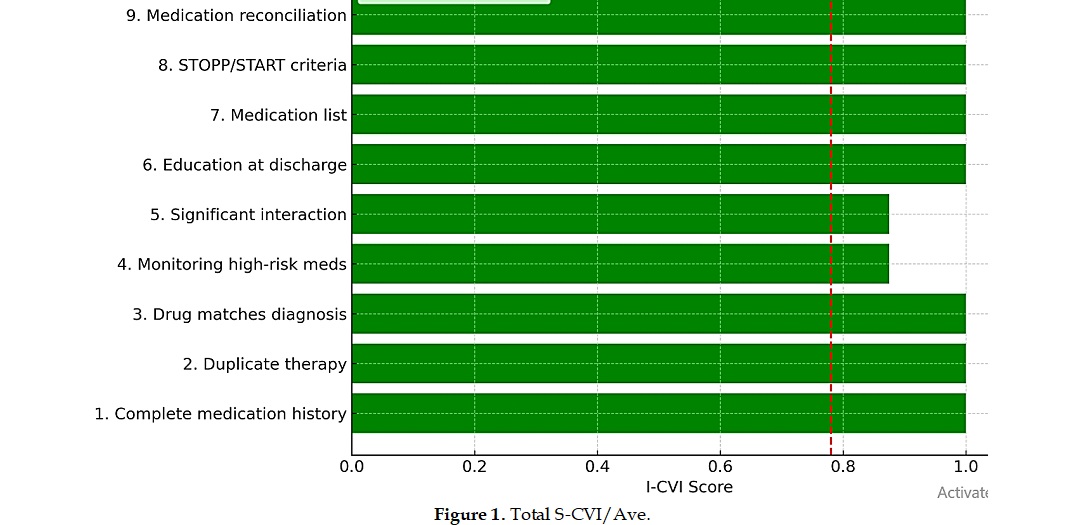
Geriatric patients with congestive heart failure (CHF) face an elevated risk of medication errors due to physiological changes, polypharmacy, and comorbidities. Integrated Medicine Management (IMM) is a multidisciplinary model designed to minimize drug-related problems through structured interventions during admission, hospitalization, and discharge. This study aimed to validate a medication error checklist developed for the IMM model, specifically for hospitalized older adults with CHF. A descriptive, quantitative design was applied, with expert-based content validation. A purposive sample of eight healthcare professionals, including physicians, clinical pharmacists, and senior nurses, was recruited. Each checklist item was assessed for relevance using a 4-point Likert scale. Content validity was evaluated using the Item-Level Content Validity Index (I-CVI) and the Scale-Level CVI (S-CVI/Ave). All nine items obtained I-CVI values of ≥0.875, with seven items achieving a full consensus (I-CVI = 1.00). The overall S-CVI/Ave was 0.97, indicating excellent content validity. The checklist integrates global safety frameworks, including the STOPP/START criteria, the WHO Medication Without Harm initiative, ISMP's high-alert medication guidance, and The Joint Commission's reconciliation protocols. Core components address reconciliation, therapy duplication, high-risk drugs, and discharge education. The validated checklist demonstrates strong content validity and clinical relevance for detecting medication-related problems in hospitalized geriatric CHF patients. Integration into digital platforms such as MINE (Medicine IN gEriatric) may enhance interprofessional collaboration, reduce preventable errors, and promote safer pharmacotherapy across care transitions.
Full text article
References
2. Hodkinson A, Tyler N, Ashcroft DM, Keers RN, Khan K, Phipps D, et al. Preventable medication harm across health care settings: a systematic review and meta-analysis. BMC Med. 2020;18(1):313. DOI: 10.1186/s12916-020-01774-9; PMID: 33153451; PMCID: PMC7646069.
3. Maher RL, Hanlon J, Hajjar ER. Clinical consequences of polypharmacy in elderly. Expert Opin Drug Saf. 2014;13(1):57-65. DOI: 10.1517/14740338.2013.827660; PMID: 24073682; PMCID: PMC3864987.
4. Manias E, Kusljic S, Wu A. Interventions to reduce medication errors in adult medical and surgical settings: a systematic review. Ther Adv Drug Saf. 2020;11:2042098620968309. DOI: 10.1177/2042098620968309; PMID: 33240478; PMCID: PMC7672746.
5. Amponsah AK, Bam V, Stolt M, Korhonen J, Axelin A. Evaluating the content validity of two versions of an instrument used in measuring pediatric pain knowledge and attitudes in the Ghanaian context. PLoS One. 2020;15(11):e0241983. DOI: 10.1371/journal.pone.0241983; PMID: 33156874; PMCID: PMC7647094.
6. Gomis-Pastor M, Berdún J, Borrás-Santos A, López ADD, Rama BFM, García-Esquirol Ó, et al. Clinical Validation of Digital Healthcare Solutions: State of the Art, Challenges and Opportunities. Healthcare. 2024;12(11):1057. DOI: 10.3390/healthcare12111057; PMID: 38891132; PMCID: PMC11171879.
7. Assunção-Costa L, Pinto CR, Machado JFF, Valli CG, de Souza LEPF, Franklin BD. Validation of a method to assess the severity of medication administration errors in Brazil. BMJ Open Qual. 2023;12(4):e002510. DOI: 10.1136/bmjoq-2023-002510; PMID: 38160020; PMCID: PMC10759053.
8. Lynn MR. Determination and quantification of content validity. Nurs Res. 1986;35(6):382-5. PMID: 3640358.
9. Polit DF, Beck CT. The content validity index: are you sure you know what's being reported? Critique and recommendations. Res Nurs Health. 2006;29(5):489-97. DOI: 10.1002/nur.20147; PMID: 16977646.
10. Donaldson LJ, Kelley ET, Dhingra-Kumar N, Kieny MP, Sheikh A. Medication Without Harm: WHO's Third Global Patient Safety Challenge. Lancet. 2017;389(10080):1680-1. DOI: 10.1016/S0140-6736(17)31047-4; PMID: 28463129.
11. ISMP releases Top 10 list of medication errors and hazards in 2020. React Wkly. 2021;1844:7. DOI: 10.1007/s40278-021-91454-9; PMCID: PMC7907321.
12. By the 2019 American Geriatrics Society Beers Criteria® Update Expert Panel. American Geriatrics Society 2019 Updated AGS Beers Criteria® for Potentially Inappropriate Medication Use in Older Adults. J Am Geriatr Soc. 2019;67(4):674-94. DOI: 10.1111/jgs.15767; PMID: 30693946.
13. Writing Committee Members; ACC/AHA Joint Committee Members. 2022 AHA/ACC/HFSA Guideline for the Management of Heart Failure. J Card Fail. 2022;28(5):e1-67. DOI: 10.1016/j.cardfail.2022.02.010; PMID: 35378257.
14. NICE Medicines and Prescribing Centre (UK). Medicines Optimisation: The Safe and Effective Use of Medicines to Enable the Best Possible Outcomes. Manchester: National Institute for Health and Care Excellence (NICE); 2015. NBKID: NBK305021
15. Wadhwa R, Boehning AP. The Joint Commission. In: StatPearls. Treasure Island (FL): StatPearls Publishing; 2023. NBKID: NBK557846.
16. Mahony DO, Sullivan DO, Byrne S, Connor MNO, Ryan C, Gallagher P. Corrigendum: STOPP/START criteria for potentially inappropriate prescribing in older people: version 2. Age Ageing. 2018;47(3):489. DOI: 10.1093/ageing/afx178; PMID: 29182733; PMCID: PMC5920325.
17. Jarrett T, Cochran J, Baus A. Applying the Medications at Transitions and Clinical Handoffs Toolkit in a Rural Primary Care Clinic: Implications for Nursing, Patients, and Caregivers. J Nurs Care Qual. 2020;35(3):233-9. DOI: 10.1097/NCQ.0000000000000454; PMID: 32433146; PMCID: PMC7247934.
18. Peterson ME, Stollings JL, Ely EW. Identifying and Resolving Drug-Related Problems in Geriatric Patients. Hosp Pharm. 2026:00185787251414339. DOI: 10.1177/00185787251414339; PMID: 41614005; PMCID: PMC12846905.
19. Niu F, Dhamayanti M, Setiawati EP, Arisanti N. Development and content validation of an interprofessional collaboration model for child sexual abuse prevention in primary health care. BMC Prim Care. 2026. DOI: 10.1186/s12875-026-03352-z; PMID: 42121062.
20. O'Mahony D, Cherubini A, Guiteras AR, Denkinger M, Beuscart JB, Onder G, et al. Correction: STOPP/START criteria for potentially inappropriate prescribing in older people: version 3. Eur Geriatr Med. 2023;14(4):633. DOI: 10.1007/s41999-023-00812-y; PMID: 37326916; PMCID: PMC10447589.
21. Mokkink LB, de Vet HCW, Prinsen CA, Terwee CB. COSMIN Methodology for Conducting Systematic Reviews of Patient-Reported Outcome Measures (PROMs). In: Maggino F, ed. Encyclopedia of Quality of Life and Well-Being Research. Cham: Springer; 2023. DOI: 10.1007/978-3-031-17299-1_2972.
22. Terwee CB, Prinsen CAC, Chiarotto A, Westerman MJ, Patrick DL, Alonso J, et al. COSMIN methodology for evaluating the content validity of patient-reported outcome measures: a Delphi study. Qual Life Res. 2018;27(5):1159-70. DOI: 10.1007/s11136-018-1829-0; PMID: 29550964; PMCID: PMC5891557.
23. Cole JA, Gonçalves-Bradley DC, Alqahtani M, Barry HE, Cadogan C, Rankin A, et al. Interventions to improve the appropriate use of polypharmacy for older people. Cochrane Database Syst Rev. 2023;10(10):CD008165. DOI: 10.1002/14651858.CD008165.pub5; PMID: 37818791; PMCID: PMC10565901.
24. Bates DW, Levine D, Syrowatka A, Kuznetsova M, Craig KJT, Rui A, et al. The potential of artificial intelligence to improve patient safety: a scoping review. NPJ Digit Med. 2021;4(1):54. DOI: 10.1038/s41746-021-00423-6; PMID: 33742085; PMCID: PMC7979747.
25. Sutton RT, Pincock D, Baumgart DC, Sadowski DC, Fedorak RN, Kroeker KI. An overview of clinical decision support systems: benefits, risks, and strategies for success. NPJ Digit Med. 2020;3:17. DOI: 10.1038/s41746-020-0221-y; PMID: 32047862; PMCID: PMC7005290.
26. World Health Organization. Global strategy on digital health 2020-2025. Geneva: World Health Organization; 2021.
Authors
Copyright (c) 2026 Welinda Dyah Ayu, Umi Athiyah, Elida Zairina

This work is licensed under a Creative Commons Attribution-ShareAlike 4.0 International License.
This work is licensed under a Creative Commons Attribution-ShareAlike 4.0 International License.
Authors continue to retain the copyright to the article if the article is published in the Borneo Journal of Pharmacy. They will also retain the publishing rights to the article without any restrictions.
Authors who publish in this journal agree to the following terms:
- Any article on the copyright is retained by the author(s).
- The author grants the journal the right of first publication with the work simultaneously licensed under a Creative Commons Attribution License that allows others to share work with an acknowledgment of the work authors and initial publications in this journal.
- Authors can enter into separate, additional contractual arrangements for the non-exclusive distribution of published articles (e.g., post-institutional repository) or publish them in a book, with acknowledgment of their initial publication in this journal.
- Authors are permitted and encouraged to post their work online (e.g., in institutional repositories or on their websites) prior to and during the submission process. This can lead to productive exchanges and earlier and greater citations of published work.
- The article and any associated published material are distributed under the Creative Commons Attribution-ShareAlike 4.0 International License.
Article Details