Rapid and Controlled: Microflow Reactor-Assisted Synthesis of Cinnamaldehyde and Ethyl Cinnamate along with Their Cytotoxic Activity Against Several Cell Lines

Article Sidebar
-
Microflow Reactor, Cinnamaldehyde Synthesis, Ethyl Cinnamate, Green Chemistry, Cytotoxic Activity
Abstract
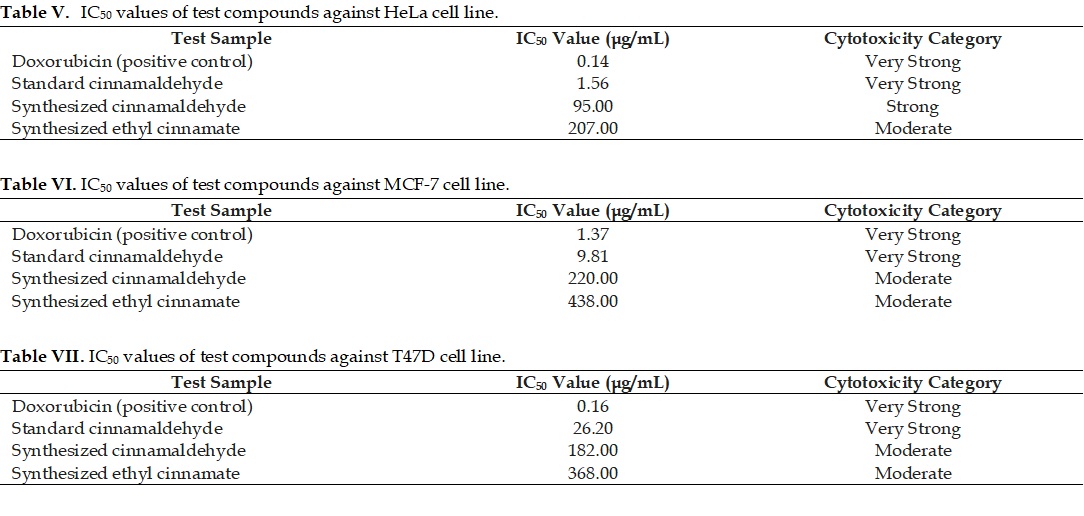
Cinnamaldehyde is a major aromatic compound utilized in the pharmaceutical industry due to its diverse biological activities, including anticancer potential. This study aims to develop a rapid and controlled synthesis method for cinnamaldehyde and ethyl cinnamate using microflow reactor technology, followed by structural elucidation and cytotoxic evaluation against HeLa, MCF-7, and T47D cancer cell lines. The synthesis of cinnamaldehyde was performed via aldol condensation of benzaldehyde and acetaldehyde (1.3:1 molar ratio) at 70°C, while ethyl cinnamate was synthesized through a two-step process involving Pinnick oxidation and Fischer esterification. The results demonstrated that microflow synthesis achieved a cinnamaldehyde yield of 52% with high purity (100% based on HPLC relative area), and ethyl cinnamate with 99% purity. In cytotoxic assays, synthesized cinnamaldehyde exhibited moderate activity, most notably against HeLa cells with an IC₅₀ of 95 µg/mL, whereas ethyl cinnamate showed lower potency (IC₅₀ > 200 µg/mL). Although the synthesized compounds were less potent than the standard cinnamaldehyde (IC₅₀ 1.56 µg/mL) and Doxorubicin control, this study confirms that microflow reactor technology is a highly effective and time-efficient method for producing high-purity cinnamate derivatives.
Full text article
References
2. Zhang G, Li T, Liu J, Wu X, Yi H. Cinnamaldehyde-Contained Polymers and Their Biomedical Applications. Polymers. 2023;15(6):1517. DOI: 10.3390/polym15061517; PMID: 36987298; PMCID: PMC10051895.
3. Guo J, Yan S, Jiang X, Su Z, Zhang F, Xie J, et al. Advances in pharmacological effects and mechanism of action of cinnamaldehyde. Front Pharmacol. 2024;15:1365949. DOI: 10.3389/fphar.2024.1365949; PMID: 38903995; PMCID: PMC11187351.
4. Handayani A, Lailaty IQ, Rosyidah A, Sari DRT, Yunarto N, Suherman D. Indonesian Cinnamon (Cinnamomum burmanni (Nees & T. Nees) Blume) as Promising Medicinal Resources: A Review. J Sylva Lestari. 2024;12(3):610-33. DOI: 10.23960/jsl.v12i3.929.
5. Fanelli F, Parisi G, Degennaro L, Luisi R. Contribution of microreactor technology and flow chemistry to the development of green and sustainable synthesis. Beilstein J Org Chem. 2017;13:520-42. DOI: 10.3762/bjoc.13.51; PMID: 28405232; PMCID: PMC5372749.
6. Capaldo L, Wen Z, Noël T. A field guide to flow chemistry for synthetic organic chemists. Chem Sci. 2023;14(16):4230-47. DOI: 10.1039/d3sc00992k; PMID: 37123197; PMCID: PMC10132167.
7. Jung J, Kaiser L, Deigner HP, Schmidt MS. Continuous synthesis of bromoalkyl glycosides by Fischer glycosylation in a microreactor. J Flow Chem. 2022;12:9-15. DOI: 10.1007/s41981-021-00202-0.
8. Richmond HH, inventor. Uniroyal Inc, assigne. Preparation of cinnamaldehyde. United States Patent US2529186A. 1950-11-07.
9. Foudah AI, Shakeel F, Alqarni MH, Ross SA, Salkini MA, Alam P. Simultaneous Estimation of Cinnamaldehyde and Eugenol in Essential Oils and Traditional and Ultrasound-Assisted Extracts of Different Species of Cinnamon Using a Sustainable/Green HPTLC Technique. Molecules. 2021;26(7):2054. DOI: 10.3390/molecules26072054; PMID: 33916710; PMCID: PMC8038348.
10. Puspita OE, Ihsan BRP, Saraswati A. Analytical method validation of cinnamaldehyde content in cinnamon (Cinnamomum burmannii) extract using high-performance liquid chromatography. J Med Pharm Allied Sci. 2023;12(4):5976–82. DOI: 10.55522/jmpas.V12I4.5005.
11. Amalia D, Ngadwiyana, Fachriyah E. Sintesis Etil Sinamat dari Sinamaldehid pada Minyak Kayu Manis (Cinnamomum cassia) dan Uji Aktivitas sebagai Antidiabetes. J Sains Mat. 2013;21(4):108-13.
12. Fadl F, Abdalla S, Ishaq A, Umar Y. DFT Study of the Molecular Structure, Conformational Preference, Spectroscopic and Vibrational Analysis of Cinnamic Acid and Cinnamaldehyde. J Mex Chem Soc. 2022;66(4):543–59. DOI: 10.29356/jmcs.v66i4.1757.
13. Purwaningsih Y, Syukur M, Purwanto URE. Sonochemical Synthesis of Ethyl Cinnamate. JKPK J Kimia Pendidikan Kimia). 2020;5(1):1-7. DOI: 10.20961/jkpk.v5i1.35525.
14. Singh N, Yadav SS, Kumar S, Narasihman B, Ramasamy K, Lim SM, et al. Synthesis, characterization, in-vitro and in-silico therapeutic studies of cinnamaldehyde derivatives. J Mol Struct. 2025;1321:140165. DOI: 10.1016/j.molstruc.2024.140165.
15. Dalcanale E, Montanari F. Selective Oxidation of Aldehydes to Carboxylic Acids with Sodium Chlorite-Hydrogen Peroxide. Chem Informationsdienst. 1986;17(34):198634147. DOI: 10.1002/chin.198634147.
16. Hussein AA, Al-Hadedi AAM, Mahrath AJ, Moustafa GAI, Almalki FA, Alqahtani A, Shityakov S, Algazally ME. Mechanistic investigations on Pinnick oxidation: a density functional theory study. R Soc Open Sci. 2020;7(2):191568. DOI: 10.1098/rsos.191568; PMID: 32257322; PMCID: PMC7062072.
17. Yu C, Li YL, Liang M, Dai SY, Ma L, Li WG, et al. Characteristics and hazards of the cinnamaldehyde oxidation process. RSC Adv. 2020;10(32):19124-33. DOI: 10.1039/c9ra10820c; PMID: 35518288; PMCID: PMC9053951.
18. Durndell LJ, Cucuzzella C, Parlett CMA, Isaacs MA, Wilson K, Lee AF. Platinum catalysed aerobic selective oxidation of cinnamaldehyde to cinnamic acid. Catal Today. 2019;333:161–8. DOI: 10.1016/j.cattod.2018.02.052.
19. Aztatzi-Mendoza MA, Porras-Núñez EL, Rivas-Galindo VM, Carranza-Rosales P, Carranza-Torres IE, García-Vielma C, et al. Green synthesis of ethyl cinnamates under microwave irradiation: photophysical properties, cytotoxicity, and cell bioimaging. RSC Adv. 2024;14(4):2391-401. DOI: 10.1039/d3ra06443c; PMID: 38213976; PMCID: PMC10783162.
20. Araújo MO, Pérez-Castillo Y, Oliveira LHG, Nunes FC, Sousa DP. Larvicidal Activity of Cinnamic Acid Derivatives: Investigating Alternative Products for Aedes aegypti L. Control. Molecules. 2020;26(1):61. DOI: 10.3390/molecules26010061; PMID: 33374484; PMCID: PMC7796249.
21. Kciuk M, Gielecińska A, Mujwar S, Kołat D, Kałuzińska-Kołat Ż, Celik I, et al. Doxorubicin-An Agent with Multiple Mechanisms of Anticancer Activity. Cells. 2023;12(4):659. DOI: 10.3390/cells12040659; PMID: 36831326; PMCID: PMC9954613.
22. Ka H, Park HJ, Jung HJ, Choi JW, Cho KS, Ha J, et al. Cinnamaldehyde induces apoptosis by ROS-mediated mitochondrial permeability transition in human promyelocytic leukemia HL-60 cells. Cancer Lett. 2003;196(2):143-52. DOI: 10.1016/s0304-3835(03)00238-6; PMID: 12860272.
23. Ranjitkar S, Zhang D, Sun F, Salman S, He W, Venkitanarayanan K, et al. Cytotoxic effects on cancerous and non-cancerous cells of trans-cinnamaldehyde, carvacrol, and eugenol. Sci Rep. 2021;11(1):16281. DOI: 10.1038/s41598-021-95394-9; PMID: 34381064; PMCID: PMC8358038.
24. Peng J, Song X, Yu W, Pan Y, Zhang Y, Jian H, et al. The role and mechanism of cinnamaldehyde in cancer. J Food Drug Anal. 2024;32(2):140-54. DOI: 10.38212/2224-6614.3502; PMID: 38934689; PMCID: PMC11210466.
25. Wang S, He M, Li L, Liang Z, Zou Z, Tao A. Cell-in-Cell Death Is Not Restricted by Caspase-3 Deficiency in MCF-7 Cells. J Breast Cancer. 2016;19(3):231-41. DOI: 10.4048/jbc.2016.19.3.231; PMID: 27721872; PMCID: PMC5053307.
26. Theodossiou TA, Olsen CE, Jonsson M, Kubin A, Hothersall JS, Berg K. The diverse roles of glutathione-associated cell resistance against hypericin photodynamic therapy. Redox Biol. 2017;12:191-7. DOI: 10.1016/j.redox.2017.02.018; PMID: 28254657; PMCID: PMC5333531.
Authors
Copyright (c) 2026 Nindita Fransiska Rahmawati, Muhtadi Muhtadi, Andi Suhendi, Ahmad Fauzi, Didin Mujahidin, Ahwan Ahwan, Agustono Wibowo

This work is licensed under a Creative Commons Attribution-ShareAlike 4.0 International License.
This work is licensed under a Creative Commons Attribution-ShareAlike 4.0 International License.
Authors continue to retain the copyright to the article if the article is published in the Borneo Journal of Pharmacy. They will also retain the publishing rights to the article without any restrictions.
Authors who publish in this journal agree to the following terms:
- Any article on the copyright is retained by the author(s).
- The author grants the journal the right of first publication with the work simultaneously licensed under a Creative Commons Attribution License that allows others to share work with an acknowledgment of the work authors and initial publications in this journal.
- Authors can enter into separate, additional contractual arrangements for the non-exclusive distribution of published articles (e.g., post-institutional repository) or publish them in a book, with acknowledgment of their initial publication in this journal.
- Authors are permitted and encouraged to post their work online (e.g., in institutional repositories or on their websites) prior to and during the submission process. This can lead to productive exchanges and earlier and greater citations of published work.
- The article and any associated published material are distributed under the Creative Commons Attribution-ShareAlike 4.0 International License.
Article Details