Antibacterial and Antibiofilm Activity of the Extract and Fractions of Kelakai (Stenochlaena palustris (Burm.F) Bedd) against Methicillin-resistant Staphylococcus aureus

Article Sidebar
-
Antibacterial, Antibiofilm, MRSA, Kelakai
Abstract
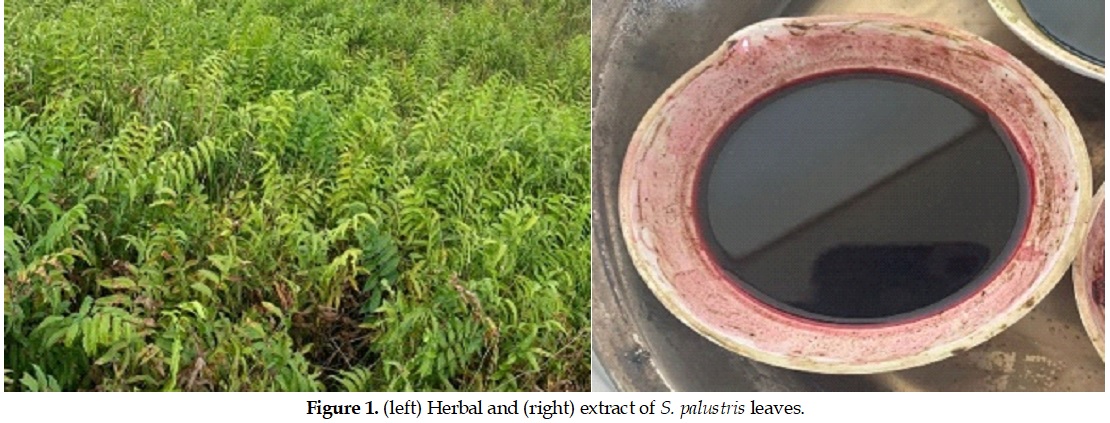
Methicillin-resistant Staphylococcus aureus (MRSA) is a major concern in healthcare due to its resistance to antibiotics and ability to form biofilms. This study investigated the antibacterial and antibiofilm activity of the extract and fractions of kelakai (Stenochlaena palustris) leaves against MRSA. Phytochemical screening revealed the presence of alkaloids, flavonoids, steroids, tannins, and triterpenoids in S. palustris leaves. The ethanolic extract of S. palustris leaves exhibited dose-dependent antibacterial activity against MRSA at concentrations up to 500 ppm. Among the fractions, the n-hexane fraction exhibited antibacterial activity at 500 and 1000 ppm, while the methanolic fraction showed inhibition only at 1000 ppm. The ethyl acetate fraction did not show any inhibition. All fractions and extract demonstrated antibiofilm activity, with the n-hexane fraction exhibiting the strongest activity (91.33 ± 1.52%) at 125 ppm. The crude extract of S. palustris leaves showed the weakest antibiofilm activity (32.66 ± 8.14%). These findings suggest that S. palustris leaves contain compounds with antibacterial and antibiofilm properties against MRSA, with the n-hexane fraction being the most promising. Further studies are needed to isolate and characterize the active compounds responsible for these activities.
Full text article
References
2. Endale H, Mathewos M, Abdeta D. Potential Causes of Spread of Antimicrobial Resistance and Preventive Measures in One Health Perspective-A Review. Infect Drug Resist. 2023;16:7515–45. DOI: 10.2147/idr.s428837; PMCID: PMC10715026; PMID: 38089962
3. Dadgostar P. Antimicrobial resistance: implications and costs. Infect Drug Resist. 2019;12: 3903–10. DOI: 10.2147/idr.s234610; PMCID: PMC6929930; PMID: 31908502
4. Lan J, Zou J, Xin H, Sun J, Han T, Sun M, et al. Nanomedicines as disruptors or inhibitors of biofilms: Opportunities in addressing antimicrobial resistance. J Control Release. 2025;381:113589. DOI: 10.1016/j.jconrel.2025.113589; PMID: 40032007
5. Alonso B, Pérez-Granda MJ, Latorre MC, Sánchez-Carrillo C, Bouza E, Muñoz P, et al. Production of biofilm by Staphylococcus aureus: Association with infective endocarditis? Enferm Infecc Microbiol Clin. 2022;40(8):418-22. DOI: 10.1016/j.eimce.2021.03.009; PMID: 36195405
6. Zhao A, Sun J, Liu Y. Understanding bacterial biofilms: From definition to treatment strategies. Front Cell Infect Microbiol. 2023;13:1137947. DOI: 10.3389/fcimb.2023.1137947; PMCID: PMC10117668; PMID: 37091673
7. Vogel JGT, Wibowo JP, Fan H, Setroikromo R, Wang K, Dömling A, et al. Discovery of chromene compounds as inhibitors of PvdQ acylase of Pseudomonas aeruginosa. Microbes Infect. 2022;24(8):105017. DOI: 10.1016/j.micinf.2022.105017; PMID: 35709935
8. Saud B, Khatri G, Amatya N, Paudel G, Shrestha V. Methicillin-Resistant and Biofilm-Producing Staphylococcus aureus in Nasal Carriage among Health Care Workers and Medical Students. Can J Infect Dis Med Microbiol. 2023;2023:8424486. DOI: 10.1155/2023/8424486; PMCID: PMC9833899; PMID: 36644335
9. Yanti F, Yustika M, Yogi S, Nuke A, Restiana RE, Vebruati V, et al. Antibacterial Activity Test of 70% Ethanol, 96% Ethanol and Methanol Extracts of Red Kelakai Leaves (Stenochlaena palustris (Burm.F) Bedd) against Cutibacterium acne bacteria. J Borneo. 2023;3(3):165–75. DOI: 10.57174/j.born.v3i3.103
10. Direktorat Jenderal Kefarmasian dan Alat Kesehatan. Farmakope Herbal Indonesia 2nd Edition. Jakarta: Kementerian Kesehatan Republik Indonesia; 2017. Available from: https://farmalkes.kemkes.go.id/2020/08/farmakope-herbal-indonesia-edisi-ii-tahun-2017-3/
11. Norhaliza S, Zamzani I, Nor I. Potensi Ekstrak Daun Salam (Syzygium polyanthum) dengan Metode UAE Sebagai Antibakteri Terhadap Bakteri Shigella dysenteriae dan Salmonella typhi. J Ilmu Kefarmasian. 2022;3(2):94–101. DOI: 10.31764/lf.v3i2.8294
12. Srivastava N, Singh A, Kumari P, Nishad JH, Gautam VS, Yadav M, et al. Advances in extraction technologies: isolation and purification of bioactive compounds from biological materials. In: Sinha RP, Häder DP, editors. Natural Bioactive Compounds: Technological Advancements. London: Academic Press; 2021. p. 409–33. DOI: 10.1016/B978-0-12-820655-3.00021-5
13. Farnsworth NR. Biological and Phytochemical Screening of Plants. J Pharm Sci. 1966;55(3):255-76. DOI: 10.1002/jps.2600550302; PMID: 5335471
14. Sasidharan S, Chen Y, Saravanan D, Sundram KM, Latha LY. Extraction, Isolation and Characterization of Bioactive Compounds from Plants Extracts. Afr J Tradit Complement Altern Med. 2011;8(1):1–10. PMCID: PMC3218439; PMID: 22238476
15. Panche AN, Diwan AD, Chandra SR. Flavonoids: An overview. J Nutr Sci. 2016;5:e47. DOI: 10.1017/jns.2016.41; PMCID: PMC5465813; PMID: 28620474
16. Godlewska K, Pacyga P, Najda A, Michalak I. Investigation of Chemical Constituents and Antioxidant Activity of Biologically Active Plant-Derived Natural Products. Molecules. 2023;28(14):5572. DOI: 10.3390/molecules28145572; PMCID: PMC10384900; PMID: 37513443
17. Dahiru MM, Nadro MS. Phytochemical Composition and Antioxidant Potential of Hyphaene thebaica Fruit. Borneo j Pharm. 2022;5(4):325–33. DOI: 10.33084/bjop.v5i4.3632
18. Clinical and Laboratory Standards Institute. Performance standards for antimicrobial susceptibility testing 30th edition. Wayne, PA: Clinical and Laboratory Standards Institute; 2020. p. 282.
19. Novaryatiin S, Sari AA, Mulyani E. Antibacterial Activity of Ethanolic Extract of Sangkareho (Callicarpa longifolia Lam.) Against Staphylococcus epidermidis. Borneo j Pharm. 2018;1(2):85–8. DOI: 10.33084/bjop.v1i2.427
20. Kost B, Basko M, Bednarek M, Socka M, Łapienis G, Biela T, et al. The influence of the functional end groups on the properties of polylactide-based materials. Prog Polym Sci. 2022;130:101556. DOI: 10.1016/j.progpolymsci.2022.101556
21. Angelina M, Mardhiyah A, Dewi RT, Fajriah S, Muthiah N, Ekapratiwi Y, et al. Physicochemical and phytochemical standardization, and antibacterial evaluation of Cassia alata leaves from different locations in Indonesia. Pharmacia. 2021;68(4):947–56. DOI: 10.3897/pharmacia.68.e76835
22. Palomares-Navarro JJ, Bernal-Mercado AT, González-Aguilar GA, Ortega-Ramirez LA, Martínez-Téllez MA, Ayala-Zavala JF. Antibiofilm Action of Plant Terpenes in Salmonella Strains: Potential Inhibitors of the Synthesis of Extracellular Polymeric Substances. Pathogens. 2023;12(1):35. DOI: 10.3390/pathogens12010035; PMCID: PMC9864247; PMID: 36678383
23. Zhou J, Bi S, Chen H, Chen T, Yang R, Li M, et al. Anti-Biofilm and Antivirulence Activities of Metabolites from Plectosphaerella cucumerina against Pseudomonas aeruginosa. Front Microbiol. 2017;8:769. DOI: 10.3389/fmicb.2017.00769; PMCID: PMC5413567; PMID: 28515715
24. Kashi M, Noei M, Chegini Z, Shariati A. Natural compounds in the fight against Staphylococcus aureus biofilms: a review of antibiofilm strategies. Front Pharmacol. 2024;15:1491363. DOI: 10.3389/fphar.2024.1491363; PMCID: PMC11615405; PMID: 39635434
25. Melander RJ, Basak AK, Melander C. Natural products as inspiration for the development of bacterial antibiofilm agents. Nat Prod Rep. 2020;37(11):1454-77. DOI: 10.1039/d0np00022a; PMCID: PMC7677205; PMID: 32608431
26. Alum EU, Gulumbe BH, Izah SC, Uti DE, Aja PM, Igwenyi IO, et al. Natural product-based inhibitors of quorum sensing: A novel approach to combat antibiotic resistance. Biochem Biophys Rep. 2025;43:102111. DOI: 10.1016/j.bbrep.2025.102111; PMCID: PMC12242448; PMID: 40641742
27. Mulat M, Banicod RJS, Tabassum N, Javaid A, Karthikeyan A, Jeong GJ, et al. Multiple Strategies for the Application of Medicinal Plant-Derived Bioactive Compounds in Controlling Microbial Biofilm and Virulence Properties. Antibiotics. 2025;14(6):555. DOI: 10.3390/antibiotics14060555; PMCID: PMC12189420; PMID: 40558146
28. Liao, C, Yu C, Guo J, Guan M. Subinhibitory concentrations of glabridin from Glycyrrhiza glabra L. reduce Listeria monocytogenes motility and hemolytic activity but do not exhibit antimicrobial activity. Front Microbiol. 2024;15:1388388. DOI: 10.3389/fmicb.2024.1388388; PMCID: PMC11288822; PMID: 39086651
29. Khaleghi M, Khorrami S. Down-regulation of biofilm-associated genes in mecA-positive methicillin-resistant S. aureus treated with M. communis extract and its antibacterial activity. AMB Express. 2021;11(1):85. DOI: 10.1186/s13568-021-01247-z; PMCID: PMC8192652; PMID: 34110520
30. Guzman JPMD, Alas TPLDL, Lucban MC, Sevilla CEC. Green tea (Camellia sinensis) extract inhibits biofilm formation in acyl homoserine lactone-producing, antibiotic-resistant Morganella morganii isolated from Pasig River, Philippines. Heliyon. 2020;6(10):e05284. DOI: 10.1016/j.heliyon.2020.e05284; PMCID: PMC7586116; PMID: 33134581
Authors
Copyright (c) 2025 Joko Priyanto Wibowo, Restu Dara Wewengkang, Medina Nurrahmah, Nurul Fajeriyati, Irfan Zamzani, Afif Pranaya Jati

This work is licensed under a Creative Commons Attribution-ShareAlike 4.0 International License.
This work is licensed under a Creative Commons Attribution-ShareAlike 4.0 International License.
Authors continue to retain the copyright to the article if the article is published in the Borneo Journal of Pharmacy. They will also retain the publishing rights to the article without any restrictions.
Authors who publish in this journal agree to the following terms:
- Any article on the copyright is retained by the author(s).
- The author grants the journal the right of first publication with the work simultaneously licensed under a Creative Commons Attribution License that allows others to share work with an acknowledgment of the work authors and initial publications in this journal.
- Authors can enter into separate, additional contractual arrangements for the non-exclusive distribution of published articles (e.g., post-institutional repository) or publish them in a book, with acknowledgment of their initial publication in this journal.
- Authors are permitted and encouraged to post their work online (e.g., in institutional repositories or on their websites) prior to and during the submission process. This can lead to productive exchanges and earlier and greater citations of published work.
- The article and any associated published material are distributed under the Creative Commons Attribution-ShareAlike 4.0 International License.
Article Details