Public Knowledge, Trust, Attitude, and Behavioral Intention toward the Integration of Jamu into National Health Services

Article Sidebar
-
Health policy integration, Jamu, Public perception, Traditional medicine, Theory of Planned Behavior
Abstract
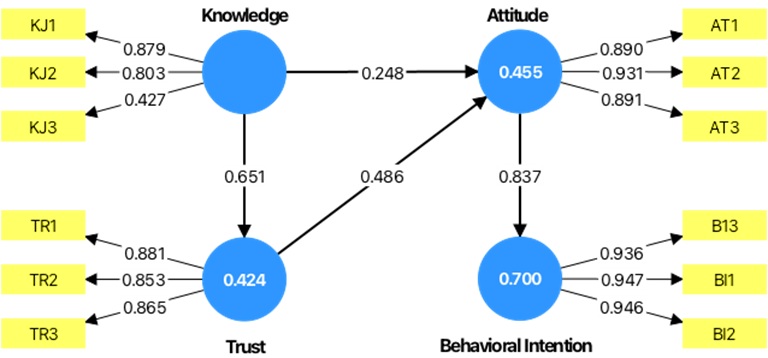
The integration of jamu into Indonesia's formal healthcare system remains an important policy issue, particularly in ensuring that regulatory development is matched by public acceptance and behavioral readiness. This study aimed to examine public perceptions of integrating jamu into national health services using a Theory of Planned Behavior (TPB)-informed framework. A quantitative cross-sectional survey was conducted among 300 webinar participants aged 18 years or older using purposive sampling. Data were collected through an anonymous online questionnaire comprising 12 items across four latent constructs: knowledge, trust, attitude, and behavioral intention. The relationships among constructs were analyzed using partial least squares structural equation modeling (PLS-SEM). The results showed that attitude was the strongest predictor of behavioral intention (β = 0.837, p <0.001), while knowledge significantly influenced trust (β = 0.651) and attitude (β = 0.248), and trust also significantly influenced attitude (β = 0.486). The model explained 70% of the variance in behavioral intention, indicating substantial explanatory power. These findings suggest a coherent behavioral pathway in which knowledge and trust strengthen attitude, which in turn drives public intention to support the integration of jamu into formal healthcare services. The study concludes that successful integration depends not only on regulatory readiness but also on strengthening public knowledge, trust, and attitudes toward traditional medicine. However, the findings should be interpreted cautiously because the sample was non-random and relatively digitally literate. Future studies should include more diverse populations and use longitudinal or mixed-method approaches to support evidence-based integration policies.
Full text article
References
2. Indonesia. Government Regulation Number 28 of 2024 concerning Implementing Regulations of Law Number 17 of 2023 concerning Health [Peraturan Pemerintah Nomor 28 Tahun 2024 tentang Peraturan Pelaksanaan Undang-Undang Nomor 17 Tahun 2023 tentang Kesehatan]. Jakarta: Ministry of State Secretariat; 2024. Available from: https://peraturan.bpk.go.id/details/294077/pp-no-28-tahun-2024.
3. Wong YMA, Ahn S, Bana A, Dua PK, Eggers R, Kuruvilla S, et al. Policy implications of WHO's Global traditional medicine strategy 2025-2034. Bull World Health Organ. 2025;103(11):715-21. DOI: 10.2471/BLT.25.293414; PMID: 41180270; PMCID: PMC12578523.
4. Harfiani E, Puspita R, Prabarini IRS. Herbal Medicine Usage During the COVID-19 Pandemic in Indonesia: Trends and Determinants. ScientificWorldJournal. 2025;2025:1639500. DOI: 10.1155/tswj/1639500; PMID: 40401107; PMCID: PMC12094868.
5. Rahayu YYS, Araki T, Rosleine D, Purwaningtyas RM. General Practitioners’ Attitudes toward Traditional Indonesian Herbal Medicine and Integrative Care in the Universal Health Coverage System. Glob J Health Sci. 2022;14(4):82-94. DOI: 10.5539/gjhs.v14n4p82.
6. Widyaningtyas D. The Utilization of Herbal Products for Public Health in Indonesia: The Role of Social Influence and Health Value on Intentions to Use Herbal Products. Public Health Indones. 2024;10(4):15–26. DOI: 10.36685/phi.v10i4.845.
7. Bosnjak M, Ajzen I, Schmidt P. The Theory of Planned Behavior: Selected Recent Advances and Applications. Eur J Psychol. 2020;16(3):352-6. DOI: 10.5964/ejop.v16i3.3107; PMID: 33680187; PMCID: PMC7909498.
8. Ajzen I, Schmidt P. Changing Behavior Using the Theory of Planned Behavior. In: Hagger MS, Cameron LD, Hamilton K, Hankonen N, Lintunen T, editors. The Handbook of Behavior Change. Cambridge: Cambridge University Press; 2020. DOI: 10.1017/9781108677318.002.
9. Huang Y, Zhang W, Wang S. Exploring influencing factors on fall prevention intentions among nursing assistants: a qualitative study. Front Public Health. 2026;14:1823811. DOI: 10.3389/fpubh.2026.1823811; PMID: 42100507; PMCID: PMC13143768.
10. Paul B, Kirubakaran R, Isaac R, Dozier M, Grant L, Weller D; et al. A systematic review of the theory of planned behaviour interventions for chronic diseases in low health-literacy settings. J Glob Health. 2023;13:04079. DOI: 10.7189/jogh.13.04079; PMID: 37681679; PMCID: PMC10506128.
11. Bilia AR, Ballerini R, Qu L, Wang M. Traditional Chinese herbal medicine in European Union: State of art, challenges, and future perspectives focusing on Italian market. Chin Herb Med. 2024;17(1):3-18. DOI: 10.1016/j.chmed.2024.11.008; PMID: 39949801; PMCID: PMC11814246.
12. Wang H, Chen Y, Wang L, Liu Q, Yang S, Wang C. Advancing herbal medicine: enhancing product quality and safety through robust quality control practices. Front Pharmacol. 2023;14:1265178. DOI: 10.3389/fphar.2023.1265178; PMID: 37818188; PMCID: PMC10561302.
13. Barkat MA, Goyal A, Barkat HA, Salauddin M, Pottoo FH, Anwer ET. Herbal Medicine: Clinical Perspective and Regulatory Status. Comb Chem High Throughput Screen. 2021;24(10):1573-82. DOI: 10.2174/1386207323999201110192942; PMID: 33176638.
14. Widayati A, Rahajeng B, Wulandari ET, Abadi BBA. Traditional medicines use among Indonesian young population: a Theory of Planned Behaviour study. Indones J Pharm Sci Technol. 2025;12(Suppl 1):51-8. DOI: 10.24198/ijpst.v12s1.57953.
15. Marlina M, Badaruddin B, Zuska F, Lubis R. The Implementation of Local Wisdom to Improve the Health and Quality of Life the Hypertension Family as a New Strategy for Early Prevention of Stroke. Glob J Health Sci. 2020;12(2):51-60. DOI: 10.5539/gjhs.v12n2p51.
16. Wang M, Liu Z, Sun Y, Zhang Y, Ghaffar A, Ren M. Integration of traditional and complementary medicine into primary health care systems: a systematic review. Bull World Health Organ. 2025;103(11):675-84C. DOI: 10.2471/BLT.25.293465; PMID: 41180277; PMCID: PMC12578535.
17. Sumarni W, Sudarmin S, Sumarti SS. The scientification of jamu: a study of Indonesian’s traditional medicine. J Phys Conf Ser. 2019;1321:032057. DOI: 10.1088/1742-6596/1321/3/032057.
18. Alfaqeeh M, Zakiyah N, Postma MJ, Suwantika AA. Setting priorities for healthcare interventions in Indonesia: a comprehensive conceptual framework. Int J Equity Health. 2025;24(1):327. DOI: 10.1186/s12939-025-02668-z; PMID: 41287082; PMCID: PMC12642239.
19. Hair JF, Risher JJ, Sarstedt M, Ringle CM. When to use and how to report the results of PLS-SEM. Eur Bus Rev. 2019;31(1):2–24. DOI: 10.1108/EBR-11-2018-0203.
20. Mohan DSR, Jawahir S, Manual A, Mutalib NEA, Noh SNM, Rahim IA, et al. Gender differences in health-seeking behaviour: insights from the National Health and Morbidity Survey 2019. BMC Health Serv Res. 2025;25(1):900. DOI: 10.1186/s12913-025-13020-0; PMID: 40611153; PMCID: PMC12224705.
21. Yunita F, Gunawan S, Silaban H, Chaidir. The journey of Indonesian traditional medicine. Tarumanagara Med J. 2024;6(2):241–52. DOI: 10.24912/tmj.v6i2.33351.
22. Febriyanti RM, Saefullah K, Susanti RD, Lestari K. Knowledge, attitude, and utilization of traditional medicine within the plural medical system in West Java, Indonesia. BMC Complement Med Ther. 2024;24(1):64. DOI: 10.1186/s12906-024-04368-7; PMID: 38287364; PMCID: PMC10826289.
23. Kristianto H, Pramesona BA, Rosyad YS, Andriani L, Putri TARK, Rias YA. The effects of beliefs, knowledge, and attitude on herbal medicine use during the COVID-19 pandemic: A cross-sectional survey in Indonesia. F1000Res. 2022;11:483. DOI: 10.12688/f1000research.116496.3; PMID: 36415209; PMCID: PMC9647142.
24. Keni K, Wilson N, Dharmawan P. Exploring Factors That Shape Indonesian’s Intentions to Purchase Herbal Medicine. J Bisnis Akuntansi. 2023;25(2):395–412. DOI: 10.34208/jba.v25i2.2204.
25. Ampomah IG, Malau-Aduli BS, Seidu AA, Malau-Aduli AEO, Emeto TI. Integrating traditional medicine into the Ghanaian health system: perceptions and experiences of traditional medicine practitioners in the Ashanti region. Int Health. 2023;15(4):414-27. DOI: 10.1093/inthealth/ihac059; PMID: 36063112; PMCID: PMC10318977.
26. Purwono S, Nisa U, Astana PRW, Wijayaningsih RA, Wicaksono AJ, Wahyuningsih MSH, et al. Factors Affecting the Perception of Indonesian Medical Doctors on Herbal Medicine Prescription in Healthcare Facilities: Qualitative and Quantitative Studies. J Herb Med. 2023;42:100747. DOI: 10.1016/j.hermed.2023.100747.
27. Yusuf M, Sophan MK, Darmawan AK, Anamisa DR, Satoto BD, Alamsyah N. SakeraHerbDB Proposing an Integrated Indonesian Traditional Herbal Medicine Database IITHMDB for Madura Islands Herbs. Tech Romanian J Appl Sci Technol. 2023;16:259–65. DOI: 10.47577/technium.v16i.9995.
28. Monalisa M, Fakih M, Perbawati C. Relevance of WHO traditional medicine strategy (2014-2023) with traditional health care policy in the perspective of national law and international law. Asian J Leg Stud. 2022;1(1):25–34. doi: 10.53402/ajls.v1i1.117.
29. Bhagawan WS, Ekasari W, Agil M. Ethnopharmacology of medicinal plants used by the Tenggerese community in Bromo Tengger Semeru National Park, Indonesia. Biodiversitas J Biol Divers. 2023;24(10):5464-77. DOI: 10.13057/biodiv/d241028.
30. Anggayasti UH, Hardiyanti M, Natalis A. Legal protection of traditional medicine knowledge in Indonesia: integrating local wisdom and modern regulations. Pan Afr Med J. 2025;51:73. DOI: 10.11604/pamj.2025.51.73.47755; PMID: 41064673; PMCID: PMC12500897.
31. Roisah R, Al Asy'arie MAH, Rahayu R, Zulfah S. Traditional Medicine Innovation Policy: Between the Protection of Traditional Knowledge, Genetic Resources, and Intellectual Property. Legality J Ilmiah Hukum. 2026;34(2):369-401. DOI: 10.22219/ljih.v34i2.43917.
32. Ikhoyameh M, Okete WE, Ogboye RM, Owoyemi OK, Gbadebo OS. Integrating traditional medicine into the African healthcare system post-Traditional Medicine Global Summit: challenges and recommendations. Pan Afr Med J. 2024;47:146. DOI: 10.11604/pamj.2024.47.146.43011; PMID: 38933435; PMCID: PMC11204987.
Authors
Copyright (c) 2026 Mohamad Kashuri, Taruna Ikrar

This work is licensed under a Creative Commons Attribution-ShareAlike 4.0 International License.
This work is licensed under a Creative Commons Attribution-ShareAlike 4.0 International License.
Authors continue to retain the copyright to the article if the article is published in the Borneo Journal of Pharmacy. They will also retain the publishing rights to the article without any restrictions.
Authors who publish in this journal agree to the following terms:
- Any article on the copyright is retained by the author(s).
- The author grants the journal the right of first publication with the work simultaneously licensed under a Creative Commons Attribution License that allows others to share work with an acknowledgment of the work authors and initial publications in this journal.
- Authors can enter into separate, additional contractual arrangements for the non-exclusive distribution of published articles (e.g., post-institutional repository) or publish them in a book, with acknowledgment of their initial publication in this journal.
- Authors are permitted and encouraged to post their work online (e.g., in institutional repositories or on their websites) prior to and during the submission process. This can lead to productive exchanges and earlier and greater citations of published work.
- The article and any associated published material are distributed under the Creative Commons Attribution-ShareAlike 4.0 International License.
Article Details