Comparative Toxicity and LC50 Determination of Phaleria macrocarpa Leaf Extracts from Sequential Maceration

Article Sidebar
Submitted
27 July 2025
Published
30 June 2026
Keywords:
-
Phaleria macrocarpa, Lethal Concentration, Brine Shrimp Lethality Test, Toxicity, Artemia salina Leach
Abstract
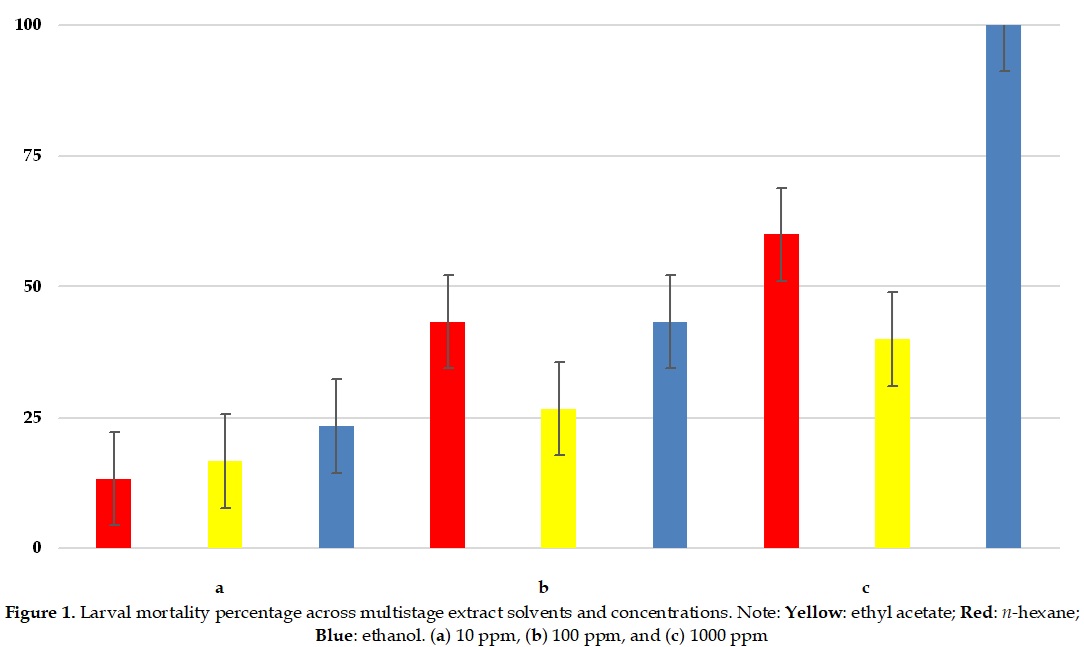
Phaleria macrocarpa is a plant renowned for its bioactive compounds, including flavonoids, alkaloids, saponins, and tannins, which are believed to have various pharmacological properties. This study aimed to determine the lethal concentration 50 (LC50) of P. macrocarpa leaf extracts obtained by sequential maceration in n-hexane, ethyl acetate, and 70% ethanol. The toxicity of the extracts was evaluated using the Brine Shrimp Lethality Test (BSLT) against Artemia salina leach larvae, a commonly used model organism in toxicity testing due to its sensitivity to various toxic substances. The results indicated that the 70% ethanol extract exhibited moderate toxicity with an LC50 of 126.981 ppm, the ethyl acetate extract was categorized as weakly toxic (LC50 of 691.730 ppm), and the n-hexane extract was classified as non-toxic (LC50 of 1416.537 ppm). These findings indicate that solvent polarity influences the extraction of bioactive compounds and their biological activity. This study highlights the novelty of sequential maceration as a selective extraction approach that enhances toxicity profiling and supports preliminary pharmacological screening for natural product-based drug development. Furthermore, the study underscores the importance of using selective extraction methods to isolate bioactive compounds based on their polarity. This study provides preliminary data on the toxicity profile of P. macrocarpa leaves and highlights the potential of its bioactive compounds for further pharmacological research, particularly in the development of natural-based therapeutic agents. Future studies should focus on isolating and identifying the active compounds responsible for the observed toxicity and on their potential for use in drug development.
Full text article
Generated from XML file
References
1. Maharani M, Lajuna L, Yuniwati C, Sabrida O, Sutrisno S. Phytochemical characteristics from Phaleria macrocarpa and its inhibitory activity on the peritoneal damage of endometriosis. J Ayurveda Integr Med. 2021;12(2):229-33. DOI: 10.1016/j.jaim.2020.06.002; PMID: 33288353; PMCID: PMC8185966.
2. Ahmad R, Mazlan MKN, Aziz AFA, Gazzali AM, Rawa MSA, Wahab HA. Phaleria macrocarpa (Scheff.) Boerl.: An updated review of pharmacological effects, toxicity studies, and separation techniques. Saudi Pharm J. 2023;31(6):874-88. DOI: 10.1016/j.jsps.2023.04.006; PMID: 37234341; PMCID: PMC10205762.
3. Christina YI, Rifa'i M, Widodo N, Djati MS. Comparative Study of Antiproliferative Activity in Different Plant Parts of Phaleria macrocarpa and the Underlying Mechanism of Action. ScientificWorldJournal. 2022;2022:3992660. DOI: 10.1155/2022/3992660; PMID: 35734014; PMCID: PMC9209002.
4. Lay MM, Karsani SA, Mohajer S, Abd Malek SN. Phytochemical constituents, nutritional values, phenolics, flavonols, flavonoids, antioxidant and cytotoxicity studies on Phaleria macrocarpa (Scheff.) Boerl fruits. BMC Complement Altern Med. 2014;14:152. DOI: 10.1186/1472-6882-14-152; PMID: 24885709; PMCID: PMC4039986.
5. Christina YI, Nafisah W, Widodo, Rifa'i M, Djati MS. Evaluation of total phenolic, flavonoid contents, antioxidant and cytotoxicity activities of various parts of Phaleria macrocarpa (Scheff.) Boerl fruit. IOP Conf Ser Earth Environ Sci. 2021;743:012026. DOI: 10.1088/1755-1315/743/1/012026.
6. Easmin MS, Sarker MZI, Ferdosh S, Shamsudin SH, Yunus KB, Uddin MS, et al. Bioactive compounds and advanced processing technology: Phaleria macrocarpa (sheff.) Boerl, a review. J Chem Technol Biotechnol. 2014;90(6):981-91. DOI: 10.1002/jctb.4603.
7. Niksic H, Becic F, Koric E, Gusic I, Omeragic E, Muratovic S, et al. Cytotoxicity screening of Thymus vulgaris L. essential oil in brine shrimp nauplii and cancer cell lines. Sci Rep. 2021;11(1):13178. DOI: 10.1038/s41598-021-92679-x; PMID: 34162964; PMCID: PMC8222331.
8. Aksono EB, Latifah AC, Suwanti LT, Haq KU, Pertiwi H. Clove Flower Extract (Syzygium aromaticum) Has Anticancer Potential Effect Analyzed by Molecular Docking and Brine Shrimp Lethality Test (BSLT). Vet Med Int. 2022;2022:5113742. DOI: 10.1155/2022/5113742; PMID: 36106174; PMCID: PMC9467815.
9. Stasiłowicz-Krzemień A, Wójcik J, Gościniak A, Szymański M, Szulc P, Górecki K, et al. Natural Deep Eutectic Solvents Combined with Supercritical Carbon Dioxide for the Extraction of Curcuminoids from Turmeric. Pharmaceuticals. 2024;17(12):1596. DOI: 10.3390/ph17121596; PMID: 39770438; PMCID: PMC11676539.
10. Nasution AN, Girsang E, Susanto JF, Chandra Y, Tambunan A, Nabati TN, et al. Photochemical Test of Phaleria macrocarpa Root Stem Fruit Seed Extract. Jambura J Health Sci. 2022;4(3):632-41. DOI: 10.35971/jjhsr.v4i3.12253.
11. Rajabi S, Ramazani A, Hamidi M, Naji T. Artemia salina as a model organism in toxicity assessment of nanoparticles. Daru. 2015;23(1):20. DOI: 10.1186/s40199-015-0105-x; PMID: 25888940; PMCID: PMC4344789.
12. Ishaque M, Bibi Y, Masood S, Al Ayoubi S, Qayyum A, Nisa S, et al. Xanthone C-glycosides isomers purified from Dryopteris ramosa (Hope) C. Chr. with bactericidal and cytotoxic prospects. Saudi J Biol Sci. 2022;29(2):1191-6. DOI: 10.1016/j.sjbs.2021.09.047; PMID: 35197786; PMCID: PMC8848010.
13. Ali H, Nguta J, Musila F, Ole-Mapenay I, Matara D, Mailu J. Evaluation of Antimicrobial Activity, Cytotoxicity, and Phytochemical Composition of Ocimum americanum L. (Lamiaceae). Evid Based Complement Alternat Med. 2022;2022:6484578. DOI: 10.1155/2022/6484578; PMID: 35341141; PMCID: PMC8947914.
14. Nhamussua RL, Mabiki FP, Mwakalesi AJ, McGaw LJ. Screening anticancer activity by Brine shrimp lethality test of extracts of Annona stenophylla (Engl. & Diels), Strophanthus petersianus (Klotzsch) and Synadenium glaucescens (Pax). PLoS One. 2026;21(1):e0336636. DOI: 10.1371/journal.pone.0336636; PMID: 41481610; PMCID: PMC12758728.
15. Ogbole OO, Ndabai NC, Akinleye TE, Attah AF. Evaluation of peptide-rich root extracts of Calliandria portoriscensis (Jacq.) Benth (Mimosaceae) for in vitro antimicrobial activity and brine shrimp lethality. BMC Complement Med Ther. 2020;20(1):30. DOI: 10.1186/s12906-020-2836-6; PMID: 32020886; PMCID: PMC7076830.
16. Ahmed AMA, Sharmen F, Mannan A, Rahman MA. Phytochemical, analgesic, antibacterial, and cytotoxic effects of Alpinia nigra (Gaertn.) Burtt leaf extract. J Tradit Complement Med. 2015;5(4):248-52. DOI: 10.1016/j.jtcme.2014.11.012; PMID: 26587396; PMCID: PMC4624352.
17. Kalusalingam A, Kamal K, Khan A, Menon B, Tan CS, Narayanan V, et al. Phaleria macrocarpa (Scheff.) Boerl. in Ethnopharmacology: Pharmacognosy, Safety, and Drug Development Perspectives. Prog Microbes Mol Biol. 2024;7(1):a0000452. DOI: 10.36877/pmmb.a0000452.
18. Hasan MM, Nishan AM, Rashid MHB, Ghos BC, Barmon J. Analytical and biological assessment of Magnolia champaca L. stem bark: Integrating ATR-FTIR, GC-MS, thrombolytic activity, brine shrimp lethality and molecular docking. J Genet Eng Biotechnol. 2025;23(2):100505. DOI: 10.1016/j.jgeb.2025.100505; PMID: 40390495; PMCID: PMC12141559.
19. Geethaa S, Thavamany PJ, Chiew SP, Thong OM. Interference from ordinarily used solvents in the outcomes of Artemia salina lethality test. J Adv Pharm Technol Res. 2013;4(4):179-82. DOI: 10.4103/2231-4040.121411; PMID: 24350047; PMCID: PMC3853693.
20. Olaru II, Olaru OT, Mihai DP, Gird CE, Zanfirescu A, Boscencu R, et al. A Dual Bioassay for Evaluation of Embryotoxicity and Acute Toxicity of Common Solvents and Surfactants in Artemia salina. Toxics. 2025;13(6):442. DOI: 10.3390/toxics13060442; PMID: 40559915; PMCID: PMC12196810.
21. Anzelc M, Burkhart CG. DMSO: an aid to combat pain and pruritus. Dermatol Online J. 2021;27(11):1156086. DOI: 10.5070/D3271156086; PMID: 35130398.
22. Ruebhart DR, Cock IE, Shaw GR. Brine shrimp bioassay: importance of correct taxonomic identification of Artemia (Anostraca) species. Environ Toxicol. 2008;23(4):555-60. DOI: 10.1002/tox.20358; PMID: 18214884.
23. Michael AS, Thompson CG, Abramovitz M. Artemia salina as a Test Organism for Bioassay. Science. 1956;123(3194):464. DOI: 10.1126/science.123.3194.464; PMID: 17775415.
24. Koehbach J, Attah AF, Berger A, Hellinger R, Kutchan TM, Carpenter EJ, et al. Cyclotide discovery in Gentianales revisited--identification and characterization of cyclic cystine-knot peptides and their phylogenetic distribution in Rubiaceae plants. Biopolymers. 2013;100(5):438-52. DOI: 10.1002/bip.22328; PMID: 23897543; PMCID: PMC3816352.
25. Zhou Y, Zhu Y, Wong WK. Statistical tests for homogeneity of variance for clinical trials and recommendations. Contemp Clin Trials Commun. 2023;33:101119. DOI: 10.1016/j.conctc.2023.101119; PMID: 37143826; PMCID: PMC10151260.
26. Hanafi, Irawan C, Sirait SM, Sulistiawaty L, Setyawati SR. Toxicity Test With Bslt (Brine Shrimp Lethality Test) Method on Methanol, Ethyl Acetate Extract, Hexane on Seeds and Rind of Matoa Extract (Pometia Pinnata). Orient J Chem. 2020;36(6):1143-7. DOI: 10.13005/ojc/360618.
27. McLaughlin JL. Crown gall tumours on potato discs and brine shrimp lethality: Two simple bioassays for higher plant screening and fractionation. In: Hostettmann K, ed. Assays for Bioactivity. Methods in Plant Biochemistry. 6th ed. London: Academic Press; 1991: 1–32.
28. Safe S, Jayaraman A, Chapkin RS, Howard M, Mohankumar K, Shrestha R. Flavonoids: structure-function and mechanisms of action and opportunities for drug development. Toxicol Res. 2021;37(2):147-62. DOI: 10.1007/s43188-020-00080-z; PMID: 33868973; PMCID: PMC8007671.
29. Hasim H, Mantik YA, Husnawati H, Priosoeryanto BP, Puspita R. Antiproliferative Potency of God's Crown Fruit (Phaleria macrocarpa) Extract Against Breast Cancer Cell. Borneo J Pharm. 2022;5(4):307-14. DOI: 10.33084/bjop.v5i4.2822.
2. Ahmad R, Mazlan MKN, Aziz AFA, Gazzali AM, Rawa MSA, Wahab HA. Phaleria macrocarpa (Scheff.) Boerl.: An updated review of pharmacological effects, toxicity studies, and separation techniques. Saudi Pharm J. 2023;31(6):874-88. DOI: 10.1016/j.jsps.2023.04.006; PMID: 37234341; PMCID: PMC10205762.
3. Christina YI, Rifa'i M, Widodo N, Djati MS. Comparative Study of Antiproliferative Activity in Different Plant Parts of Phaleria macrocarpa and the Underlying Mechanism of Action. ScientificWorldJournal. 2022;2022:3992660. DOI: 10.1155/2022/3992660; PMID: 35734014; PMCID: PMC9209002.
4. Lay MM, Karsani SA, Mohajer S, Abd Malek SN. Phytochemical constituents, nutritional values, phenolics, flavonols, flavonoids, antioxidant and cytotoxicity studies on Phaleria macrocarpa (Scheff.) Boerl fruits. BMC Complement Altern Med. 2014;14:152. DOI: 10.1186/1472-6882-14-152; PMID: 24885709; PMCID: PMC4039986.
5. Christina YI, Nafisah W, Widodo, Rifa'i M, Djati MS. Evaluation of total phenolic, flavonoid contents, antioxidant and cytotoxicity activities of various parts of Phaleria macrocarpa (Scheff.) Boerl fruit. IOP Conf Ser Earth Environ Sci. 2021;743:012026. DOI: 10.1088/1755-1315/743/1/012026.
6. Easmin MS, Sarker MZI, Ferdosh S, Shamsudin SH, Yunus KB, Uddin MS, et al. Bioactive compounds and advanced processing technology: Phaleria macrocarpa (sheff.) Boerl, a review. J Chem Technol Biotechnol. 2014;90(6):981-91. DOI: 10.1002/jctb.4603.
7. Niksic H, Becic F, Koric E, Gusic I, Omeragic E, Muratovic S, et al. Cytotoxicity screening of Thymus vulgaris L. essential oil in brine shrimp nauplii and cancer cell lines. Sci Rep. 2021;11(1):13178. DOI: 10.1038/s41598-021-92679-x; PMID: 34162964; PMCID: PMC8222331.
8. Aksono EB, Latifah AC, Suwanti LT, Haq KU, Pertiwi H. Clove Flower Extract (Syzygium aromaticum) Has Anticancer Potential Effect Analyzed by Molecular Docking and Brine Shrimp Lethality Test (BSLT). Vet Med Int. 2022;2022:5113742. DOI: 10.1155/2022/5113742; PMID: 36106174; PMCID: PMC9467815.
9. Stasiłowicz-Krzemień A, Wójcik J, Gościniak A, Szymański M, Szulc P, Górecki K, et al. Natural Deep Eutectic Solvents Combined with Supercritical Carbon Dioxide for the Extraction of Curcuminoids from Turmeric. Pharmaceuticals. 2024;17(12):1596. DOI: 10.3390/ph17121596; PMID: 39770438; PMCID: PMC11676539.
10. Nasution AN, Girsang E, Susanto JF, Chandra Y, Tambunan A, Nabati TN, et al. Photochemical Test of Phaleria macrocarpa Root Stem Fruit Seed Extract. Jambura J Health Sci. 2022;4(3):632-41. DOI: 10.35971/jjhsr.v4i3.12253.
11. Rajabi S, Ramazani A, Hamidi M, Naji T. Artemia salina as a model organism in toxicity assessment of nanoparticles. Daru. 2015;23(1):20. DOI: 10.1186/s40199-015-0105-x; PMID: 25888940; PMCID: PMC4344789.
12. Ishaque M, Bibi Y, Masood S, Al Ayoubi S, Qayyum A, Nisa S, et al. Xanthone C-glycosides isomers purified from Dryopteris ramosa (Hope) C. Chr. with bactericidal and cytotoxic prospects. Saudi J Biol Sci. 2022;29(2):1191-6. DOI: 10.1016/j.sjbs.2021.09.047; PMID: 35197786; PMCID: PMC8848010.
13. Ali H, Nguta J, Musila F, Ole-Mapenay I, Matara D, Mailu J. Evaluation of Antimicrobial Activity, Cytotoxicity, and Phytochemical Composition of Ocimum americanum L. (Lamiaceae). Evid Based Complement Alternat Med. 2022;2022:6484578. DOI: 10.1155/2022/6484578; PMID: 35341141; PMCID: PMC8947914.
14. Nhamussua RL, Mabiki FP, Mwakalesi AJ, McGaw LJ. Screening anticancer activity by Brine shrimp lethality test of extracts of Annona stenophylla (Engl. & Diels), Strophanthus petersianus (Klotzsch) and Synadenium glaucescens (Pax). PLoS One. 2026;21(1):e0336636. DOI: 10.1371/journal.pone.0336636; PMID: 41481610; PMCID: PMC12758728.
15. Ogbole OO, Ndabai NC, Akinleye TE, Attah AF. Evaluation of peptide-rich root extracts of Calliandria portoriscensis (Jacq.) Benth (Mimosaceae) for in vitro antimicrobial activity and brine shrimp lethality. BMC Complement Med Ther. 2020;20(1):30. DOI: 10.1186/s12906-020-2836-6; PMID: 32020886; PMCID: PMC7076830.
16. Ahmed AMA, Sharmen F, Mannan A, Rahman MA. Phytochemical, analgesic, antibacterial, and cytotoxic effects of Alpinia nigra (Gaertn.) Burtt leaf extract. J Tradit Complement Med. 2015;5(4):248-52. DOI: 10.1016/j.jtcme.2014.11.012; PMID: 26587396; PMCID: PMC4624352.
17. Kalusalingam A, Kamal K, Khan A, Menon B, Tan CS, Narayanan V, et al. Phaleria macrocarpa (Scheff.) Boerl. in Ethnopharmacology: Pharmacognosy, Safety, and Drug Development Perspectives. Prog Microbes Mol Biol. 2024;7(1):a0000452. DOI: 10.36877/pmmb.a0000452.
18. Hasan MM, Nishan AM, Rashid MHB, Ghos BC, Barmon J. Analytical and biological assessment of Magnolia champaca L. stem bark: Integrating ATR-FTIR, GC-MS, thrombolytic activity, brine shrimp lethality and molecular docking. J Genet Eng Biotechnol. 2025;23(2):100505. DOI: 10.1016/j.jgeb.2025.100505; PMID: 40390495; PMCID: PMC12141559.
19. Geethaa S, Thavamany PJ, Chiew SP, Thong OM. Interference from ordinarily used solvents in the outcomes of Artemia salina lethality test. J Adv Pharm Technol Res. 2013;4(4):179-82. DOI: 10.4103/2231-4040.121411; PMID: 24350047; PMCID: PMC3853693.
20. Olaru II, Olaru OT, Mihai DP, Gird CE, Zanfirescu A, Boscencu R, et al. A Dual Bioassay for Evaluation of Embryotoxicity and Acute Toxicity of Common Solvents and Surfactants in Artemia salina. Toxics. 2025;13(6):442. DOI: 10.3390/toxics13060442; PMID: 40559915; PMCID: PMC12196810.
21. Anzelc M, Burkhart CG. DMSO: an aid to combat pain and pruritus. Dermatol Online J. 2021;27(11):1156086. DOI: 10.5070/D3271156086; PMID: 35130398.
22. Ruebhart DR, Cock IE, Shaw GR. Brine shrimp bioassay: importance of correct taxonomic identification of Artemia (Anostraca) species. Environ Toxicol. 2008;23(4):555-60. DOI: 10.1002/tox.20358; PMID: 18214884.
23. Michael AS, Thompson CG, Abramovitz M. Artemia salina as a Test Organism for Bioassay. Science. 1956;123(3194):464. DOI: 10.1126/science.123.3194.464; PMID: 17775415.
24. Koehbach J, Attah AF, Berger A, Hellinger R, Kutchan TM, Carpenter EJ, et al. Cyclotide discovery in Gentianales revisited--identification and characterization of cyclic cystine-knot peptides and their phylogenetic distribution in Rubiaceae plants. Biopolymers. 2013;100(5):438-52. DOI: 10.1002/bip.22328; PMID: 23897543; PMCID: PMC3816352.
25. Zhou Y, Zhu Y, Wong WK. Statistical tests for homogeneity of variance for clinical trials and recommendations. Contemp Clin Trials Commun. 2023;33:101119. DOI: 10.1016/j.conctc.2023.101119; PMID: 37143826; PMCID: PMC10151260.
26. Hanafi, Irawan C, Sirait SM, Sulistiawaty L, Setyawati SR. Toxicity Test With Bslt (Brine Shrimp Lethality Test) Method on Methanol, Ethyl Acetate Extract, Hexane on Seeds and Rind of Matoa Extract (Pometia Pinnata). Orient J Chem. 2020;36(6):1143-7. DOI: 10.13005/ojc/360618.
27. McLaughlin JL. Crown gall tumours on potato discs and brine shrimp lethality: Two simple bioassays for higher plant screening and fractionation. In: Hostettmann K, ed. Assays for Bioactivity. Methods in Plant Biochemistry. 6th ed. London: Academic Press; 1991: 1–32.
28. Safe S, Jayaraman A, Chapkin RS, Howard M, Mohankumar K, Shrestha R. Flavonoids: structure-function and mechanisms of action and opportunities for drug development. Toxicol Res. 2021;37(2):147-62. DOI: 10.1007/s43188-020-00080-z; PMID: 33868973; PMCID: PMC8007671.
29. Hasim H, Mantik YA, Husnawati H, Priosoeryanto BP, Puspita R. Antiproliferative Potency of God's Crown Fruit (Phaleria macrocarpa) Extract Against Breast Cancer Cell. Borneo J Pharm. 2022;5(4):307-14. DOI: 10.33084/bjop.v5i4.2822.
Authors
1.
Nurmala S, Alamsyah RD, Sofihidayati T, Zamzani I, Ayuchecaria N, Asih SW. Comparative Toxicity and LC50 Determination of Phaleria macrocarpa Leaf Extracts from Sequential Maceration. Borneo J Pharm [Internet]. 2026Jun.30 [cited 2026Oct.19];9(2):145-52. Available from: https://journal.umpr.ac.id/index.php/bjop/article/view/10392
Copyright (c) 2026 Sara Nurmala, Rahmat Dwi Alamsyah, Trirakhma Sofihidayati, Irfan Zamzani, Noverda Ayuchecaria, Sari Wulan Asih

This work is licensed under a Creative Commons Attribution-ShareAlike 4.0 International License.
This work is licensed under a Creative Commons Attribution-ShareAlike 4.0 International License.
Authors continue to retain the copyright to the article if the article is published in the Borneo Journal of Pharmacy. They will also retain the publishing rights to the article without any restrictions.
Authors who publish in this journal agree to the following terms:
- Any article on the copyright is retained by the author(s).
- The author grants the journal the right of first publication with the work simultaneously licensed under a Creative Commons Attribution License that allows others to share work with an acknowledgment of the work authors and initial publications in this journal.
- Authors can enter into separate, additional contractual arrangements for the non-exclusive distribution of published articles (e.g., post-institutional repository) or publish them in a book, with acknowledgment of their initial publication in this journal.
- Authors are permitted and encouraged to post their work online (e.g., in institutional repositories or on their websites) prior to and during the submission process. This can lead to productive exchanges and earlier and greater citations of published work.
- The article and any associated published material are distributed under the Creative Commons Attribution-ShareAlike 4.0 International License.
Article Details