Molecular Docking and QSAR Analysis of N-(Ethylcarbamothioyl)benzamide Derivatives as Dual Estrogen-Alpha and Progesterone Receptors Inhibitor for Breast Cancer

Article Sidebar
-
Breast cancer, Molecular docking, N-(Ethylcarbamothyoil)benzamide derivatives, Quantitative structure-activity relationship, In silico
Abstract
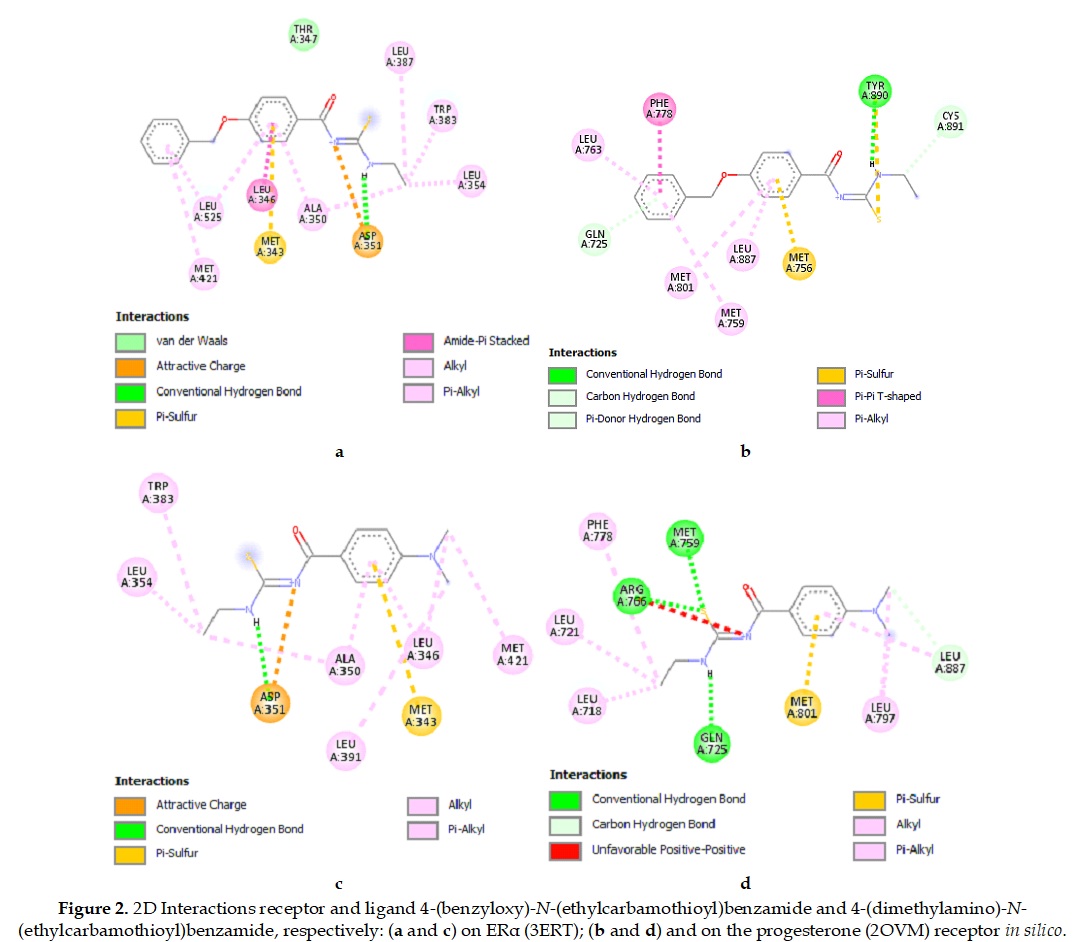
Luminal A subtype breast cancer is the most prevalent disease suffered by women, characterized by the presence of positive hormone receptors in the form of estrogen and progesterone. Thiourea derivatives have been shown to exhibit cytotoxicity against breast cancer cells in silico across multiple receptor targets. The purpose of this study was to determine the binding energy and QSAR equation of N-(Ethylcarbamothioyl)benzamide derivatives in silico. Molecular docking of the compounds was performed using AutoDockTools-1.5.7 with estrogen-α (PDB ID: 3ERT) and progesterone (PDB ID: 2OVM) receptor targets. The results showed that the compound 4-(benzyloxy)-N-(ethylcarbamothioyl)benzamide had the smallest free energy of binding (∆G) and Ki on estrogen-α and progesterone receptor of -7.13 kcal/mol and 5.96 μM and -8.04 kcal/mol and 1.27 μM, respectively. The best QSAR equation for estrogen-α receptor is ∆G = 0.465 (LogP)2 - 2.276 logP + 0.311 ELUMO - 0.091 MR + 5.075 (R = 0.914, α <0.001, F = 16.595 and SE = 0.41331) and progesterone receptor is ∆G = -0.058 (LogP)2 - 0.033 tPSA + 0.011 Etot - 0.08 MR + 1.683 (R = 0.92, α <0.001, F = 18.028 and SE = 0.37388). The QSAR equation is statistically significant if the R-squared value approaches 1, significance (α <0.05), Fcount > Ftable, and the smallest standard deviation (s). The predicted physicochemical properties that influence cytotoxic activity at the estrogen-α receptor are lipophilic (logP), electronic (ELUMO), and steric (MR). In contrast, those at the progesterone receptor are lipophilic (tPSA), electronic (Etot), and steric (MR).
Full text article
References
2. Samad MA, Ahmad I, Khan MR, Suhail M, Zughaibi TA, Al-Abbasi FA, et al. Breast Cancer: Molecular Pathogenesis and Targeted Therapy. MedComm. 2025;6(10):e70404. DOI: 10.1002/mco2.70404; PMID: 41049266; PMCID: PMC12495454.
3. Nolan E, Lindeman GJ, Visvader JE. Deciphering breast cancer: from biology to the clinic. Cell. 2023;186(8):1708-28. DOI: 10.1016/j.cell.2023.01.040; PMID: 36931265.
4. Gao JJ, Swain SM. Luminal A Breast Cancer and Molecular Assays: A Review. Oncologist. 2018;23(5):556-65. DOI: 10.1634/theoncologist.2017-0535; PMID: 29472313; PMCID: PMC5947456.
5. Bray F, Laversanne M, Sung H, Ferlay J, Siegel RL, Soerjomataram I, et al. Global cancer statistics 2022: GLOBOCAN estimates of incidence and mortality worldwide for 36 cancers in 185 countries. CA Cancer J Clin. 2024;74(3):229-63. DOI: 10.3322/caac.21834; PMID: 38572751.
6. Li Z, Wei H, Li S, Wu P, Mao X. The Role of Progesterone Receptors in Breast Cancer. Drug Des Devel Ther. 2022;16:305-14. DOI: 10.2147/DDDT.S336643; PMID: 35115765; PMCID: PMC8801368.
7. Choi Y. Estrogen Receptor β Expression and Its Clinical Implication in Breast Cancers: Favorable or Unfavorable? J Breast Cancer. 2022;25(2):75-93. DOI: 10.4048/jbc.2022.25.e9; PMID: 35380018; PMCID: PMC9065353.
8. Munzone E, Colleoni M. Optimal management of luminal breast cancer: how much endocrine therapy is long enough? Ther Adv Med Oncol. 2018;10:1758835918777437. DOI: 10.1177/1758835918777437; PMID: 29977350; PMCID: PMC6024281.
9. Chakraborty S, Biswas PK. Structural insights into selective agonist actions of tamoxifen on human estrogen receptor alpha. J Mol Model. 2014;20(8):2338. DOI: 10.1007/s00894-014-2338-x; PMID: 25060147; PMCID: PMC4379705.
10. Agamah FE, Mazandu GK, Hassan R, Bope CD, Thomford NE, Ghansah A, et al. Computational/in silico methods in drug target and lead prediction. Brief Bioinform. 2020;21(5):1663-75. DOI: 10.1093/bib/bbz103; PMID: 31711157; PMCID: PMC7673338.
11. Kesuma D, Siswandono, Kirtishanti A. Molecular docking and biological activity N-(4-Methoxy)-benzoyl-N’-phenylthiourea and N-(4-Trifluoro)-benzoyl-N’-phenylthiourea as anti-breast cancer candidates. Rasayan J Chem. 2022;15(2):1503-8. DOI: 10.31788/RJC.2022.1526836.
12. Kesuma D, Kristishanti A, Makayasa CHA, Sumartha IGA. Anticancer activity of N-(4-t-butylbenzoyl)-N’-phenylthiourea: molecular docking, synthesis, and cytotoxic activity in breast and cervical cancer cells. J Pharm Pharmacogn Res. 2023;11(2):208-15. DOI: 10.56499/jppres22.1508_11.2.208.
13. Widiandani T, Siswandono, Meiyanto E. Anticancer evaluation of N-benzoyl-3-allylthiourea as potential antibreast cancer agent through enhances HER-2 expression. J Adv Pharm Technol Res. 2020;11(4):163-8. DOI: 10.4103/japtr.JAPTR_77_20; PMID: 33425698; PMCID: PMC7784947.
14. Fayyaz A, Ejaz SA, Ahmed A, Channar PA, Afzal S, Ujan R, et al. Design, synthesis, and anticancer activity of novel isocryptolepine 'aza' type acyl thiourea derivatives via combined experimental and computational approach. Biosci Rep. 2026;46(1):BSR20253519. DOI: 10.1042/BSR20253519; PMID: 41428767; PMCID: PMC12863032.
15. Siswandono, Widiandani T, Hardjono S. Docking and cytotoxicity test on human breast cancer cell line (T47D) of N-(Allylcarbamothioyl)-3-chlorobenzamide dan N-(Allylcarbamothioyl)-3,4-dichlorobenzamide. Res J Pharm Biol Chem Sci. 2018;8(2): 1909-14.
16. Widiandani T, Siswandono S, Meiyanto E, Sulistyowaty MI, Purwanto BT, Hardjono S. New N-allylthiourea derivatives: Synthesis, molecular docking and in vitro cytotoxicity studies. Trop J Pharm Res. 2018;17(8):1607-13. DOI: 10.4314/tjpr.v17i8.20.
17. Ruswanto, Miftah AM, Tjahjono DH, Siswandono. Synthesis and in vitro cytotoxicity of 1-Benzoyl-3-Methylthiourea derivatives. Procedia Chem. 2015;17(1):157-61. DOI: 10.1016/j.proche.2015.12.105.
18. Morphet B, Rees SWP, Haverkate NA, Aziz H, Leung E, Pilkington LI, et al. Synthesis and Anti-Proliferative Activity of 5-Benzoyl and 5-Benzylhydroxy Derivatives of 3-Amino-2-Arylcarboxamido-Thieno[2-3-b]Pyridines. Int J Mol Sci. 2023;24(14):11407. DOI: 10.3390/ijms241411407; PMID: 37511173; PMCID: PMC10380547.
19. Khedraoui M, Abchir O, Nour H, Yamari I, Errougui A, Samadi A, et al. An In Silico Study Based on QSAR and Molecular Docking and Molecular Dynamics Simulation for the Discovery of Novel Potent Inhibitor against AChE. Pharmaceuticals. 2024;17(7):830. DOI: 10.3390/ph17070830; PMID: 39065681; PMCID: PMC11280381.
20. Pires DE, Blundell TL, Ascher DB. pkCSM: Predicting Small-Molecule Pharmacokinetic and Toxicity Properties Using Graph-Based Signatures. J Med Chem. 2015;58(9):4066-72. DOI: 10.1021/acs.jmedchem.5b00104; PMID: 25860834; PMCID: PMC4434528.
21. Pratama MRF, Poerwono H, Siswodihardjo S. Molecular docking of novel 5-O-benzoylpinostrobin derivatives as wild type and L858R/T790M/V948R mutant EGFR inhibitor. J Basic Clin Physiol Pharmacol. 2019;30(6):20190301. DOI: 10.1515/jbcpp-2019-0301; PMID: 31855568.
22. Pratama MRF, Poerwono H, Siswandono S. Design and Molecular Docking of Novel 5-O-Benzoylpinostrobin Derivatives as Anti-Breast Cancer. Thai J Pharm Sci. 2019;43(4):201-12. DOI: 10.56808/3027-7922.3054
23. Pratama MRF, Poerwono H, Siswodiharjo S. ADMET properties of novel 5-O-benzoylpinostrobin derivatives. J Basic Clin Physiol Pharmacol. 2019;30(6):20190251. DOI: 10.1515/jbcpp-2019-0251; PMID: 31851612.
24. Castro-Alvarez A, Costa AM, Vilarrasa J. The Performance of Several Docking Programs at Reproducing Protein-Macrolide-Like Crystal Structures. Molecules. 2017;22(1):136. DOI: 10.3390/molecules22010136; PMID: 28106755; PMCID: PMC6155922.
25. Claveria-Gimeno R, Vega S, Abian O, Velazquez-Campoy A. A look at ligand binding thermodynamics in drug discovery. Expert Opin Drug Discov. 2017;12(4):363-77. DOI: 10.1080/17460441.2017.1297418; PMID: 28276703.
26. Attaallah R, Amine A. The Kinetic and Analytical Aspects of Enzyme Competitive Inhibition: Sensing of Tyrosinase Inhibitors. Biosensors. 2021;11(9):322. DOI: 10.3390/bios11090322; PMID: 34562912; PMCID: PMC8471001.
27. Hall J. A simple model for determining affinity from irreversible thermal shifts. Protein Sci. 2019;28(10):1880-7. DOI: 10.1002/pro.3701; PMID: 31361943; PMCID: PMC6739816.
28. Wan S, Bhati AP, Zasada SJ, Coveney PV. Rapid, accurate, precise and reproducible ligand-protein binding free energy prediction. Interface Focus. 2020;10(6):20200007. DOI: 10.1098/rsfs.2020.0007; PMID: 33178418; PMCID: PMC7653346.
29. Gimeno A, Delgado S, Valverde P, Bertuzzi S, Berbís MA, Echavarren J, et al. Minimizing the Entropy Penalty for Ligand Binding: Lessons from the Molecular Recognition of the Histo Blood-Group Antigens by Human Galectin-3. Angew Chem Int Ed Engl. 2019;58(22):7268-72. DOI: 10.1002/anie.201900723; PMID: 30942512; PMCID: PMC6619289.
30. Lam TP, Tran NN, Pham LD, Lai NV, Dang BN, Truong NN, et al. Flavonoids as dual-target inhibitors against α-glucosidase and α-amylase: a systematic review of in vitro studies. Nat Prod Bioprospect. 2024;14(1):4. DOI: 10.1007/s13659-023-00424-w; PMID: 38185713; PMCID: PMC10772047.
31. Badukle H, Jawarkar RD, Shah U, Chaudhary S, Alzahrani AYA, Samad A, et al. From in-silico QSAR modeling to in-vitro MTT assay: experimental validation of novel uPAR leads for triple-negative breast cancer (TNBC) and skin cancer. Sci Rep. 2026;16(1):5786. DOI: 10.1038/s41598-026-36406-4; PMID: 41559139; PMCID: PMC12894839.
32. Decherchi S, Cavalli A. Thermodynamics and Kinetics of Drug-Target Binding by Molecular Simulation. Chem Rev. 2020;120(23):12788-833. DOI: 10.1021/acs.chemrev.0c00534; PMID: 33006893; PMCID: PMC8011912.
33. Savale RU, Bhowmick S, Osman SM, Alasmary FA, Almutairi TM, Abdullah DS, et al. Pharmacoinformatics approach based identification of potential Nsp15 endoribonuclease modulators for SARS-CoV-2 inhibition. Arch Biochem Biophys. 2021;700:108771. DOI: 10.1016/j.abb.2021.108771; PMID: 33485847; PMCID: PMC7825923.
34. Artamonov DV, Popova PI, Korf EA, Voitenko NG, Chernysheva AA, Avdonin PV, et al. Interpretable Machine Learning with SHAP Identifies Key Biomarkers in a Multi-Factorial Spectrum of Age-Related Neurological and Metabolic Conditions. Int J Mol Sci. 2026;27(4):1805. DOI: 10.3390/ijms27041805; PMID: 41751941; PMCID: PMC12941188.
35. Gupta KM, Chin X, Kanaujia P. Molecular Interactions between APIs and Enteric Polymeric Excipients in Solid Dispersion: Insights from Molecular Simulations and Experiments. Pharmaceutics. 2023;15(4):1164. DOI: 10.3390/pharmaceutics15041164; PMID: 37111649; PMCID: PMC10143979.
36. Tahiroğlu V, Gören K, Kotan G, Yüksek H. Correction: In silico drug evaluation by molecular docking, ADME studies and synthesis, characterization, biological activities, DFT, SAR analysis of the novel Mannich bases. BMC Chem. 2025;19(1):265. DOI: 10.1186/s13065-025-01644-6; PMID: 41024197; PMCID: PMC12477802.
Authors
Copyright (c) 2026 Anung Kustriyani, Bambang Tri Purwanto, Tri Widiandani, Khoirunnisa Muslimawati

This work is licensed under a Creative Commons Attribution-ShareAlike 4.0 International License.
This work is licensed under a Creative Commons Attribution-ShareAlike 4.0 International License.
Authors continue to retain the copyright to the article if the article is published in the Borneo Journal of Pharmacy. They will also retain the publishing rights to the article without any restrictions.
Authors who publish in this journal agree to the following terms:
- Any article on the copyright is retained by the author(s).
- The author grants the journal the right of first publication with the work simultaneously licensed under a Creative Commons Attribution License that allows others to share work with an acknowledgment of the work authors and initial publications in this journal.
- Authors can enter into separate, additional contractual arrangements for the non-exclusive distribution of published articles (e.g., post-institutional repository) or publish them in a book, with acknowledgment of their initial publication in this journal.
- Authors are permitted and encouraged to post their work online (e.g., in institutional repositories or on their websites) prior to and during the submission process. This can lead to productive exchanges and earlier and greater citations of published work.
- The article and any associated published material are distributed under the Creative Commons Attribution-ShareAlike 4.0 International License.
Article Details