Molecular Docking and In Silico Evaluation of Beluntas (Pluchea indica) Phytochemicals as Potential Angiotensin-Converting Enzyme Inhibitors for Hypertension Treatment

Article Sidebar
-
Pluchea indica, In silico drug discovery, Natural ACE Inhibitor
Abstract
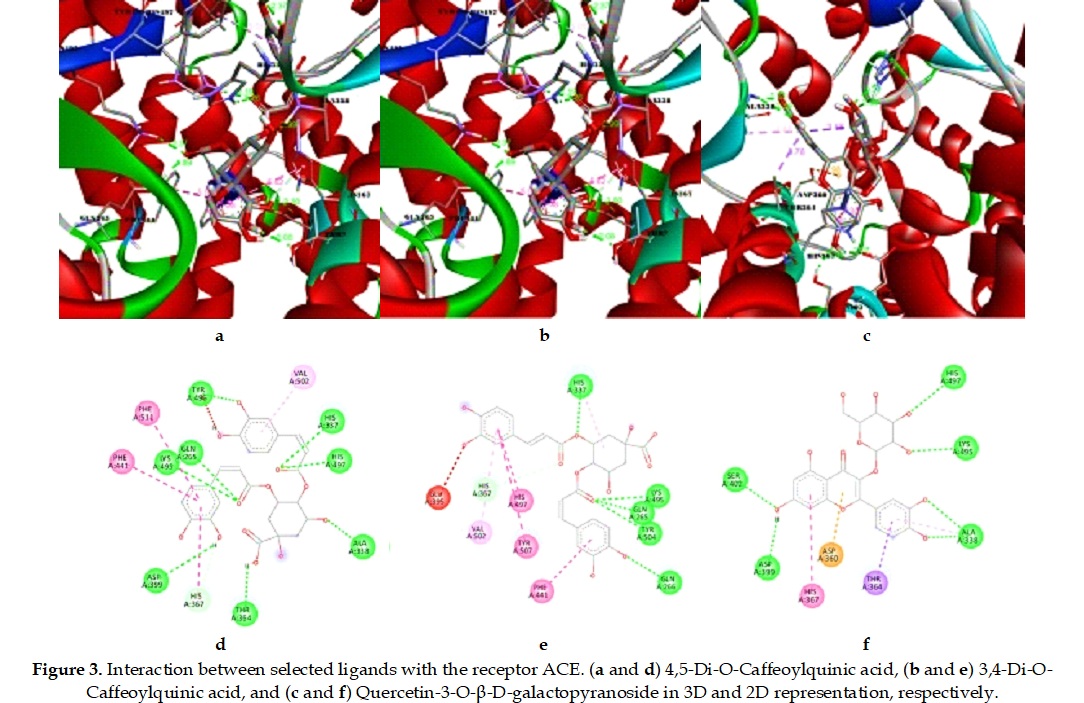
Hypertension remains a major global health concern due to its high prevalence and strong association with cardiovascular diseases and kidney failure. A key component of blood pressure regulation is the Angiotensin-Converting Enzyme (ACE), which catalyzes the conversion of Angiotensin I into the vasoconstrictor Angiotensin II, making it a primary target for antihypertensive drugs. Although synthetic ACE inhibitors such as ramiprilat are effective, their use is often associated with adverse effects, highlighting the need for safer alternatives. This study employs molecular docking and in silico analysis to evaluate the potential of phytochemicals from beluntas (Pluchea indica) as natural ACE inhibitors. A total of 110 phytoconstituents were screened for pharmacokinetic properties using ADMET analysis, leading to the selection of 20 ligands for docking simulations. Among these, 4,5-di-O-caffeoylquinic acid exhibited the highest binding affinity (-9.409 kcal/mol), followed by di-O-caffeoylquinic acid (-8.984 kcal/mol) and quercetin-3-O-β-D-galactopyranoside (-8.372 kcal/mol). These compounds demonstrated stronger binding affinities than the ACE natural substrate, Angiotensin I (-7.133 kcal/mol), and the ACE inhibitor, ramiprilat (-8.717 kcal/mol), suggesting their potential as competitive ACE inhibitors. The binding interactions of these compounds were characterized by hydrogen bonding with key catalytic residues (HIS368, GLU368), electrostatic stabilization, and hydrophobic interactions within the enzyme active site. Notably, caffeoylquinic acid derivatives closely mimicked the binding mode of ramiprilat, whereas quercetin glycosides exhibited a distinct interaction pattern, indicating a possible alternative inhibitory mechanism. These findings provide evidence supporting the potential of P. indica phytochemicals as natural ACE inhibitors and warrant further investigation into their therapeutic applications in hypertension management.
Full text article
References
2. Hikmawanti NPE, Saputri FC, Yanuar A, Jantan I, Ningrum RA, Mun'im A. Insights into the anti-infective effects of Pluchea indica (L.) Less and its bioactive metabolites against various bacteria, fungi, viruses, and parasites. J Ethnopharmacol. 2024;320:117387. DOI: 10.1016/j.jep.2023.117387; PMID: 37944874.
3. Khaksar G, Chaichana N, Assatarakul K, Sirikantaramas S. Caffeoylquinic acid profiling: comparative analysis in yerba mate, Indian camphorweed, and stevia extracts with emphasis on the influence of brewing conditions and cold storage in yerba mate infusion. PeerJ. 2024;12:e17250. DOI: 10.7717/peerj.17250; PMID: 38726376; PMCID: PMC11080990.
4. Baharuddin SA, Shah NNAK, Yazan LS, Rashed AA, Kadota K, Al-Awaadh AM, et al. Optimization of Pluchea indica (L.) leaf extract using ultrasound-assisted extraction and its cytotoxicity on the HT-29 colorectal cancer cell line. Ultrason Sonochem. 2023;101:106702. DOI: 10.1016/j.ultsonch.2023.106702; PMID: 38041881; PMCID: PMC10701412.
5. Al-Askar AA, Hashem AH, Elhussieny NI, Saied E. Green Biosynthesis of Zinc Oxide Nanoparticles Using Pluchea indica Leaf Extract: Antimicrobial and Photocatalytic Activities. Molecules. 2023;28(12):4679. DOI: 10.3390/molecules28124679; PMID: 37375234; PMCID: PMC10304739.
6. Wahyuni DK, Junairiah J, Rosyanti C, Kharisma VD, Syukriya AJ, Rahmawati CT, et al. Computational and in vitro analyses of the antibacterial effect of the ethanolic extract of Pluchea indica L. leaves. Biomed Rep. 2024;21(4):137. DOI: 10.3892/br.2024.1825; PMID: 39129835; PMCID: PMC11310492.
7. Khalil AMA, Saied E, Mekky AE, Saleh AM, Al Zoubi OM, Hashem AH. Green biosynthesis of bimetallic selenium-gold nanoparticles using Pluchea indica leaves and their biological applications. Front Bioeng Biotechnol. 2024;11:1294170. DOI: 10.3389/fbioe.2023.1294170; PMID: 38274007; PMCID: PMC10809157.
8. Buranasukhon W, Athikomkulchai S, Tadtong S, Chittasupho C. Wound healing activity of Pluchea indica leaf extract in oral mucosal cell line and oral spray formulation containing nanoparticles of the extract. Pharm Biol. 2017;55(1):1767-74. DOI: 10.1080/13880209.2017.1326511; PMID: 28534695; PMCID: PMC7012013.
9. Cho CL, Lee YZ, Tseng CN, Cho J, Cheng YB, Wang KW, et al. Hexane fraction of Pluchea indica root extract inhibits proliferation and induces autophagy in human glioblastoma cells. Biomed Rep. 2017;7(5):416-22. DOI: 10.3892/br.2017.979; PMID: 29181154; PMCID: PMC5700394.
10. Nopparat J, Nualla-Ong A, Phongdara A. Ethanolic extracts of Pluchea indica (L.) leaf pretreatment attenuates cytokine-induced β-cell apoptosis in multiple low-dose streptozotocin-induced diabetic mice. PLoS One. 2019;14(2):e0212133. DOI: 10.1371/journal.pone.0212133; PMID: 30779805; PMCID: PMC6380574.
11. Nopparat J, Nualla-Ong A, Phongdara A. Treatment with Pluchea indica (L.) Less. leaf ethanol extract alleviates liver injury in multiple low-dose streptozotocin-induced diabetic BALB/c mice. Exp Ther Med. 2020;20(2):1385-96. DOI: 10.3892/etm.2020.8877; PMID: 32742373; PMCID: PMC7388285.
12. Franco C, Sciatti E, Favero G, Bonomini F, Vizzardi E, Rezzani R. Essential Hypertension and Oxidative Stress: Novel Future Perspectives. Int J Mol Sci. 2022;23(22):14489. DOI: 10.3390/ijms232214489; PMID: 36430967; PMCID: PMC9692622.
13. Valentini A, Heilmann RM, Kühne A, Biagini L, De Bellis D, Rossi G. The Renin-Angiotensin-Aldosterone System (RAAS): Beyond Cardiovascular Regulation. Vet Sci. 2025;12(8):777. DOI: 10.3390/vetsci12080777; PMID: 40872727; PMCID: PMC12390185.
14. Griendling KK, Camargo LL, Rios FJ, Alves-Lopes R, Montezano AC, Touyz RM. Oxidative Stress and Hypertension. Circ Res. 2021;128(7):993-1020. DOI: 10.1161/CIRCRESAHA.121.318063; PMID: 33793335; PMCID: PMC8293920.
15. Daneshzad E, Keshavarz SA, Qorbani M, Larijani B, Azadbakht L. Dietary total antioxidant capacity and its association with sleep, stress, anxiety, and depression score: A cross-sectional study among diabetic women. Clin Nutr ESPEN. 2020;37:187-94. DOI: 10.1016/j.clnesp.2020.03.002; PMID: 32359742.
16. Manoharan S. Is It Still Relevant to Discover New ACE Inhibitors from Natural Products? YES, but Only with Comprehensive Approaches to Address the Patients' Real Problems: Chronic Dry Cough and Angioedema. Molecules. 2023;28(11):4532. DOI: 10.3390/molecules28114532. PMID: 37299008; PMCID: PMC10254462.
17. Akif M, Georgiadis D, Mahajan A, Dive V, Sturrock ED, Isaac RE, et al. High-resolution crystal structures of Drosophila melanogaster angiotensin-converting enzyme in complex with novel inhibitors and antihypertensive drugs. J Mol Biol. 2010;400(3):502-17. DOI: 10.1016/j.jmb.2010.05.024; PMID: 20488190.
18. Humphrey W, Dalke A, Schulten K. VMD: visual molecular dynamics. J Mol Graph. 1996;14(1):33-8. DOI: 10.1016/0263-7855(96)00018-5. PMID: 8744570.
19. Tian W, Chen C, Lei X, Zhao J, Liang J. CASTp 3.0: computed atlas of surface topography of proteins. Nucleic Acids Res. 2018;46(W1):W363-W367. DOI: 10.1093/nar/gky473; PMID: 29860391; PMCID: PMC6031066.
20. Myung Y, de Sá AGC, Ascher DB. Deep-PK: deep learning for small molecule pharmacokinetic and toxicity prediction. Nucleic Acids Res. 2024;52(W1):W469-75. DOI: 10.1093/nar/gkae254; PMID: 38634808; PMCID: PMC11223837.
21. Eberhardt J, Santos-Martins D, Tillack AF, Forli S. AutoDock Vina 1.2.0: New Docking Methods, Expanded Force Field, and Python Bindings. J Chem Inf Model. 2021;61(8):3891-8. DOI: 10.1021/acs.jcim.1c00203; PMID: 34278794; PMCID: PMC10683950.
22. Masuyer G, Schwager SL, Sturrock ED, Isaac RE, Acharya KR. Molecular recognition and regulation of human angiotensin-I converting enzyme (ACE) activity by natural inhibitory peptides. Sci Rep. 2012;2:717. DOI: 10.1038/srep00717; PMID: 23056909; PMCID: PMC3466449.
23. Zheng W, Tian E, Liu Z, Zhou C, Yang P, Tian K, et al. Small molecule angiotensin converting enzyme inhibitors: A medicinal chemistry perspective. Front Pharmacol. 2022;13:968104. DOI: 10.3389/fphar.2022.968104; PMID: 36386190; PMCID: PMC9664202.
24. Pratama MRF, Poerwono H, Siswodiharjo S. ADMET properties of novel 5-O-benzoylpinostrobin derivatives. J Basic Clin Physiol Pharmacol. 2019;30(6):20190251. DOI: 10.1515/jbcpp-2019-0251; PMID: 31851612.
25. Yu F, Zhang Z, Luo L, Zhu J, Huang F, Yang Z, et al. Identification and Molecular Docking Study of a Novel Angiotensin-I Converting Enzyme Inhibitory Peptide Derived from Enzymatic Hydrolysates of Cyclina sinensis. Mar Drugs. 2018;16(11):411. DOI: 10.3390/md16110411; PMID: 30373231; PMCID: PMC6265983.
26. Thompson MW. Regulation of zinc-dependent enzymes by metal carrier proteins. Biometals. 2022;35(2):187-213. DOI: 10.1007/s10534-022-00373-w; PMID: 35192096; PMCID: PMC8862405.
27. Rowland R, Brandariz-Nuñez A. Analysis of the Role of N-Linked Glycosylation in Cell Surface Expression, Function, and Binding Properties of SARS-CoV-2 Receptor ACE2. Microbiol Spectr. 2021;9(2):e0119921. DOI: 10.1128/Spectrum.01199-21; PMID: 34494876; PMCID: PMC8557876.
28. El-Baba TJ, Lutomski CA, Burnap SA, Bolla JR, Baker LA, Baldwin AJ, et al. Uncovering the Role of N-Glycan Occupancy on the Cooperative Assembly of Spike and Angiotensin Converting Enzyme 2 Complexes: Insights from Glycoengineering and Native Mass Spectrometry. J Am Chem Soc. 2023;145(14):8021-32. DOI: 10.1021/jacs.3c00291; PMID: 37000485; PMCID: PMC10103161.
29. El-Feky AM, El-Rashedy AA, Ibrahim NE. Computational and bioactivity investigations of flavonoid fraction from Dodonaea viscosa against oxidative stress and inflammation. Sci Rep. 2025;15(1):43652. DOI: 10.1038/s41598-025-29576-0; PMID: 41381691; PMCID: PMC12701060.
30. Zhuo C, Zeng C, Liu H, Wang H, Peng Y, Zhao Y. Advances and Mechanisms of RNA-Ligand Interaction Predictions. Life. 2025;15(1):104. DOI: 10.3390/life15010104; PMID: 39860045; PMCID: PMC11767038.
31. Loeffler JR, Fernández-Quintero ML, Schauperl M, Liedl KR. STACKED - Solvation Theory of Aromatic Complexes as Key for Estimating Drug Binding. J Chem Inf Model. 2020;60(4):2304-13. DOI: 10.1021/acs.jcim.9b01165; PMID: 32142283; PMCID: PMC7189365.
32. Carlsson AC, Scholfield MR, Rowe RK, Ford MC, Alexander AT, Mehl RA, et al. Increasing Enzyme Stability and Activity through Hydrogen Bond-Enhanced Halogen Bonds. Biochemistry. 2018;57(28):4135-47. DOI: 10.1021/acs.biochem.8b00603; PMID: 29921126; PMCID: PMC6052408.
Authors
Copyright (c) 2026 Achmad Ramadhanna’il Rasjava, Nabila Hadiah Akbar, Aulia Rhamdani Arfan, Dyah Ayu Pramoda Wardani, Aditya Maulana Perdana Putra, Khoirunnisa Muslimawati, Putri Helena Junjung Buih, Taufik Muhammad Fakih

This work is licensed under a Creative Commons Attribution-ShareAlike 4.0 International License.
This work is licensed under a Creative Commons Attribution-ShareAlike 4.0 International License.
Authors continue to retain the copyright to the article if the article is published in the Borneo Journal of Pharmacy. They will also retain the publishing rights to the article without any restrictions.
Authors who publish in this journal agree to the following terms:
- Any article on the copyright is retained by the author(s).
- The author grants the journal the right of first publication with the work simultaneously licensed under a Creative Commons Attribution License that allows others to share work with an acknowledgment of the work authors and initial publications in this journal.
- Authors can enter into separate, additional contractual arrangements for the non-exclusive distribution of published articles (e.g., post-institutional repository) or publish them in a book, with acknowledgment of their initial publication in this journal.
- Authors are permitted and encouraged to post their work online (e.g., in institutional repositories or on their websites) prior to and during the submission process. This can lead to productive exchanges and earlier and greater citations of published work.
- The article and any associated published material are distributed under the Creative Commons Attribution-ShareAlike 4.0 International License.
Article Details