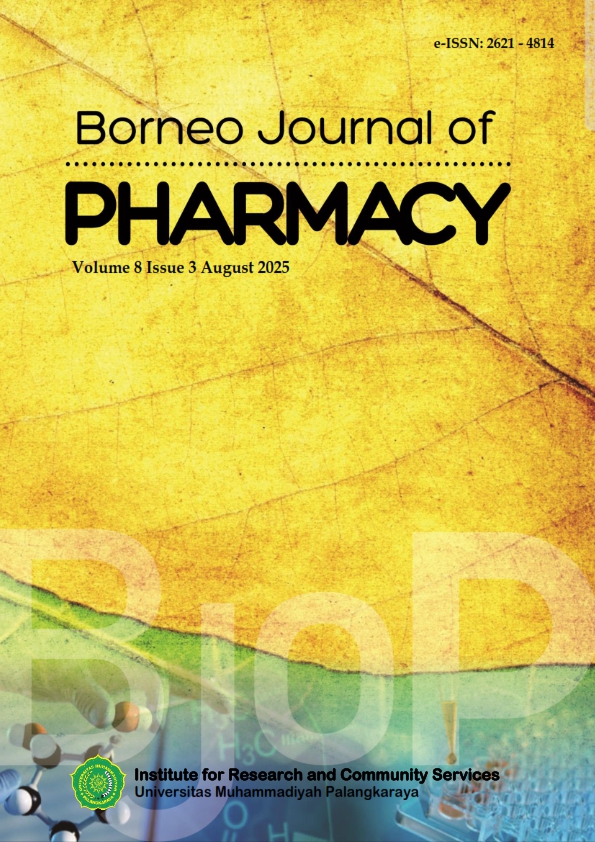
Cover, Content, and Editorial Note from Borneo J Pharm Vol. 8 No. 3 August 2025 From Borneo's Bounty to Global Insights: Embracing Natural Products and Computational Innovation in Pharmacy

Article Sidebar
-
Borneo Journal of Pharmacy
Abstract
Assalamu’alaikum Wr. Wb.
Alhamdulillahirabbil ‘alamin. The newest edition of Borneo Journal of Pharmacy (Borneo J Pharm) was published in August 2025. This edition contains ten articles: Pharmacology-Toxicology, Pharmacognosy-Phytochemistry, Analytical Pharmacy-Medicinal Chemistry, Microbiology Pharmacy, Natural Product Development, Clinical-Community Pharmacy, and Management Pharmacy. This edition includes writings from three countries: India, Indonesia, and Russia. The authors come from several institutions, including Universitas Pakuan, Universitas Surabaya, Universitas Airlangga, Universitas Sam Ratulangi, Universitas Muslim Indonesia, Uttaranchal University, Virtual Research Center for Bioinformatics and Biotechnology, Universitas Brawijaya, Ural State Agrarian University, Gorbatov Research Center for Food Systems, South Ural State Agrarian University, Yaroslav-the-Wise Novgorod State University, Universitas Islam Negeri Mataram, Universitas Ma Chung, National Research and Innovation Agency of the Republic of Indonesia, Universitas Mulia, Universitas Muhammadiyah Klaten, Rumah Sakit Umum Pusat Dr. Sardjito, Sekolah Tinggi Ilmu Kesehatan ISFI Banjarmasin, Universitas Sari Mulia, and Universitas Muhammadiyah Yogyakarta.
This collection of articles powerfully showcases the journal's commitment to advancing pharmaceutical science across three vital frontiers: natural products research, cutting-edge computational analysis, and health system optimization. The research presented here not only taps into the rich biodiversity of Indonesia, particularly the Borneo region and its cultural connections, but also leverages modern technology to accelerate drug discovery and enhance patient care.
Harnessing Nature's Pharmacopoeia
A significant portion of this issue is dedicated to the scientific validation of traditional remedies, highlighting the pharmacological promise of flora from the region and beyond.
In a compelling in vivo study, the effect of javanese chili (Piper retrofractum) and lemon (Citrus limon) formula on total cholesterol levels in male white rats demonstrates the potential of optimizing herbal combinations. The research found that the two extracts' specific ratios (1:1 and 1:2) yielded substantial hypocholesterolemic effects, even superior to the positive control simvastatin. This reinforces the necessity of dosage and ratio optimization in herbal formulation.
Further contributing to the natural products sphere, comparison of characteristics and antibacterial activity of mandai cempedak vinegar with variations in fermentation methods explores a traditional fermented food product from East Kalimantan. This work characterizes the potential probiotic lactic acid bacteria (LAB) from Mandai vinegar, providing a valuable foundation for its future development as a functional food ingredient.
Rounding out this theme, two studies focus on the ubiquitous red ginger (Zingiber officinale var. rubrum). Comparison of chromatogram profiles of red ginger (Zingiber officinale var. rubrum Theilade) rhizome essential oil based on differences in growing places provides critical industrial insight, showing that geographic location significantly alters the vital oil composition—a finding crucial for standardization and quality control. Complementing this, the physicochemical profile and stability of red ginger (Zingiber officinale var. rubrum) SNEDDS as a potential aphrodisiac demonstrates that advanced delivery systems, specifically SNEDDS, can effectively enhance the stability of this valuable extract, paving the way for superior pharmaceutical products.
Accelerating Drug Discovery with In Silico Power
This issue strongly features the application of computational pharmacy, demonstrating how molecular docking and predictive modeling are revolutionizing the identification of new drug candidates: In silico analysis of the antigastritis activity of gedi (Abelmoschus manihot) flower flavonoids on H2 receptor identified quercetin as a key flavonoid in gedi flower with promising potential as an H2 antagonist for gastritis treatment; molecular docking analysis of flavonoids from Syzygium cumini (L.) Skeels: proapoptotic potential as an anticancer mechanism points to epigallocatechin 3-O-gallate and ellagic acid as potent anti-Non-Small Cell Lung Cancer (NSCLC) agents, targeting key apoptotic proteins; and molecular docking study of substituted benzamide derivatives as analgesic candidates employed computational screening to identify promising derivatives of N-allyl-N'-(benzoylcarbamothioyl)benzamide, generating a library of novel compounds that warrant further in vivo validation. These studies underscore the efficiency of in silico methods in prioritizing targets, saving resources, and guiding future laboratory investigations. They are further supported by discovery of novel alkaloids from Magnolia Genus: a literature review from 2002-2024. This comprehensive review consolidates the recent identification of novel bioactive alkaloids, providing a roadmap for natural product drug development.
Advancing Clinical Pharmacy and Health Economics
Beyond product development, the journal remains committed to applied research that improves healthcare delivery: balancing need and feasibility: stakeholder insights on frequent blood glucose monitoring in Indonesia provide a qualitative analysis of the barriers (e.g., irregular patient visits, negative emotions) and facilitators (e.g., active role of pharmacists, free NHI testing) to essential blood glucose and HbA1c monitoring. This research is crucial for developing targeted strategies to ensure medication effectiveness and patient safety in primary care settings, and finally, the cost analysis of inpatient stroke treatment at PKU Muhammadiyah Yogyakarta Hospital based on INA-CBG's tariff in 2023 delves into health economics, analyzing the financial feasibility of stroke management under the updated INA-CBG's reimbursement system. Such studies are vital for ensuring hospital sustainability and effective resource allocation within the national health insurance framework.
Collectively, this issue presents a vibrant mosaic of pharmaceutical research—from traditional phytochemistry and modern nanodelivery to computational screening and health policy analysis. We hope this diverse findings will inspire further collaboration between academic research, industry, and clinical practice, ultimately translating knowledge into better health outcomes.
Editorial boards are fully aware that there is still room for improvement in this edition; hence, with all humility, we are willing to accept constructive suggestions and feedback for improvements to the publication for the subsequent editions. The editorial board would like to thank all editors, reviewers, and contributors to the scientific articles who have provided the repertoire for this issue. We hope that all parties, especially the contributors, could re-participate in the publication in the next edition in November 2025.
Wassalamu’alaikum Wr. Wb.
Full text article
References
Authors
Copyright (c) 2025 Chief Editor of Borneo J Pharm

This work is licensed under a Creative Commons Attribution-ShareAlike 4.0 International License.
This work is licensed under a Creative Commons Attribution-ShareAlike 4.0 International License.
Authors continue to retain the copyright to the article if the article is published in the Borneo Journal of Pharmacy. They will also retain the publishing rights to the article without any restrictions.
Authors who publish in this journal agree to the following terms:
- Any article on the copyright is retained by the author(s).
- The author grants the journal the right of first publication with the work simultaneously licensed under a Creative Commons Attribution License that allows others to share work with an acknowledgment of the work authors and initial publications in this journal.
- Authors can enter into separate, additional contractual arrangements for the non-exclusive distribution of published articles (e.g., post-institutional repository) or publish them in a book, with acknowledgment of their initial publication in this journal.
- Authors are permitted and encouraged to post their work online (e.g., in institutional repositories or on their websites) prior to and during the submission process. This can lead to productive exchanges and earlier and greater citations of published work.
- The article and any associated published material are distributed under the Creative Commons Attribution-ShareAlike 4.0 International License.
Article Details