Relationship Between Finnish Diabetic Risk Score (FINDRISC) with Health-Related Quality of Life in Yogyakarta

Article Sidebar
-
Type 2 Diabetes Mellitus, FINDRISC, Health-Related Quality of Life
Abstract
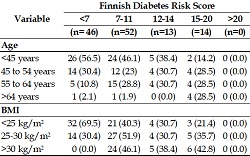
The number of people with type 2 diabetes mellitus (T2DM) in Indonesia increases every year. Control of the development of T2DM can be done by screening using Finnish Diabetic Risk Score (FINDRISC)-Indonesian. FINDRISC is a valid tool for estimating the risk of T2DM within the next 10 years. This condition can have a major impact on the estimated life span and quality of life in the future. The purpose of this research is to determine the relationship between FINDRISC-Indonesian and respondent characteristics with HRQoL from EuroQol-5 Dimension-5 Level (EQ-5D-5L) in Yogyakarta. The cross-sectional study was conducted on 125 respondents who met the inclusion criteria. The risk of developing T2DM was assessed using a validated and widely used FINDRISC (range 0-26 points), and quality of life was measured by the EQ-5D-5L instrument. Overall data were analyzed using the Pearson correlation test and Independent t-test. The results showed the domain of pain was the domain that reported most respondents' most problems (28.8%). The respondent's utility value was 0.958 ± 0.69, and the VAS value was 79.4 ± 0.7. There was a significant difference in utility value based on age characteristics (p = 0.013). There was a relationship between age and utility value (p = 0.006) and FINDRISC score with utility value (p = 0.003). This study concludes that a high FINDRISC score affects the quality of life, and older age has a lower quality of life.
Full text article
References
Authors
Copyright (c) 2021 Ninda Sari Wahyuningtyas, Dyah Aryani Perwitasari, Satibi Satibi

This work is licensed under a Creative Commons Attribution-ShareAlike 4.0 International License.
This work is licensed under a Creative Commons Attribution-ShareAlike 4.0 International License.
Authors continue to retain the copyright to the article if the article is published in the Borneo Journal of Pharmacy. They will also retain the publishing rights to the article without any restrictions.
Authors who publish in this journal agree to the following terms:
- Any article on the copyright is retained by the author(s).
- The author grants the journal the right of first publication with the work simultaneously licensed under a Creative Commons Attribution License that allows others to share work with an acknowledgment of the work authors and initial publications in this journal.
- Authors can enter into separate, additional contractual arrangements for the non-exclusive distribution of published articles (e.g., post-institutional repository) or publish them in a book, with acknowledgment of their initial publication in this journal.
- Authors are permitted and encouraged to post their work online (e.g., in institutional repositories or on their websites) prior to and during the submission process. This can lead to productive exchanges and earlier and greater citations of published work.
- The article and any associated published material are distributed under the Creative Commons Attribution-ShareAlike 4.0 International License.