Bibliometric Study of Microwave-Assisted Synthesis of Flavanone Derivatives
DOI:
https://doi.org/10.33084/bjop.v6i4.5602Keywords:
Bibliometrics, Flavanone, Good health and Well-being, Microwave-assisted, SynthesisAbstract
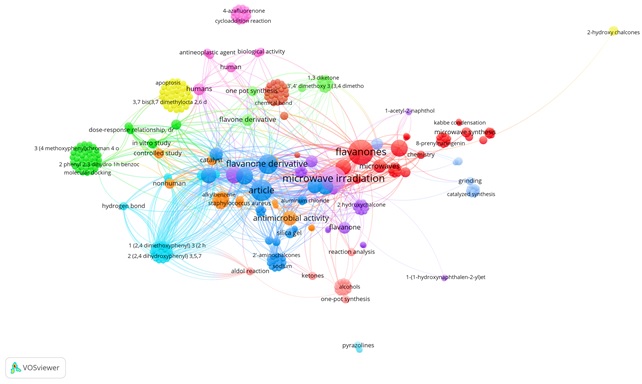
This study aims to describe various studies related to synthesizing flavanone derivatives using the microwave-assisted method with a bibliometric approach. Metadata information was collected from Scopus on June 30th, 2023, with three keywords (microwave-assisted OR microwave, synthesis, and flavanone) searched for article titles, abstracts, and keywords. Analysis and research mapping were carried out with VOSviewer. Of the 33 articles relevant for analysis, 15 keyword clusters were obtained, most of which contained a list of flavanone derivatives. Interestingly, none of these clusters contain keywords for well-known compounds from the flavanone group, such as pinostrobin, pinocembrin, or hesperetin. In other words, there is an excellent opportunity to obtain novelty for microwave-assisted derivatization studies of flavanones. The chances of publication of these studies are greater in Chemistry of Heterocyclic Compounds (Springer Nature), Oriental Journal of Chemistry (Scientific Publishers), and Tetrahedron Letters (Elsevier), each with three documents. Meanwhile, most researchers on this topic come from India with 13 documents. This information allows researchers on this topic to determine potential flavanones that have the opportunity to be derivatized by the microwave-assisted method.
Downloads
References
Ullah A, Munir S, Badshah SL, Khan N, Ghani L, Poulson BG, et al. Important Flavonoids and Their Role as a Therapeutic Agent. Molecules. 2020;25(22):5243. doi:10.3390/molecules25225243
Ku YS, Ng MS, Cheng SS, Lo AWY, Xiao Z, Shin TS, et al. Understanding the Composition, Biosynthesis, Accumulation and Transport of Flavonoids in Crops for the Promotion of Crops as Healthy Sources of Flavonoids for Human Consumption. Nutrients. 2020;12(6):1717. doi:10.3390/nu12061717
Baker DHA. An ethnopharmacological review on the therapeutical properties of flavonoids and their mechanisms of actions: A comprehensive review based on up to date knowledge. Toxicol Rep. 2022;9:445-69. doi:10.1016/j.toxrep.2022.03.011
Al-Khayri JM, Sahana GR, Nagella P, Joseph BV, Alessa FM, Al-Mssallem MQ. Flavonoids as Potential Anti-Inflammatory Molecules: A Review. Molecules. 2022;27(9):2901. doi:10.3390/molecules27092901
Kharissova OV, Kharisov BI, González CMO, Méndez YP, López I. Greener synthesis of chemical compounds and materials. R Soc Open Sci. 2019;6(11):191378. doi:10.1098/rsos.191378
Marotta L, Rossi S, Ibba R, Brogi S, Calderone V, Butini S, et al. The green chemistry of chalcones: Valuable sources of privileged core structures for drug discovery. Front Chem. 2022;10:988376. doi:10.3389/fchem.2022.988376
Poerwono H, Sasaki S, Hattori Y, Higashiyama K. Efficient microwave-assisted prenylation of pinostrobin and biological evaluation of its derivatives as antitumor agents. Bioorg Med Chem Lett. 2010;20(7):2086-9. doi:10.1016/j.bmcl.2010.02.068
Pratama MRF, Praditapuspa EN, Widiyana AP, Kesuma D, Poerwono H, Widiandani T, et al. Bibliometric Analysis of Research on Boesenbergia rotunda, Pinostrobin, and Their Derivatives: Dominance of Southeast Asian Researchers. Revista Cubana de Información en Ciencias de la Salud. 2023;34:e2423.
Sinyeue C, Matsui M, Oelgemöller M, Bregier F, Chaleix V, Sol V, et al. Synthesis and Investigation of Flavanone Derivatives as Potential New Anti-Inflammatory Agents. Molecules. 2023;27(6):1781. doi:10.3390/molecules27061781
Saba L, Porcu M, De Rubeis G, Balestrieri A, Serra A, Carta MG. A new system of authorship best assessment. J Public Health Res. 2023;12(1):22799036221149840. doi:10.1177/22799036221149840
Downloads
Published
Issue
Section
Categories
License
Copyright (c) 2023 Hadi Poerwono, Marcellino Rudyanto

This work is licensed under a Creative Commons Attribution-ShareAlike 4.0 International License.
This work is licensed under a Creative Commons Attribution-ShareAlike 4.0 International License.
Authors continue to retain the copyright to the article if the article is published in the Borneo Journal of Pharmacy. They will also retain the publishing rights to the article without any restrictions.
Authors who publish in this journal agree to the following terms:
- Any article on the copyright is retained by the author(s).
- The author grants the journal the right of first publication with the work simultaneously licensed under a Creative Commons Attribution License that allows others to share work with an acknowledgment of the work authors and initial publications in this journal.
- Authors can enter into separate, additional contractual arrangements for the non-exclusive distribution of published articles (e.g., post-institutional repository) or publish them in a book, with acknowledgment of their initial publication in this journal.
- Authors are permitted and encouraged to post their work online (e.g., in institutional repositories or on their websites) prior to and during the submission process. This can lead to productive exchanges and earlier and greater citations of published work.
- The article and any associated published material are distributed under the Creative Commons Attribution-ShareAlike 4.0 International License.