Chemical Constituents and Antioxidant Activity of Melothria scabra Naudin Fruits
DOI:
https://doi.org/10.33084/bjop.v4i4.2890Keywords:
Cucurbitaceae, Melothria scabra Naudin, Cucurbitacin B glycoside, Antioxidant activityAbstract
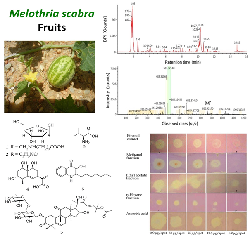
The fruit of Melothria scabra Naudin is traditionally used by natives of South East Sulawesi and has economic values in the local markets. Nonetheless, little scientific information was gained from this plant to support its development for nutraceutical and pharmaceutical aspects. This study aimed to investigate the phytochemicals contained in the ethanol extract and organic fractions (methanol, ethyl acetate, and hexane) of the fruits using specific reagents and an LC-MS/MS analysis, as well as to evaluate their total phenolics, total flavonoids, and DPPH radical scavenging activity using a dot-blot staining and spectrophotometric assays. Results showed that the fruits of M. scabra contained alkaloids, tannins, flavonoids, terpenoids, and saponins. Six compounds were successfully identified from the ethanol extract of the fruits for the first time that is D-1-[(3-carboxypropyl)amino]-1-deoxyfructose (1), fructose-C3H5NO (2), valine (3), 1β, 3α, 9β-trihydroxyeudesma-5,11(13)-dien-12-oic acid (4), Cucurbitacin B-2-O-α-L-rhamnopyranosyl-β-D-glucopyranoside (5), and 2-heptyl-3-hydroxy-4(H)-quinolone (6). Total phenolics in the extract and organic fractions were in the range of 54.2 ± 2.4 to 259.1 ± 8.4 mg GAE/g, while total flavonoids were in the range of 1.6 ± 0.2 to 22.4 ± 0.2 mg QE/g. The ethanol extract and its organic fractions (methanol and ethyl acetate) were potent radical scavengers with SC50 values ranging from 20.7 to 37.5 µg/mL when compared with ascorbic acid, gallic acid, and quercetin (SC50 of 2.8 to 9.4 µg/mL). This study concludes that M. scabra fruits could be developed as a source of natural antioxidant agents for nutraceuticals and pharmaceuticals purposes.
Downloads
Downloads
Published
Issue
Section
Categories
License
Copyright (c) 2021 Harni Sartika Kamaruddin, Megawati Megawati, Nurliana Nurliana, Carla Wulandari Sabandar

This work is licensed under a Creative Commons Attribution-ShareAlike 4.0 International License.
This work is licensed under a Creative Commons Attribution-ShareAlike 4.0 International License.
Authors continue to retain the copyright to the article if the article is published in the Borneo Journal of Pharmacy. They will also retain the publishing rights to the article without any restrictions.
Authors who publish in this journal agree to the following terms:
- Any article on the copyright is retained by the author(s).
- The author grants the journal the right of first publication with the work simultaneously licensed under a Creative Commons Attribution License that allows others to share work with an acknowledgment of the work authors and initial publications in this journal.
- Authors can enter into separate, additional contractual arrangements for the non-exclusive distribution of published articles (e.g., post-institutional repository) or publish them in a book, with acknowledgment of their initial publication in this journal.
- Authors are permitted and encouraged to post their work online (e.g., in institutional repositories or on their websites) prior to and during the submission process. This can lead to productive exchanges and earlier and greater citations of published work.
- The article and any associated published material are distributed under the Creative Commons Attribution-ShareAlike 4.0 International License.