Illness Risk Perceptions and Efficacy Beliefs Among Indonesian in the Course of COVID-19 Pandemic
DOI:
https://doi.org/10.33084/bjop.v5i4.3287Keywords:
COVID-19, Risk Perception, Efficacy Beliefs, IndonesiaAbstract
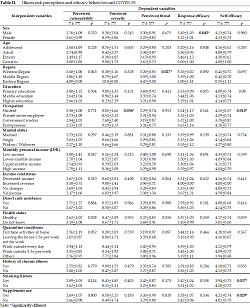
COVID-19, a worldwide pandemic, has posed a significant challenge to public health systems worldwide. Health risk perception and efficacy belief are primary constructs influencing individuals' protective behavior due to the outbreak. Our study investigated each item of illness risk perception, efficacy belief, and its related factors concerning the COVID-19 pandemic. An analytical cross-sectional study was conducted among 227 respondents aged 17 to 70. Data collection was conducted using convenience sampling by distributing the web questionnaire between April and July 2020. Mann-Whitney or Kruskal-Wallis bivariate analysis was performed using SPSS version 21.0 to assess the relationship between individual characteristic factors, illness risk perception, and efficacy belief. The study established that respondents had a medium to a high level of illness risk perception and a reasonable efficacy belief in dealing with the COVID-19 pandemic. Region (p=0.027) and occupation (p=0.036) differences were significantly associated with the threat and severity perception, respectively. Smoking history (p=0.037), supplement use (p=0.029), and occupation (p=0.018) differences were significantly associated with self-efficacy. Meanwhile, gender (p=0.045) differences were significantly associated with response efficacy. Therefore, the public's illness risk perception and efficacy belief could be substantial in planning, modifying, and implementing a coordinated response for risk communication in current and future epidemics.
Downloads
References
She J, Jiang J, Ye L, Hu L, Bai C, Song Y. 2019 novel coronavirus of pneumonia in Wuhan, China: emerging attack and management strategies. Clin Transl Med. 2020;9(1):19. doi:10.1186/s40169-020-00271-z
Cucinotta D, Vanelli M. WHO Declares COVID-19 a Pandemic. Acta Biomed. 2020;91(1):157-60. doi:10.23750/abm.v91i1.9397
Djalante R, Lassa J, Setiamarga D, Sudjatma A, Indrawan M, Haryanto B, et al. Review and analysis of current responses to COVID-19 in Indonesia: Period of January to March 2020. Prog Disaster Sci. 2020;6:100091. doi:10.1016/j.pdisas.2020.100091
World Health Organization. Coronavirus Disease 2019 (COVID-19) Situation Report-18. Jakarta, Indonesia: WHO Indonesia; 2020. Available from: https://www.who.int/docs/default-source/searo/indonesia/covid19/who-situation-report-18.pdf
Alam MM, Fawzi AM, Islam MM, Said J. Impacts of COVID-19 pandemic on national security issues: Indonesia as a case study. Secur J. 2022;35(4):1067-86. doi:10.1057/s41284-021-00314-1
Lusida MAP, Salamah S, Jonatan M, Wiyogo IO, Asyari CH, Ali ND, et al. Prevalence of and risk factors for depression, anxiety, and stress in non-hospitalized asymptomatic and mild COVID-19 patients in East Java province, Indonesia. PLoS One. 2022;17(7):e0270966. doi:10.1371/journal.pone.0270966
Akbar Z, Aisyawati MS. Coping Strategy, Social Support, and Psychological Distress Among University Students in Jakarta, Indonesia During the COVID-19 Pandemic. Front Psychol. 2021;12:694122. doi:10.3389/fpsyg.2021.694122
Abdullah I. COVID-19: Threat and fear in Indonesia. Psychol Trauma Theory Res Pract Policy. 2021;12(5):488-90. doi:10.1037/tra0000878
Xiong J, Lipsitz O, Nasri F, Lui LMW, Gill H, Phan L, et al. Impact of COVID-19 pandemic on mental health in the general population: A systematic review. J Affect Disord. 2020;277:55–64. doi:10.1016/j.jad.2020.08.001
Giallonardo V, Sampogna G, Del Vecchio V, Luciano M, Albert U, Carmassi C, et al. The Impact of Quarantine and Physical Distancing Following COVID-19 on Mental Health: Study Protocol of a Multicentric Italian Population Trial. Front psychiatry. 2020;11:533. doi:10.3389/fpsyt.2020.00533
Zewdie A, Mose A, Sahle T, Bedewi J, Gashu M, Kebede N, et al. The health belief model's ability to predict COVID-19 preventive behavior: A systematic review. SAGE Open Med. 2022;10:20503121221113668. doi:10.1177/20503121221113668
Karl JA, Fischer R, Druică E, Musso F, Stan A. Testing the Effectiveness of the Health Belief Model in Predicting Preventive Behavior During the COVID-19 Pandemic: The Case of Romania and Italy. Front Psychol. 2022;12:627575. doi:10.3389/fpsyg.2021.627575
Sobkow A, Zaleskiewicz T, Petrova D, Garcia-Retamero R, Traczyk J. Worry, Risk Perception, and Controllability Predict Intentions Toward COVID-19 Preventive Behaviors. Front Psychol. 2020;11:582720. doi:10.3389/fpsyg.2020.582720
Ferrer R, Klein WM. Risk perceptions and health behavior. Curr Opin Psychol. 2015;5:85-9. doi:10.1016/j.copsyc.2015.03.012
Schneiderman N, Ironson G, Siegel SD. Stress and health: psychological, behavioral, and biological determinants. Annu Rev Clin Psychol. 2005;1:607-28. doi:10.1146/annurev.clinpsy.1.102803.144141
Cipolletta S, Andreghetti GR, Mioni G. Risk Perception towards COVID-19: A Systematic Review and Qualitative Synthesis. Int J Environ Res Public Health. 2022;19(8):4649. doi:10.3390/ijerph19084649
Diotaiuti P, Valente G, Mancone S, Falese L, Bellizzi F, Anastasi D, et al. Perception of Risk, Self-Efficacy and Social Trust during the Diffusion of Covid-19 in Italy. Int J Environ Res Public Health. 2021;18(7):3427. doi:10.3390/ijerph18073427
Nanda RO, Lolita L, Indayati W, Rusdiyanti I, Ikhsanudin A, Mareti S. Knowledge, precautionary actions, and perceived risk of COVID-19 among indonesian people. Int J Public Health Sci. 2021;10(1):8–15. doi:10.11591/ijphs.v10i1.20589
Nanda RO, Lolita L, Indayati W, Rusdiyanti I, Nurjannah, Ikhsanudin A, et al. Covid-19 risk perception among Indonesians in early stage of the outbreak. Int J Public Health Sci. 2021;10(2):249–57. doi:10.11591/ijphs.v10i2.20678
Lutfi M, Buntuang PCD, Kornelius Y, Erdiyansyah, Hasanuddin B. The impact of social distancing policy on small and medium-sized enterprises (SMEs) in Indonesia. Probl Perspect Manag. 2020;18(3):492-503. doi:10.21511/ppm.18(3).2020.40
de Zwart O, Veldhuijzen IK, Elam G, Aro AR, Abraham T, Bishop GD, et al. Perceived threat, risk perception, and efficacy beliefs related to SARS and other (emerging) infectious diseases: Results of an international survey. Int J Behav Med. 2009;16(1):30–40. doi:10.1007/s12529-008-9008-2
Umamaheswar J, Tan C. “Dad, Wash Your Hands”: Gender, Care Work, and Attitudes toward Risk during the COVID-19 Pandemic. Socius. 2020;6:1-14. doi:10.1177/2378023120964376
Griffith DM, Sharma G, Holliday CS, Enyia OK, Valliere M, Semlow AR, et al. Men and COVID-19: A Biopsychosocial Approach to Understanding Sex Differences in Mortality and Recommendations for Practice and Policy Interventions. Prev Chronic Dis. 2020;17:E63. doi:10.5888/pcd17.200247
World Health Organization. Coronavirus Disease 2019 (COVID-19) Situation Report-41. Jakarta, Indonesia: WHO Indonesia; 2020. Available from: https://www.who.int/docs/default-source/coronaviruse/situation-reports/20200301-sitrep-41-covid-19.pdf?sfvrsn=6768306d_2&download=true
van der Plaat DA, Madan I, Coggon D, van Tongeren M, Edge R, Muiry R, et al. Risks of COVID-19 by occupation in NHS workers in England. Occup Environ Med. 2022;79(3):176-83. doi:10.1136/oemed-2021-107628
Walsh B, Redmond P, Roantree B, Redmond P. Differences in risk of severe outcomes from COVID-19 across occupations in Ireland. ESRI Survey and Statistical Report Series Number 93. Dublin, Ireland: The Economic and Social Research Institute; 2020. doi:10.26504/sustat93
Lan FY, Wei CF, Hsu YT, Christiani DC, Kales SN. Work-related COVID-19 transmission in six Asian countries/areas: A follow-up study. PLoS One. 2020;15(5):e0233588. doi:10.1371/journal.pone.0233588
Kashyap VK, Dhasmana A, Massey A, Kotnala S, Zafar N, Jaggi M, et al. Smoking and COVID-19: Adding Fuel to the Flame. Int J Mol Sci. 2020;21(18):6581. doi:10.3390/ijms21186581
Ahmed N, Maqsood A, Abduljabbar T, Vohra F. Tobacco Smoking a Potential Risk Factor in Transmission of COVID-19 Infection. Pak J Med Sci. 2020;36(COVID19-S4):S104-7. doi:10.12669/pjms.36.covid19-s4.2739
Li W, Moore MJ, Vasilieva N, Sui J, Wong SK, Berne MA, et al. Angiotensin-converting enzyme 2 is a functional receptor for the SARS coronavirus. Nature. 2003;426(6965):450-4. doi:10.1038/nature02145
Ni W, Yang X, Yang D, Bao J, Li R, Xiao Y, et al. Role of angiotensin-converting enzyme 2 (ACE2) in COVID-19. Crit Care. 2020;24(1):422. doi:10.1186/s13054-020-03120-0
Polverino F. Cigarette Smoking and COVID-19: A Complex Interaction. Am J Respir Crit Care Med. 2020;202(3):471–2. doi:10.1164/rccm.202005-1646le
Alqahtani JS, Oyelade T, Aldhahir AM, Alghamdi SM, Almehmadi M, Alqahtani AS, et al. Prevalence, Severity and Mortality associated with COPD and Smoking in patients with COVID-19: A Rapid Systematic Review and Meta-Analysis. PLoS One. 2020;15(5):e0233147. doi:10.1371/journal.pone.0233147
Kumar P, Kumar M, Bedi O, Gupta M, Kumar S, Jaiswal G, et al. Role of vitamins and minerals as immunity boosters in COVID-19. Inflammopharmacology. 2021;29(4):1001-16. doi:10.1007/s10787-021-00826-7
Ahmed MH, Hassan A, Molnár J. The Role of Micronutrients to Support Immunity for COVID-19 Prevention. Rev Bras Farmacogn. 2021;31(4):361-74. doi:10.1007/s43450-021-00179-w
Sahebnasagh A, Saghafi F, Avan R, Khoshi A, Khataminia M, Safdari M, et al. The prophylaxis and treatment potential of supplements for COVID-19. Eur J Pharmacol. 2020;887:173530. doi:10.1016/j.ejphar.2020.173530
Mrityunjaya M, Pavithra V, Neelam R, Janhavi P, Halami PM, Ravindra PV. Immune-Boosting, Antioxidant and Anti-inflammatory Food Supplements Targeting Pathogenesis of COVID-19. Front Immunol. 2020;11:570122. doi:10.3389/fimmu.2020.570122
Handayani W, Insani TD, Fisher M, Gim THT, Mardhotillah S, Adam UEF. Effects of COVID-19 restriction measures in Indonesia: A comparative spatial and policy analysis of selected urban agglomerations. Int J Disaster Risk Reduct. 2022;76:103015. doi:10.1016/j.ijdrr.2022.103015
Mya KS, Aye SM, Hlaing WA, Hlaing SS, Aung T, Lwin SMM, et al. Awareness, perceived risk and protective behaviours of Myanmar adults on COVID-19. Int J Commun Med Public Health. 2020;7(5):1627. doi:10.18203/2394-6040.ijcmph20201530
Kwok KO, Li KK, Chan HHH, Yi YY, Tang A, Wei WI, et al. Community Responses during Early Phase of COVID-19 Epidemic, Hong Kong. Emerg Infect Dis. 2020;26(7):1575–9. doi:10.3201/eid2607.200500
Yıldırım M, Güler A. COVID-19 severity, self-efficacy, knowledge, preventive behaviors, and mental health in Turkey. Death Stud. 2020;46(4):979-86. doi:10.1080/07481187.2020.1793434
Sulistyawati, Rokhmayanti, Aji B, Wijayanti SPM, Hastuti SKW, Sukesi TW, et al. Knowledge, Attitudes, Practices and Information Needs During the COVID-19 Pandemic in Indonesia. Risk Manag Healthc Policy. 2021;14:163. doi:10.2147/rmhp.s288579
Serafini G, Parmiagini B, Amerio A, Aguglia A, Sher L, Amore M. The psychological impact of COVID-19 on the mental health in the general population. QJM. 2020;113(8):531-7. doi:10.1093/qjmed/hcaa201
Husnah, Salawati L, Sakdiah, Nazira N, Firdausa S, Nawawi YS. Perception and preventive behavior during COVID-19 pandemic among residents in Banda Aceh, Indonesia: a cross-sectional study. Med J Indones. 2021;30:290-6. doi:10.13181/mji.oa.215674
Cori L, Bianchi F, Cadum E, Anthonj C. Risk Perception and COVID-19. Int J Environ Res Public Health. 2020;17(9):3114. doi:10.3390/ijerph17093114
Ghio D, Lawes-Wickwar S, Tang MY, Epton T, Howlett N, Jenkinson E, et al. What influences people's responses to public health messages for managing risks and preventing infectious diseases? A rapid systematic review of the evidence and recommendations. BMJ Open. 2021;11(11):e048750. doi:10.1136/bmjopen-2021-048750
Liu PL. COVID-19 information on social media and preventive behaviors: Managing the pandemic through personal responsibility. Soc Sci Med. 2021;277:113928. doi:10.1016/j.socscimed.2021.113928
Ayuningtyas D, Haq HU, Utami RRM, Susilia S. Requestioning the Indonesia Government's Public Policy Response to the COVID-19 Pandemic: Black Box Analysis for the Period of January-July 2020. Front Public Health. 2021;9:612994. doi:10.3389/fpubh.2021.612994
Published
Issue
Section
Categories
License
Copyright (c) 2022 Lolita Lolita, Azis Ikhsanudin

This work is licensed under a Creative Commons Attribution-ShareAlike 4.0 International License.
This work is licensed under a Creative Commons Attribution-ShareAlike 4.0 International License.
Authors continue to retain the copyright to the article if the article is published in the Borneo Journal of Pharmacy. They will also retain the publishing rights to the article without any restrictions.
Authors who publish in this journal agree to the following terms:
- Any article on the copyright is retained by the author(s).
- The author grants the journal the right of first publication with the work simultaneously licensed under a Creative Commons Attribution License that allows others to share work with an acknowledgment of the work authors and initial publications in this journal.
- Authors can enter into separate, additional contractual arrangements for the non-exclusive distribution of published articles (e.g., post-institutional repository) or publish them in a book, with acknowledgment of their initial publication in this journal.
- Authors are permitted and encouraged to post their work online (e.g., in institutional repositories or on their websites) prior to and during the submission process. This can lead to productive exchanges and earlier and greater citations of published work.
- The article and any associated published material are distributed under the Creative Commons Attribution-ShareAlike 4.0 International License.