In Vitro Evaluation of Prebiotic Potential of Red Ginger (Zingiber officinale var. rubrum) Rhizome Ethanol Extract on Lactobacillus acidophilus and Escherichia coli
DOI:
https://doi.org/10.33084/bjop.v7i3.6029Keywords:
Prebiotic, Phenol, Carbohydrate, Red gingerAbstract
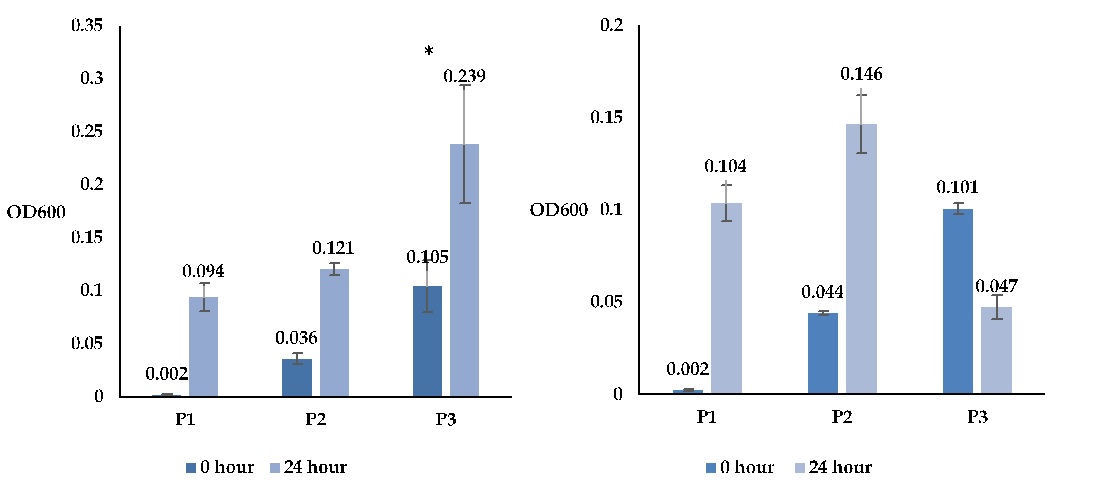
Prebiotics, including carbohydrates and phenols, promote beneficial gut bacteria (probiotics). Red ginger (Zingiber officinale var. rubrum) rhizomes, rich in these compounds, have been traditionally used in medicine but their prebiotic potential remains unexplored. This study investigated the in vitro prebiotic effects of Z. officinale var. rubrum rhizomes on Lactobacillus acidophilus (beneficial) and Escherichia coli (opportunistic) bacteria. Prebiotic activity was assessed using a turbidimetric method, measuring bacterial growth via UV-Vis spectrophotometry at 600 nm. The prebiotic index and percentage inhibition were calculated to evaluate the impact on bacterial growth. Additionally, total phenol content was determined using the Folin-Ciocalteu method. Results indicate that Z. officinale var. rubrum rhizomes exhibit prebiotic properties, stimulating L. acidophilus growth (prebiotic index of 156.035 and percentage inhibition value of -153.128%) while inhibiting E. coli growth (54.343% inhibition). The rhizomes contained 31.15 mg GAE/g extract of total phenols and 23.55% carbohydrates. These findings suggest that Z. officinale var. rubrum rhizomes possess prebiotic potential, warranting further investigation for potential applications in gut health management.
Downloads
References
Kumar M, Nagpal R, Kumar R, Hemalatha R, Verma V, Kumar A, et al. Cholesterol-lowering probiotics as potential biotherapeutics for metabolic diseases. Exp Diabetes Res. 2012;2012:902917. DOI: 10.1155/2012/902917; PMCID: PMC3352670; PMID: 22611376
Lopes SMS, Francisco MG, Higashi B, de Almeida RTR, Krausová G, Pilau EJ, et al. Chemical characterization and prebiotic activity of fructo-oligosaccharides from Stevia rebaudiana (Bertoni) roots and in vitro adventitious root cultures. Carbohydr Polym. 2016;152:718-25. DOI: 10.1016/j.carbpol.2016.07.043; PMID: 27516323
Davani-Davari D, Negahdaripour M, Karimzadeh I, Seifan M, Mohkam M, Masoumi SJ, et al. Prebiotics: Definition, Types, Sources, Mechanisms, and Clinical Applications. Foods. 2019;8(3):92. DOI: 10.3390/foods8030092; PMCID: PMC6463098; PMID: 30857316
Slavin J. Fiber and prebiotics: Mechanisms and health benefits. Nutrients. 2013;5(4):1417-35. DOI: 10.3390/nu5041417; PMCID: PMC3705355; PMID: 23609775
Zhang S, Kou X, Zhao H, Mak KK, Balijepalli MK, Pichika MR. Zingiber officinale var. rubrum: Red Ginger's Medicinal Uses. Molecules. 2022;27(3):775. DOI: 10.3390/molecules27030775; PMCID: PMC8840670; PMID: 35164040
Widiawati A, Husni A, Wanniatie V, Septinova D. Status Mikrobiologis Yoghurt Susu Kambing Dengan Penambahan Ekstrak Jahe Merah (Zingiber Officinale var. Rubrum). J Riset Inovasi Peternakan J Res Innov Anim. 2022;6(3):293-9. DOI: 10.23960/jrip.2022.6.3.293-299
Srikandi S, Humaeroh M, Sutamihardja R. Kandungan Gingerol dan Shogaol dari Ekstrak Jahe Merah (Zingiber officinale Roscoe) dengan Metode Maserasi Bertingkat. Al-Kimiya J Ilmu Kimia Terapan. 2020;7(2):75–81. DOI: 10.15575/ak.v7i2.6545
Wang J, Chen Y, Hu X, Feng F, Cai L, Chen F. Assessing the effects of ginger extract on polyphenol profiles and the subsequent impact on the fecal microbiota by simulating digestion and fermentation in vitro. Nutrients. 2020;12(10):3194. DOI: 10.3390/nu12103194; PMCID: PMC7650818; PMID: 33086593
Hapsari AM, Masfria, Dalimunthe A. Pengujian Kandungan Total Fenol Ekstrak Etanol Tempuyung (Shoncus arvensis L.). Talenta Conf Ser Trop Med. 2018;1(1):284-90. DOI: 10.32734/tm.v1i1.75
Wiyantoko B, Rusitasari R, Putri RN, Muhaimin. Identifikasi Glukosa Hasil Hidrolisis Serat Daun Nanas Menggunakan Metode Fenol-Asam Sulfat Secara Spektrofotometri UV-Visibel. In: Kusumawati N, Samik, Nurhayati, editors. Prosiding Seminar Nasional Kimia. 2017 Oct 7; Surabaya, Indonesia. Fakultas MIPA Universitas Negeri Surabaya: Surabaya; 2017. p. 124–31.
Phirom-on K, Apiraksakorn J. Development of cellulose-based prebiotic fiber from banana peel by enzymatic hydrolysis. Food Biosci. 2021;41:101083. DOI: 10.1016/j.fbio.2021.101083
Di Lodovico S, Gasparri F, Di Campli E, Di Fermo P, D'Ercole S, Cellini L, et al. Prebiotic Combinations Effects on the Colonization of Staphylococcal Skin Strains. Microorganisms. 2020;9(1):37. DOI: 10.3390/microorganisms9010037; PMCID: PMC7824076; PMID: 33374268
Ministry of Health of the Republic of Indonesia. Farmakope Herbal Indonesia Edisi II. Jakarta: Ministry of Health of the Republic of Indonesia; 2017.
Senduk TW, Montolalu LADY, Dotulong V. The rendement of boiled water extract of mature leaves of mangrove Sonneratia alba. J Perikanan Kelautan Trop. 2022;11(1):9–15. DOI: 10.35800/jpkt.11.1.2020.28659
Ćujić N, Šavikin K, Janković T, Pljevljakušić D, Zdunić G, Ibrić S. Optimization of polyphenols extraction from dried chokeberry using maceration as traditional technique. Food Chem. 2016;194:135–42. DOI: 10.1016/j.foodchem.2015.08.008; PMID: 26471536
Martins PM, Thorat BN, Lanchote AD, Freitas LAP. Green extraction of glycosides from Stevia rebaudiana (Bert.) with low solvent consumption: A desirability approach. Resour Technol. 2016;2(4):247–53. DOI: 10.1016/j.reffit.2016.11.007
Herawati IE, Saptarini NM. Studi Fitokimia pada Jahe Merah (Zingiber officinale Roscoe Var. Sunti Val). Majalah Farmasetika. 2020;4(Suppl 1):22–7. DOI: 10.24198/mfarmasetika.v4i0.25850
Rodríguez-Daza MC, Pulido-Mateos EC, Lupien-Meilleur J, Guyonnet D, Desjardins Y, Roy D. Polyphenol-Mediated Gut Microbiota Modulation: Toward Prebiotics and Further. Front Nutr. 2021;8:689456. DOI: 10.3389/fnut.2021.689456; PMCID: PMC8276758; PMID: 34268328
Suryani CL. Optimasi metode ekstraksi fenol dari rimpang jahe emprit (Zingiber officinale Var. Rubrum). J Agrisains. 2012;3(4):63–70.
Ghasemzadeh A, Jaafar HZE, Rahmat A. Antioxidant Activities, Total Phenolics and Flavonoids Content in Two Varieties of Malaysia Young Ginger (Zingiber officinale Roscoe). Molecules. 2010;15(6):4324–33. DOI: 10.3390/molecules15064324; PMCID: PMC6264263; PMID: 20657444
Mao QQ, Xu XY, Cao SY, Gan RY, Corke H, Beta T, et al. Bioactive Compounds and Bioactivities of Ginger (Zingiber officinale Roscoe). Foods. 2019;8(6):185. DOI: 10.3390/foods8060185; PMCID: PMC6616534; PMID: 31151279
Lukiati B, Sulisetijono, Nugrahaningsih, Masita R. Determination of total phenol and flavonoid levels and antioxidant activity of methanolic and ethanolic extract Zingiber officinale Rosc var. Rubrum rhizome. AIP Conf Proc. 2020;2231:040003. DOI: 10.1063/5.0002657
Mahmudati N, Wahyono P, Djunaedi D. Antioxidant activity and total phenolic content of three varieties of Ginger (Zingiber officinale) in decoction and infusion extraction method. J Phys Conf Ser. 2020;1567:022028. DOI: 10.1088/1742-6596/1567/2/022028
Haroen U, Syafwan S, Kurniawan K, Budiansyah A. Determination of total phenolics, flavonoids, and testing of antioxidant and antibacterial activities of red ginger (Zingiber officinale var. Rubrum). J Adv Vet Anim Res. 2024;11(1):114-24. DOI: 10.5455/javar.2024.k755; PMCID: PMC11055600; PMID: 38680806
Ezez D, Tefera M. Effects of solvents on total phenolic content and antioxidant activity of ginger extracts. J Chem. 2021;2021(1):6635199. DOI: 10.1155/2021/6635199
Plamada D, Vodnar DC. Polyphenols-Gut Microbiota Interrelationship: A Transition to a New Generation of Prebiotics. Nutrients. 2021;14(1):137. DOI: 10.3390/nu14010137; PMCID: PMC8747136; PMID: 35011012
Supu RD, Diantini A, Levita J. Red ginger (Zingiber officinale var. rubrum): Its chemical constituents, pharmacological activities and safety. Fitofarmaka J Ilmiah Farmasi. 2018;8(1):25–31. DOI: 10.33751/jf.v8i1.1168
Verenzia NA, Sukardi, Mujianto, Wachid M. Karakterisasi Fisikokimia dan Organoleptik Stik dengan Formulasi Tepung Lemon (Citrus limon L) dan Pati Jahe Merah (Zingiber officinale var Rubrum). Food Technol Halal Sci J. 2022;5(1):93–108. DOI: 10.22219/fths.v5i1.18979
Nasution AS, Hasbullah R, Hartulistiyoso E. Effect of Drying Temperature on Quality of Dried Red Ginger (Zingiber Officinale Var. Rubrum). J Teknik Pertanian Lampung. 2023;12(1):107-17. DOI: 10.23960/jtep-l.v12i1.107-117
Sánchez-Clemente R, Guijo MI, Nogales J, Blasco R. Carbon Source Influence on Extracellular pH Changes along Bacterial Cell-Growth. Genes. 2020;11(11):1292. DOI: 10.3390/genes11111292; PMCID: 10.3390/genes11111292; PMID: 33142974
Wihansah RRS, Yusuf M, Arifin M, Oktaviana AY, Rifkhan R, Negara JK, et al. Pengaruh Pemberian Glukosa yang Berbeda terhadap Adaptasi Escherichia coli pada Cekaman Lingkungan Asam. 2018;13(1):36–42. DOI: 10.31186/jspi.id.13.1.29-35
Lordan C, Thapa D, Ross RP, Cotter PD. Potential for enriching next-generation health-promoting gut bacteria through prebiotics and other dietary components. Gut Microbes. 2020;11(1):1–20. DOI: 10.1080/19490976.2019.1613124; PMCID: PMC6973326; PMID: 31116628
Figueroa-González I, Rodríguez-Serrano G, Gómez-Ruiz L, García-Garibay M, Cruz-Guerrero A. Prebiotic effect of commercial saccharides on probiotic bacteria isolated from commercial products. Food Sci Technol. 2019;39(3):747-53. DOI: 10.1590/fst.07318
Helal MMI, Osman MY, Ghobashy MOI, Helmy WA. Study of some biological activities of aqueous extract of ginger (Zingiber officinale). Egypt Pharm J. 2014;13(2):144–50. DOI: 10.4103/1687-4315.147093
Downloads
Published
Issue
Section
Categories
License
Copyright (c) 2024 Fadil Rido Gumelar, Farendina Suarantika, Bertha Rusdi

This work is licensed under a Creative Commons Attribution-ShareAlike 4.0 International License.
This work is licensed under a Creative Commons Attribution-ShareAlike 4.0 International License.
Authors continue to retain the copyright to the article if the article is published in the Borneo Journal of Pharmacy. They will also retain the publishing rights to the article without any restrictions.
Authors who publish in this journal agree to the following terms:
- Any article on the copyright is retained by the author(s).
- The author grants the journal the right of first publication with the work simultaneously licensed under a Creative Commons Attribution License that allows others to share work with an acknowledgment of the work authors and initial publications in this journal.
- Authors can enter into separate, additional contractual arrangements for the non-exclusive distribution of published articles (e.g., post-institutional repository) or publish them in a book, with acknowledgment of their initial publication in this journal.
- Authors are permitted and encouraged to post their work online (e.g., in institutional repositories or on their websites) prior to and during the submission process. This can lead to productive exchanges and earlier and greater citations of published work.
- The article and any associated published material are distributed under the Creative Commons Attribution-ShareAlike 4.0 International License.