Kelor (Moringa oleifera) Bioactive Compounds as Potential Anti-Breast Cancer Agents: In Silico Studies
DOI:
https://doi.org/10.33084/bjop.v8i4.7435Keywords:
Breast Anticancer, Computational Studies, Moringa Leaves, EstrogenAbstract
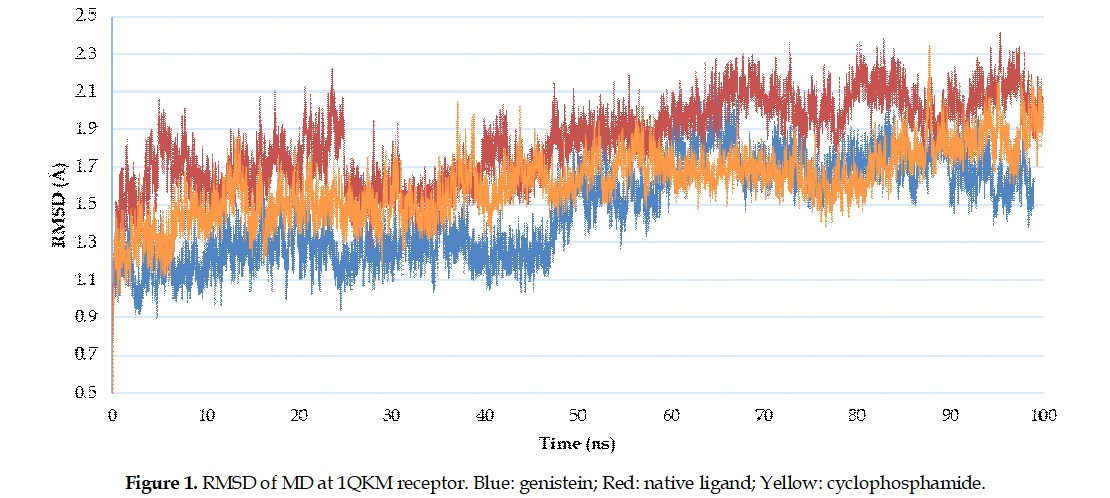
Breast cancer is the most common type of cancer in women. Kelor (Moringa oleifera) leaves are a plant with medicinal properties for treatment. This study aimed to determine the activity and identify the metabolite compounds of M. oleifera leaves that are more effective and stable at the estrogen receptor (ER), potentially serving as an anticancer agent for breast cancer. The methods employed are computational studies, including molecular docking, PKCSM tests, and molecular dynamics simulations. The results of a computational molecular docking study of 23 M. oleifera leaf compounds identified the three best compounds from the docking results of the best ER genistein compounds on the 1QKM receptor, as well as genistein and luteolin compounds on the 1X7J receptor, all with low free energy values. From the pkCSM test of 23 compounds, three compounds were selected that showed good absorbance and distribution, and the toxicity prediction indicated that one compound did not exhibit hepatotoxicity. Molecular dynamics results for the Luteolin 1X7J compound, simulated for 100 ns, showed lower and more stable RMSD and RMSF values compared to those of compounds on the ER.
Downloads
References
Łukasiewicz S, Czeczelewski M, Forma A, Baj J, Sitarz R, Stanisławek A. Breast Cancer-Epidemiology, Risk Factors, Classification, Prognostic Markers, and Current Treatment Strategies-An Updated Review. Cancers. 2021;13(17):4287. DOI: 10.3390/cancers13174287; PMCID: PMC8428369; PMID; 34503097
Zhang YN, Xia KR, Li CY, Wei BL, Zhang B. Review of Breast Cancer Pathologigcal Image Processing. Biomed Res Int. 2021;2021:1994764. DOI: 10.1155/2021/1994764; PMCID: PMC8478535; PMID: 34595234
Sultan R, Ahmed A, Wei L, Saeed H, Islam M, Ishaq M. The anticancer potential of chemical constituents of Moringa oleifera targeting CDK-2 inhibition in estrogen receptor positive breast cancer using in-silico and in vitro approaches. BMC Complement Med Ther. 2023;23(1):396. DOI: 10.1186/s12906-023-04198-z; PMCID: PMC10625284; PMID: 37925393
Wang J, Wu SG. Breast Cancer: An Overview of Current Therapeutic Strategies, Challenge, and Perspectives. Breast Cancer. 2023;15:721-30. DOI: 10.2147/bctt.s432526; PMCID: PMC10596062; PMID: 37881514
Habara M, Shimada M. Estrogen receptor α revised: Expression, structure, function, and stability. Bioessays. 2022;44(12):e2200148. DOI: 10.1002/bies.202200148; PMID: 36192154
Liu Y, Ma H, Yao J. ERα, A Key Target for Cancer Therapy: A Review. Onco Targets Ther. 2020;13:2183-91. DOI: 10.2147/ott.s236532; PMCID: PMC7073439; PMID: 32210584
Atanasov AG, Zotchev SB, Dirsch VM, International Natural Product Sciences Taskforce, Supuran CT. Natural products in drug discovery: advances and opportunities. Nat Rev Drug Discov. 2021;20(3):200-16. DOI: 10.1038/s41573-020-00114-z; PMCID: PMC7841765; PMID: 33510482
Kumar S, Murti Y, Arora S, Akram W, Bhardwaj H, Gupta K, et al. Exploring the therapeutic potential of Moringa oleifera Lam. in Traditional Chinese Medicine: A comprehensive review. Pharmacol Res Mod Chin Med. 2024;12:100473. DOI: 10.1016/j.prmcm.2024.100473
Amin MF, Ariwibowo T, Putri SA, Kurnia D. Moringa oleifera: A Review of the Pharmacology, Chemical Constituents, and Application for Dental Health. Pharmaceuticals. 2024;17(1):142. DOI: 10.3390/ph17010142; PMCID: PMC10819732; PMID: 38276015
Pareek A, Pant M, Gupta MM, Kashania P, Ratan Y, Jain V, et al. Moringa oleifera: An Updated Comprehensive Review of Its Pharmacological Activities, Ethnomedicinal, Phytopharmaceutical Formulation, Clinical, Phytochemical, and Toxicological Aspects. Int J Mol Sci. 2023;24(3):2098. DOI: 10.3390/ijms24032098; PMCID; PMC9916933; PMID: 36768420
Soto JA, Gómez AC, Vásquez M, Barreto AN, Molina KS, Zuniga-Gonzalez CA. Biological properties of Moringa oleifera: A systematic review of the last decade. F1000Res. 2025;13:1390. DOI: 10.12688/f1000research.157194.2; PMCID; PMC11782934; PMID: 39895949
Tahiroğlu V, Gören K, Bağlan M. In Silico drug evaluation by molecular docking, ADME studies and DFT calculations of 2-(6-chloro-2-(4-chlorophenyl)imidazo[1,2-a]pyridin-3-yl)-N, N-dipropylacetamide. BMC Pharmacol Toxicol. 2025;26(1):116. DOI: 10.1186/s40360-025-00958-4; PMCID: PMC12135494; PMID: 40468388
Masarkar N, Ray SK, Saleem Z, Mukherjee S. Potential anti-cancer activity of Moringa oleifera derived bio-active compounds targeting hypoxia-inducible factor-1 alpha in breast cancer. J Complement Integr Med. 2023;21(3):282–94. DOI: 10.1515/jcim-2023-0182; PMID: 37712721
Ruswanto R, Nofianti T, Mardianingrum R, Lestari T. Desain dan Studi In Silico Senyawa Turunan Kuwanon-H sebagai Kandidat Obat Anti-HIV. J Kimia Valensi. 2018;4(1):57–66. DOI: 10.15408/jkv.v4i1.6867
Pratama MRF, Poerwono H, Siswodihardjo S. Introducing a two‐dimensional graph of docking score difference vs. similarity of ligand‐receptor interactions. Indones J Biotechnol. 2021;26(1):54-60. DOI: 10.22146/ijbiotech.62194
Yang C, Chen EA, Zhang Y. Protein-Ligand Docking in the Machine-Learning Era. Moleules. 2022;27(14):4568. DOI: 10.3390/molecules27144568; PMCID: PMC9323102; PMID: 35889440
Pires DEV, Blundell TL, Ascher DB. pkCSM: Predicting Small-Molecule Pharmacokinetic and Toxicity Properties Using Graph-Based Signatures. J Med Chem. 2015;58(9):4066-72. DOI: 10.1021/acs.jmedchem.5b00104; PMCID: PMC4434528; PMID: 25860834
Trott O, Olson AJ. AutoDock Vina: improving the speed and accuracy of docking with a new scoring function, efficient optimization, and multithreading. J Comput Chem. 2010;31(2):455–61. DOI: 10.1002/jcc.21334; PMCID: PMC3041641; PMID: 19499576
Lee S, Kim S, Lee GR, Kwon S, Woo H, Seok C, et al. Evaluating GPCR modeling and docking strategies in the era of deep learning-based protein structure prediction. Comput Struct Biotechnol J. 2022;21:158-67. DOI: 10.1016/j.csbj.2022.11.057; PMCID: PMC9747351; PMID: 36544468
Sobolev OV, Afonine PV, Moriarty NW, Hekkelman ML, Joosten RP, Perrakis A, et al. A Global Ramachandran Score Identifies Protein Structures with Unlikely Stereochemistry. Structure. 2020;28(11):1249-58. DOI: 10.1016/j.str.2020.08.005; PMCID: PMC7642142; PMID: 32857966
Bafna D, Ban F, Rennie PS, Singh K, Cherkasov A. Computer-Aided Ligand Discovery for Estrogen Receptor Alpha. Int J Mol Sci. 2020;21(12):4193. DOI: 10.3390/ijms21124193; PMCID: PMC7352601; PMID; 32545494
Fatima S, Usmani MA, Srivastava AK. Bioactive metabolites of Moringa oleifera with functional activities. Res Pharm. 2024;4:25-37. DOI: 10.25081/rip.2024.v14.9060
Terefe EM, Ghosh A. Molecular Docking, Validation, Dynamics Simulations, and Pharmacokinetic Prediction of Phytochemicals Isolated From Croton dichogamus Against the HIV-1 Reverse Transcriptase. Bioinform Bio Insights. 2022;16:11779322221125605. DOI: 10.1177/11779322221125605; PMCID: PMC9516429; PMID: 36185760
Tousif M, Nadeem M, Tabassum M, Rizvi MMA, Haque SE. Anticancer efficacy of nerolidol, cyclophosphamide, and their combination against breast cancer cell line MCF-7. Med Oncol. 2024;42(10):430. DOI: 10.1007/s12032-025-02997-7; PMID: 40828487
Dogara AM, Al-Sultani ATK, Kadium SMA, Mohammed HA, Al-Taey DKA, Alsaffar MF, et al. Anticancer Potential of moringa oleifera Lam: a Systematic Review. IOP Conf Ser Earth Environ Sci. 2024;1371:052072. DOI: 10.1088/1755-1315/1371/5/052072
Dyson HJ, Wright PE, Scheraga HA. The role of hydrophobic interactions in initiation and propagation of protein folding. Proc Natl Acad Sci U S A. 2006;103(35):13057-61. DOI: 10.1073/pnas.0605504103; PMCID: PMC1559752; PMID; 16916929
Leeson PD, Bento AP, Gaulton A, Hersey A, Manners EJ, Radoux CJ, et al. Target-Based Evaluation of "Drug-Like" Properties and Ligand Efficiencies. J Med Chem. 2021;64(11):7210-30. DOI: 10.1021/acs.jmedchem.1c00416; PMCID: PMC7610969; PMD: 33983732
Sharma V, Paliwal R, Janmeda P, Sharma S. Chemopreventive efficacy of Moringa oleifera pods against 7, 12-dimethylbenz[a]anthracene induced hepatic carcinogenesis in mice. Asian Pac J Cancer Prev. 2012;13(6):2563-9. DOI: 10.7314/apjcp.2012.13.6.2563; PMID: 22938421
Deodhar M, Al Rihani SB, Arwood MJ, Darakjian L, Dow P, Turgeon J, et al. Mechanisms of CYP450 Inhibition: Understanding Drug-Drug Interactions Due to Mechanism-Based Inhibition in Clinical Practice. Pharmaceutics. 2020;12(9):846. DOI: 10.3390/pharmaceutics12090846; PMCID: PMC7557591; PMID: 32899642
Dewaker V, Park ST, Lee JJ, Kim HS. Discovery and Exploration of Small Molecule Binders for CT83: Computational Insights from Homology Modeling, Virtual Screening, MD Simulations, Interaction Fingerprint, and Network Communications. ACS Omega. 2025;10(22):22884-908. DOI: 10.1021/acsomega.5c00053; PMCID: PMC12163856; PMID: 40521510
Downloads
Published
Issue
Section
Categories
License
Copyright (c) 2025 Saeful Amin, Vanessa Angelica Sheryl, Ade Yeni Aprillia, Anisa Pebiansyah

This work is licensed under a Creative Commons Attribution-ShareAlike 4.0 International License.
This work is licensed under a Creative Commons Attribution-ShareAlike 4.0 International License.
Authors continue to retain the copyright to the article if the article is published in the Borneo Journal of Pharmacy. They will also retain the publishing rights to the article without any restrictions.
Authors who publish in this journal agree to the following terms:
- Any article on the copyright is retained by the author(s).
- The author grants the journal the right of first publication with the work simultaneously licensed under a Creative Commons Attribution License that allows others to share work with an acknowledgment of the work authors and initial publications in this journal.
- Authors can enter into separate, additional contractual arrangements for the non-exclusive distribution of published articles (e.g., post-institutional repository) or publish them in a book, with acknowledgment of their initial publication in this journal.
- Authors are permitted and encouraged to post their work online (e.g., in institutional repositories or on their websites) prior to and during the submission process. This can lead to productive exchanges and earlier and greater citations of published work.
- The article and any associated published material are distributed under the Creative Commons Attribution-ShareAlike 4.0 International License.