Effect of Red Ginger Extract Prepared Using a Natural Deep Eutectic Solvent on Body Weight and Obesity-Related Parameters in Rats Fed an Atherogenic Diet
DOI:
https://doi.org/10.33084/bjop.v9i3.9461Keywords:
Natural Deep Eutectic Solvents, Antiobesity, Red gingerAbstract
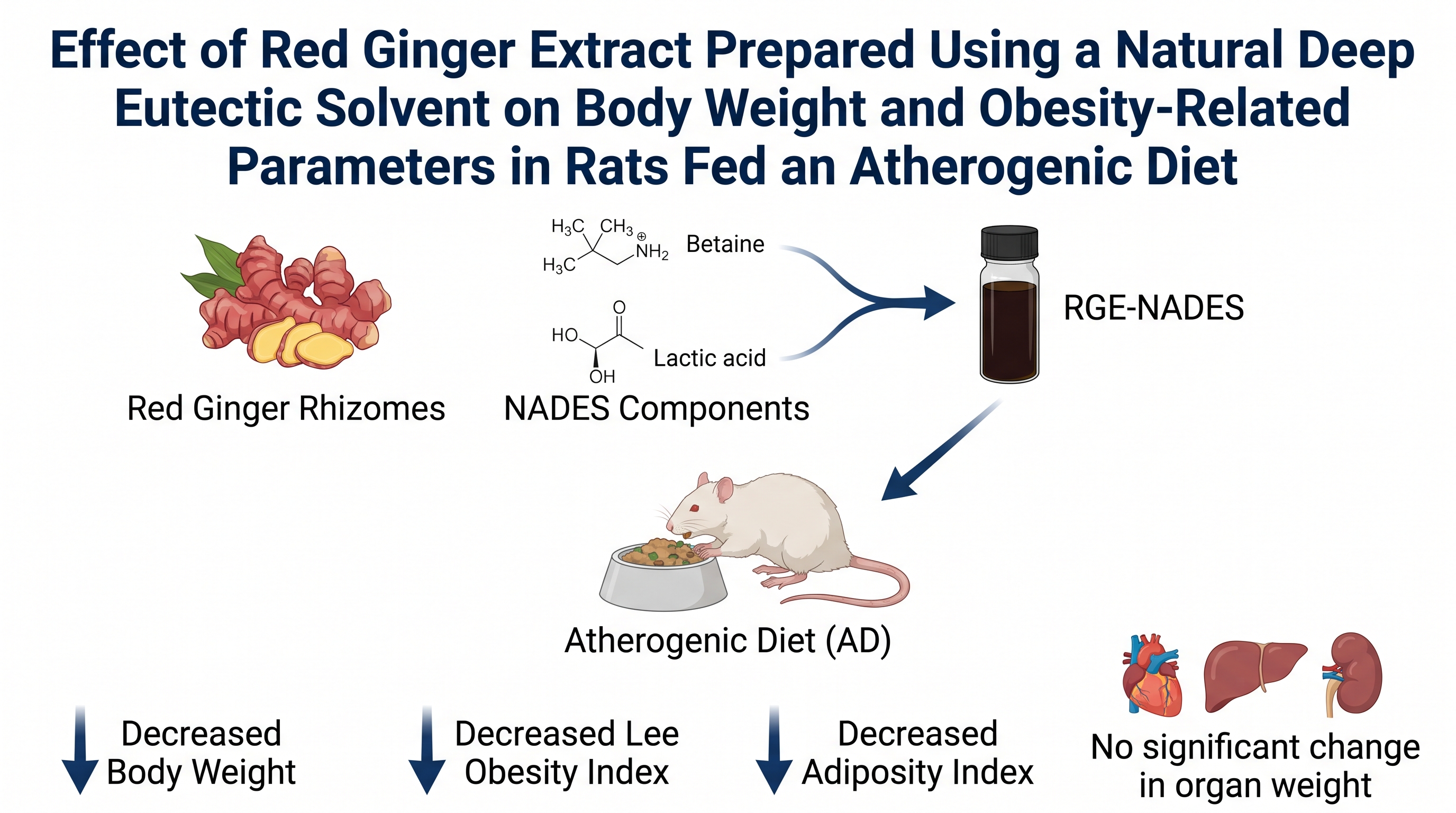
This study evaluated the anti-obesity effects of red ginger (Zingiber officinale var. rubrum) extract prepared using Natural Deep Eutectic Solvents (RGE-NADES) in rats fed an atherogenic diet (AD). Zingiber officinale var. rubrum rhizomes were extracted via ultrasound-assisted extraction using a betaine-lactic acid NADES (1:2 ratio) at a 1:30 solid-to-solvent ratio. Twenty Sprague-Dawley rats were divided into five groups (n = 4): normal control, negative control (AD), orlistat (2.16 mg/kg BW), RGE-NADES 25 mg/kg BW, and RGE-NADES 50 mg/kg BW. Treatments and diets were administered over 14 days, during which body weight, nasoanal length, and food intake were monitored. End-of-study assessments included the Lee obesity index, adiposity index, and relative organ indices. Compared with the negative control group, both RGE-NADES doses significantly reduced body weight and the Lee obesity index (p < 0.05), with decreases of 10.31% (25 mg/kg) and 8.68% (50 mg/kg), respectively. Food intake and adiposity index were also lower in the treatment groups, with a statistically significant reduction in adiposity index observed specifically at 25 mg/kg. Importantly, RGE-NADES administration did not produce significant differences in relative heart, liver, or kidney indices across groups (p > 0.05). Overall, RGE-NADES effectively mitigates body weight gain and obesity indicators in AD-fed rats over a 14-day period without adversely affecting major organ weights.Downloads
References
Ahmed SK, Mohammed RA. Obesity: Prevalence, causes, consequences, management, preventive strategies and future research directions. Metabol Open. 2025;27:100375. DOI: 10.1016/j.metop.2025.100375; PMID: 41041606; PMCID: PMC12486175.
Młynarska E, Bojdo K, Bulicz A, Frankenstein H, Gąsior M, Kustosik N, et al. Obesity as a Multifactorial Chronic Disease: Molecular Mechanisms, Systemic Impact, and Emerging Digital Interventions. Curr Issues Mol Biol. 2025;47(10):787. DOI: 10.3390/cimb47100787; PMID: 41150735; PMCID: PMC12564886.
Lin X, Li H. Obesity: Epidemiology, Pathophysiology, and Therapeutics. Front Endocrinol. 2021;12:706978. DOI: 10.3389/fendo.2021.706978; PMID: 34552557; PMCID: PMC8450866.
Badan Penelitian dan Pengembangan Kesehatan Kementerian Kesehatan Republik Indonesia. Laporan Nasional Riset Kesehatan Dasar (Riskesdas) 2007. Jakarta: Departemen Kesehatan Republik Indonesia; 2008. Available from: http://www.badankebijakan.kemkes.go.id/repositori/id/eprint/4378
Badan Kebijakan Pembangunan Kesehatan, Kementerian Kesehatan Republik Indonesia. Laporan Tematik Survei Kesehatan Indonesia (SKI) Tahun 2023: Potret Indonesia Sehat. Jakarta: Kementerian Kesehatan RI; 2024. Available from: https://www.badankebijakan.kemkes.go.id/hasil-ski-2023/
Zhang S, Kou X, Zhao H, Mak KK, Balijepalli MK, Pichika MR. Zingiber officinale var. rubrum: Red Ginger's Medicinal Uses. Molecules. 2022;27(3):775. DOI: 10.3390/molecules27030775; PMID: 35164040; PMCID: PMC8840670.
Nirvana SJ, Widiyani T, Budiharjo A. Antihypercholesterolemia activities of red ginger extract (Zingiber officinale Roxb. var rubrum) on Wistar rats. IOP Conf Ser Mater Sci Eng. 2020;858(1):012025. DOI: 10.1088/1757-899X/858/1/012025.
Rampengan DDCH, Syahputra RA, Halim P, Kumalawati DA, Ramadhan RN, Surya R, et al. Red ginger confers antioxidant activity, inhibits lipid and sugar metabolic enzymes, and downregulates miR-21/132 expression. J Agric Food Res. 2024;18:101526. DOI: 10.1016/j.jafr.2024.101526.
Yulianita Y, Mun’im A, Yanuar A, Saputri FC. Analysis of gingerol and shogaol compounds from red ginger (Zingiber officinale var. Rubrum) extract using several combinations of natural deep eutectic solvents. Int J Appl Pharm. 2024;16(special 3):51–5. DOI: 10.22159/ijap.2024.v16s3.09.
Shaukat MN, Nazir A, Fallico B. Ginger Bioactives: A Comprehensive Review of Health Benefits and Potential Food Applications. Antioxidants. 2023;12(11):2015. DOI: 10.3390/antiox12112015; PMID: 38001868; PMCID: PMC10669910.
Saravanan G, Ponmurugan P, Deepa MA, Senthilkumar B. Anti-obesity action of gingerol: effect on lipid profile, insulin, leptin, amylase and lipase in male obese rats induced by a high-fat diet. J Sci Food Agric. 2014;94(14):2972-7. DOI: 10.1002/jsfa.6642; PMID: 24615565.
Dugasani S, Pichika MR, Nadarajah VD, Balijepalli MK, Tandra S, Korlakunta JN. Comparative antioxidant and anti-inflammatory effects of [6]-gingerol, [8]-gingerol, [10]-gingerol and [6]-shogaol. J Ethnopharmacol. 2010;127(2):515-20. DOI: 10.1016/j.jep.2009.10.004; PMID: 19833188.
Huang MM, Yiin CL, Lock SSM, Chin BLF, Othman I, Zauzi NSA, et al. Natural deep eutectic solvents (NADES) for sustainable extraction of bioactive compounds from medicinal plants: Recent advances, challenges, and future directions. J Mol Liq. 2025;425:127202. DOI: 10.1016/j.molliq.2025.127202.
Hikmawanti NPE, Ramadon D, Jantan I, Mun'im A. Natural Deep Eutectic Solvents (NADES): Phytochemical Extraction Performance Enhancer for Pharmaceutical and Nutraceutical Product Development. Plants. 2021;10(10):2091. DOI: 10.3390/plants10102091; PMID: 34685899; PMCID: PMC8538609.
Yulianita Y, Rusli Z, Monica HR. Screening and optimization method of natural deep eutectic solvent extracts from Phyllanthus niruri by ultrasonic-assisted extraction. Res J Pharm Technol. 2023;16(11):5213–7. DOI: 10.52711/0974-360X.2023.00845.
Yulianita, Herlina N, Handayani MTR, Al Aziz NM, Safitri A, Pamungkas RR. Cardioprotective effects of red ginger extracted using natural deep eutectic solvent on lipid profile in atherosclerotic rats. J Jamu Indones. 2025;10(3):158–63. DOI: 10.29244/jji.v10i3.410.
Hanani E. Análisis Fitokimia. Jakarta: EGC; 2015.
Dahanayake JM, Perera PK, Galappatty P, Perera HDSM, Arawwawala LDAM. Comparative Phytochemical Analysis and Antioxidant Activities of Tamalakyadi Decoction with Its Modified Dosage Forms. Evid Based Complement Alternat Med. 2019;2019:6037137. DOI: 10.1155/2019/6037137; PMID: 31186663; PMCID: PMC6521515.
Lee MO. Determination of the surface area of the white rat with its application to the expression of metabolic results. Am J Physiol. 1929;89(1):24–33. DOI: 10.1152/ajplegacy.1929.89.1.24.
Arika WM, Kibiti CM, Njagi JM, Ngugi MP. Anti-obesity effects of dichloromethane leaf extract of Gnidia glauca in high fat diet-induced obese rats. Heliyon. 2019;5(11):e02800. DOI: 10.1016/j.heliyon.2019.e02800; PMID: 31844729; PMCID: PMC6895710.
Rahman H, Prambudi SN, Endranaka W. Application of Ultrasonic Assisted Extraction Method for Extraction of 6-Gingerol in Zingiber officinale Var. Rubrum. In: Makul N, ed. Current Overview on Science and Technology Research Vol. 6. Kolkata: Book Publisher International; 2022. p. 71–82. DOI: 10.9734/bpi/costr/v6/8010F.
Srikandi S, Humaeroh M, Sutamihardja R. Kandungan gingerol dan shogaol dari ekstrak jahe merah (Zingiber officinale Roscoe) dengan metode maserasi bertingkat. Al Kimiya J Ilmu Kimia Terapan. 2020;7(2):75–81. DOI: 10.15575/ak.v7i2.6545.
Amin HM, Tawfek NS, El-Hussein BKA, El-Ghany MSA. Anti-obesity potential of orlistat and amphetamine in rats fed on a high-fat diet. Middle East J Appl Sci. 2015;5(2):453-61.
Jodynis-Liebert J, Kujawska M. Biphasic Dose-Response Induced by Phytochemicals: Experimental Evidence. J Clin Med. 2020;9(3):718. DOI: 10.3390/jcm9030718; PMID: 32155852; PMCID: PMC7141213.
Isa Y, Miyakawa Y, Yanagisawa M, Goto T, Kang MS, Kawada T, et al. 6-Shogaol and 6-gingerol, the pungent of ginger, inhibit TNF-alpha mediated downregulation of adiponectin expression via different mechanisms in 3T3-L1 adipocytes. Biochem Biophys Res Commun. 2008;373(3):429-34. DOI: 10.1016/j.bbrc.2008.06.046; PMID: 18577375.
Hong KH, Um MY, Ahn J, Ha TY. 6-Gingerol Ameliorates Adiposity and Inflammation in Adipose Tissue in High Fat Diet-Induced Obese Mice: Association with Regulating of Adipokines. Nutrients. 2023;15(15):3457. DOI: 10.3390/nu15153457; PMID: 37571394; PMCID: PMC10421254.
Suk S, Seo SG, Yu JG, Yang H, Jeong E, Jang YJ, et al. A bioactive constituent of ginger, 6-shogaol, prevents adipogenesis and stimulates lipolysis in 3t3-l1 adipocytes. J Food Biochem. 2016;40(1):84–90. DOI: 10.1111/jfbc.12191.
Crichton M, Davidson AR, Innerarity C, Marx W, Lohning A, Isenring E, et al. Orally consumed ginger and human health: an umbrella review. Am J Clin Nutr. 2022;115(6):1511-27. DOI: 10.1093/ajcn/nqac035; PMID: 35147170; PMCID: PMC9170469.
Suk S, Kwon GT, Lee E, Jang WJ, Yang H, Kim JH, et al. Gingerenone A, a polyphenol present in ginger, suppresses obesity and adipose tissue inflammation in high-fat diet-fed mice. Mol Nutr Food Res. 2017;61(10):10.1002/mnfr.201700139. DOI: 10.1002/mnfr.201700139; PMID: 28556482; PMCID: PMC5947313.
Downloads
Published
Issue
Section
Categories
License
Copyright (c) 2026 Yulianita Yulianita, Nina Herlina, Ragil Raihan Pamungkas, Aditiya Safitri, Novandi Masis Al Aziz, Marybet Tri Retno Handayani

This work is licensed under a Creative Commons Attribution-ShareAlike 4.0 International License.
This work is licensed under a Creative Commons Attribution-ShareAlike 4.0 International License.
Authors continue to retain the copyright to the article if the article is published in the Borneo Journal of Pharmacy. They will also retain the publishing rights to the article without any restrictions.
Authors who publish in this journal agree to the following terms:
- Any article on the copyright is retained by the author(s).
- The author grants the journal the right of first publication with the work simultaneously licensed under a Creative Commons Attribution License that allows others to share work with an acknowledgment of the work authors and initial publications in this journal.
- Authors can enter into separate, additional contractual arrangements for the non-exclusive distribution of published articles (e.g., post-institutional repository) or publish them in a book, with acknowledgment of their initial publication in this journal.
- Authors are permitted and encouraged to post their work online (e.g., in institutional repositories or on their websites) prior to and during the submission process. This can lead to productive exchanges and earlier and greater citations of published work.
- The article and any associated published material are distributed under the Creative Commons Attribution-ShareAlike 4.0 International License.