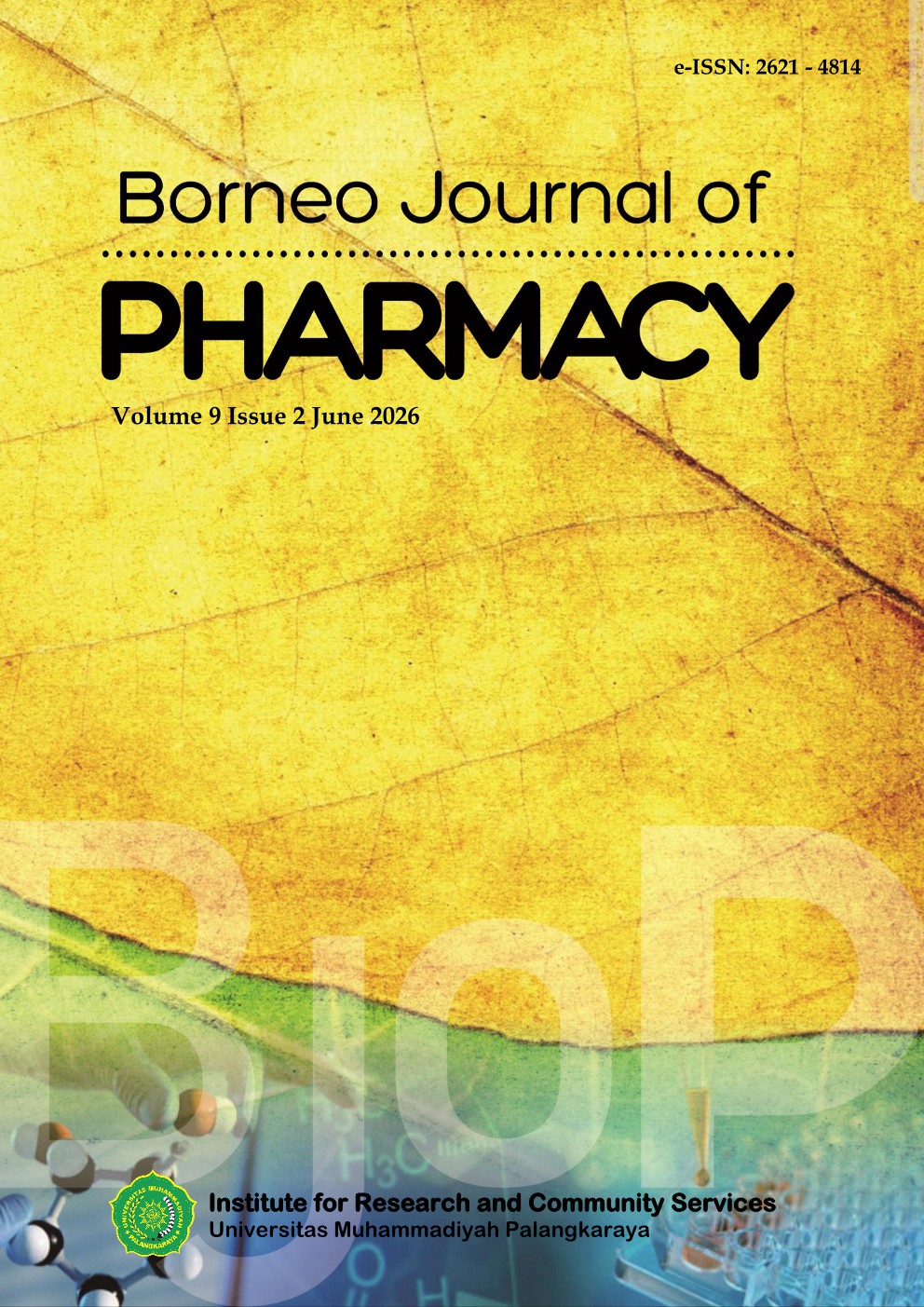
Cover, Content, and Editorial Note from Borneo J Pharm Vol. 9 No. 2 June 2026 Translating Bioactive Chemistry into Clinical Stewardship and Integrative Health Policy

Article Sidebar
-
Borneo Journal of Pharmacy
Abstract
Assalamu'alaikum Wr. Wb.
Alhamdulillahirabbil 'alamin. The next edition of Borneo Journal of Pharmacy (Borneo J Pharm) has been published in June 2026. This edition contains twelve articles spanning: Pharmacology-Toxicology, Pharmaceutical, Analytical Pharmacy-Medicinal Chemistry, Natural Product Development, Clinical-Community Pharmacy, and Pharmaceutical Regulations. This edition includes writings from three countries: Indonesia, Malaysia, and South Korea. The authors come from several institutions, including Universitas Airlangga, Universiti Malaya, Institut Teknologi Bandung, Universitas Pakuan, Universitas Muhammadiyah Banjarmasin, Universitas Palangka Raya, Universitas Bina Bangsa, Universitas Ciputra, Universitas Ahmad Dahlan, Universitas Muhammadiyah Yogyakarta, International Islamic University Malaysia, Universitas Muhammadiyah Surakarta, Universitas Sahid Surakarta, Universiti Teknologi MARA Pahang, Universitas Lambung Mangkurat, University of Science and Technology, Korea Institute of Oriental Medicine, Universitas Wahid Hasyim, Universitas Borneo Lestari, Universitas Surabaya, Universitas STRADA Indonesia, STIKES Dian Husada, Universitas Muhammadiyah Palangkaraya, Universitas Sam Ratulangi, Universitas Gadjah Mada, Indonesian Food and Drug Authority, and Universitas Indonesia.
The articles published in this issue underscore the multidisciplinary nature of contemporary pharmacy, spanning vector control, natural product chemistry, innovative drug delivery systems, advanced computational drug design, clinical pharmacology, rational antibiotic stewardship, and the sociocultural dynamics that shape health policy. Together, these contributions bridge basic laboratory discovery, advanced formulation engineering, clinical practice, and public health integration.
Vector Control, Phytochemistry, and Cytotoxic Screenings
Addressing vector-borne disease control through sustainable botanical alternatives, Herdiansyah et al. evaluated the mosquitocidal potential of Syzygium aromaticum volatile extracts formulated into electric vaporizer mats against Aedes aegypti. Their findings demonstrated that a 1% clove bud extract produced notable mortality with prolonged action (LT50 = 1.468 min; LT90 = 50.543 min). Complementary in silico docking and molecular dynamics simulations revealed that β-caryophyllene and chavicol form stable interactions with odorant-binding protein 1 (AaegOBP1) and pyruvate kinase (PK1), pointing to dual sensory disruption and metabolic interference as mechanisms of action.
In the domain of natural product safety profiling, Nurmala et al. examined Phaleria macrocarpa leaf extracts obtained via sequential maceration and evaluated them using the Brine Shrimp Lethality Test (Artemia salina). Their comparative evaluation revealed a distinct polarity-dependent toxicity gradient: the 70% ethanol extract exhibited moderate toxicity (LC50 = 126.981 ppm), the ethyl acetate extract showed weak toxicity (LC50 = 691.730 ppm), and the n-hexane extract was non-toxic (LC50 = 1416.537 ppm). This highlights how selective multi-stage extraction enriches specific bioactive secondary metabolites for preliminary cytotoxic and pharmacological screenings.
Using chemical synthesis and green chemistry approaches, Rahmawati et al. employed continuous microflow reactor technology to rapidly synthesize cinnamaldehyde and ethyl cinnamate. Microflow processing achieved high chromatographic purity (100% for cinnamaldehyde; 99% for ethyl cinnamate) within a short 10-minute residence time at 70°C. In cytotoxic assays against HeLa, MCF-7, and T47D cancer cell lines, synthesized cinnamaldehyde displayed selective antiproliferative activity, particularly against HeLa cells (IC50 = 95 µg/mL), emphasizing the key role of the conjugated aldehyde pharmacophore.
Advanced Drug Delivery Systems and Biomaterial Innovations
Topical formulation development and wound management represent another key theme in this issue. Sukamdi et al. optimized a hydrogel formulation incorporating Carica papaya leaf extract and Virgin Coconut Oil (VCO). Increasing VCO concentration enhanced matrix viscosity, spreadability, and adhesion duration while lowering the IC50 in DPPH radical-scavenging assays. Formula 5 (containing 9% VCO and 20% extract) demonstrated very strong antioxidant capacity (IC50 = 31.50 µg/mL), establishing a synergistic vehicle for dermatological barrier protection.
Focusing on chronic and diabetic wound healing, Fatimah et al. formulated a 15% Celosia argentea leaf extract hydrogel patch. The formulation exhibited stable physicochemical properties across accelerated freeze-thaw cycles, caused no microvascular irritation in the HET-CAM bioassay, and achieved an 85.60% wound closure rate in diabetic Wistar rats, comparable to that of the standard commercial silver sulfadiazine cream (88.40%).
Concurrently, Prihantini et al. integrated low-molecular-weight chitosan with Ageratum conyzoides ethanolic extract in hydrogel patches designed around the TIME (Tissue, Inflammation, Moisture, Epithelization) clinical framework. Formulation F3 (2:1 extract-to-chitosan ratio) demonstrated high flavonoid content (9.96%), excellent folding endurance (>470 folds), and superior in vivo wound closure kinetics in rat models (97% closure by day 14; t90 = 7.75 days; rate constant k = 0.2972 day-1), following first-order kinetics without an initial lag phase.
Computational Drug Discovery and Neuroprotection
In computational drug discovery, Putra et al. performed an in silico evaluation of 62 phytochemicals from Lagerstroemia speciosa targeting three key antidiabetic enzymes: aldose reductase, glucokinase, and glycogen synthase kinase 3-β (GSK3-β). Molecular docking, 100 ns molecular dynamics simulations, and MM/PBSA binding free energy calculations identified kaempferol as a stable, selective, and drug-like lead candidate for aldose reductase inhibition, supported by high hydrogen-bond occupancy (64.38%) and a balanced electrostatic profile.
Investigating acute central nervous system pathology, Thohari et al. evaluated the neuroprotective effects of thymoquinone (TQ), the active constituent of Nigella sativa, in a Wistar rat model of intracerebral hemorrhage (ICH). Oral TQ administration significantly elevated matrix metalloproteinase-9 (MMP-9) expression (p < 0.001) at day 7 post-insult while suppressing pro-inflammatory cascades (NLRP3, TNF-α, IL-1β) and modulating superoxide dismutase (SOD) activity. The authors highlight a potential phase-dependent dual role for MMP-9, shifting from acute tissue damage toward subacute neurovascular remodeling and extracellular matrix repair.
Clinical Pharmacology and Antimicrobial Stewardship
Transitioning from bench research to clinical application, Primasari et al. evaluated amikacin dosing regimens, pharmacokinetic/pharmacodynamic (PK/PD) parameters (Cmax/MIC ratios), and clinical outcomes among 40 hospitalized patients receiving therapy for Gram-negative infections at a hospital in Yogyakarta. Although 39 of 44 regimens complied with standard dosing guidelines and yielded favorable clinical outcomes in 66.7% of appropriate cases, pharmacokinetic calculations revealed that only 46.2% achieved the target peak plasma concentration (Cmax), and only 11.1% achieved the target Cmax/MIC ratio. These findings emphasize that guideline-concordant empirical dosing often fails to meet optimal PK/PD targets, underscoring the need for Therapeutic Drug Monitoring (TDM) and individualized dosing strategies in Indonesian healthcare settings.
In primary care antibiotic stewardship, Hariyani et al. conducted a quantitative (Defined Daily Dose, DDD) and qualitative (Gyssens algorithm) analysis of antibiotic prescribing for outpatient pneumonia at a health center in Blitar. While total consumption was dominated by first-line amoxicillin (232.42 DDD/1,000 patients/day; 65.82%), qualitative auditing revealed that rational prescribing (Gyssens Category 0) reached only 6.42%. Major prescribing vulnerabilities included pediatric weight-based dosing inaccuracies (Category IIA; 33.94%), suboptimal empirical drug selection (Category IVA; 29.36%), and antibiotic prescribing in cases lacking valid bacterial indications (Category V; 27.52%), underscoring the urgent need for structured audit-and-feedback programs and clinical decision-support tools in primary care.
Social Pharmacy, Health Anthropology, and Policy Integration
Completing the spectrum from bench to bedside and community, two studies examined the integration of traditional medicine into national healthcare systems. Wiyono et al. used a qualitative health anthropology approach to examine community preferences regarding traditional and modern medicine in North Sulawesi. Their decision-making framework revealed that disease severity dictates therapeutic choices: traditional preparations (e.g., jamu, ginger, turmeric) are preferred for mild, self-limiting ailments due to perceived natural safety and cultural tradition, whereas modern biomedicine is prioritized for severe or chronic conditions due to diagnostic precision and clinical proof. Notably, 53.3% of participants practiced concurrent or complementary therapy, reflecting a pragmatic adaptation within a pluralistic health system.
At the macro-policy level, Kashuri and Ikrar evaluated public knowledge, trust, attitudes, and behavioral intentions regarding the integration of Jamu into Indonesia's formal National Health Services (JKN). Utilizing Partial Least Squares Structural Equation Modeling (PLS-SEM) informed by the Theory of Planned Behavior (TPB) among 300 survey participants, the study demonstrated that attitude is the primary direct driver of public behavioral intention (β = 0.837, p < 0.001), with knowledge significantly influencing trust (β = 0.651) and attitude (β = 0.248), and trust further strengthening attitude (β = 0.486). The structural model accounted for 70% of the variance in behavioral intention (R2 = 0.700), demonstrating that successful policy implementation depends not only on regulatory readiness but also on public health literacy and trust building.
The editorial board is fully aware that there is still room for improvement in this edition; hence, with all humility, we are willing to accept constructive suggestions and feedback to improve the publication in future editions. The editorial board would like to thank all editors, reviewers, and contributors of the scientific articles who have provided the repertoire in this issue. We hope that all parties, especially the contributors, will participate again in the publication of the next edition, scheduled for September 2026.
Wassalamu'alaikum Wr. Wb.
Palangka Raya, June 2026
Editor-in-Chief
Full text article
References
Authors
Copyright (c) 2026 Mohammad Rizki Fadhil Pratama

This work is licensed under a Creative Commons Attribution-ShareAlike 4.0 International License.
This work is licensed under a Creative Commons Attribution-ShareAlike 4.0 International License.
Authors continue to retain the copyright to the article if the article is published in the Borneo Journal of Pharmacy. They will also retain the publishing rights to the article without any restrictions.
Authors who publish in this journal agree to the following terms:
- Any article on the copyright is retained by the author(s).
- The author grants the journal the right of first publication with the work simultaneously licensed under a Creative Commons Attribution License that allows others to share work with an acknowledgment of the work authors and initial publications in this journal.
- Authors can enter into separate, additional contractual arrangements for the non-exclusive distribution of published articles (e.g., post-institutional repository) or publish them in a book, with acknowledgment of their initial publication in this journal.
- Authors are permitted and encouraged to post their work online (e.g., in institutional repositories or on their websites) prior to and during the submission process. This can lead to productive exchanges and earlier and greater citations of published work.
- The article and any associated published material are distributed under the Creative Commons Attribution-ShareAlike 4.0 International License.
Article Details