Natural Self-Foaming Clay Soap with Etlingera elatior Fruit Extract for Skincare
DOI:
https://doi.org/10.33084/bjop.v8i2.5800Keywords:
Antioxidant, Etlingera elatior, Cosmetics, Self-Foaming Clay SoapAbstract
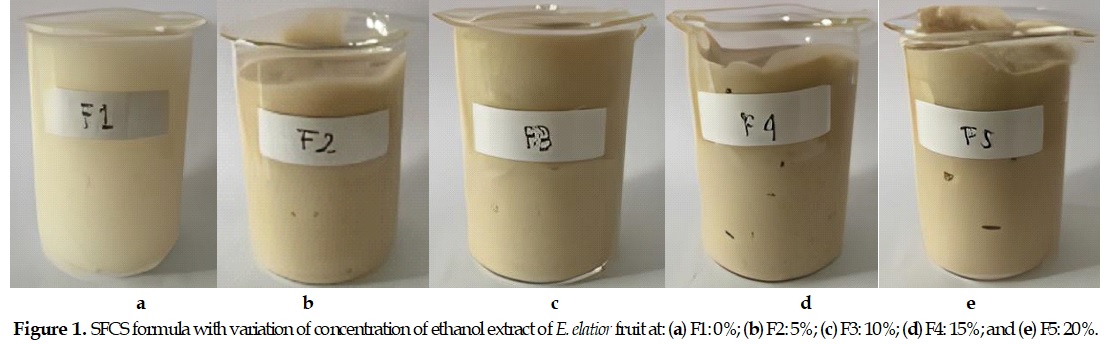
Etlingera elatior (Wualae), a plant recognized for its flavonoid-derived antioxidant properties, presents a potential source for cosmeceutical applications. This study investigated the formulation and evaluation of a Self-Foaming Clay Soap (SFCS) incorporating an ethanol extract of E. elatior fruit. The SFCS base, comprising surfactant as a cleansing and foaming agent combined with bentonite clay for enhanced serviceability and oil adsorption, was formulated with varying concentrations of bentonite (0%, 5%, 10%, 15%, and 20% w/w), designated as FI to FV, respectively, alongside other necessary excipients. The resulting SFCS preparations underwent rigorous physical and chemical stability assessments following accelerated storage conditions (freeze-thaw cycles). Evaluated parameters included organoleptic properties, foam stability and height, viscosity, dispersibility, homogeneity, and pH. The evaluation revealed that Formulation II (FII), containing 5% w/w bentonite, exhibited the most favorable stability profile and met the established criteria for SFCS semisolid preparations. Specifically, FII demonstrated a foam stabilization rate of 84.61% and a foam height of 2.6 cm after freeze-thaw cycling, a viscosity of 10,000 cPs, a spreadability diameter of 4.1 cm, a homogeneous texture devoid of coarse particles, and a skin-compatible pH of 5. These findings suggest that an SFCS formulation incorporating a 5% w/w concentration of bentonite and E. elatior fruit extract holds promising potential as a stable and efficacious skincare preparation.
Downloads
References
Mayangsari E, Mustika A, Nurdiana N, Samad NA. Comparison of UVA vs UVB Photoaging Rat Models in Short-term Exposure. Med Arch. 2024;78(2):88-91. DOI: 10.5455/medarh.2024.78.88-91; PMCID: PMC10983087; PMID: 38566862
Wong QYA, Chew FT. Defining skin aging and its risk factors: a systematic review and meta-analysis. Sci Rep. 2021;11(1):22075. DOI: 10.1038/s41598-021-01573-z; PMCID: PMC8586245; PMID: 34764376
Ihekweme GO, Shondo JN, Orisekeh KI, Kalu-Uka GM, Nwuzor IC, Onwualu AP. Characterization of certain Nigerian clay minerals for water purification and other industrial applications. Heliyon. 2020;6(4):e03783. DOI: 10.1016/j.heliyon.2020.e03783; PMCID: PMC7182682; PMID: 32346634
Otunola BO, Ololade OO. A review on the application of clay minerals as heavy metal adsorbents for remediation purposes. 2020;18:100692. DOI: 10.1016/j.eti.2020.100692
Pizzino G, Irrera N, Cucinotta M, Pallio G, Mannino F, Arcoraci V, et al. Oxidative Stress: Harms and Benefits for Human Health. Oxid Med Cell Longev. 2017;2017:8416763. DOI: 10.1155/2017/8416763; PMCID: PMC5551541; PMID: 28819546
Maury GL, Rodríguez DM, Hendrix S, Arranz JCE, Boix YF, Pacheco AO, et al. Antioxidants in Plants: A Valorization Potential Emphasizing the Need for the Conservation of Plant Biodiversity in Cuba. Antioxidants. 2020;9(11):1048. DOI: 10.3390/antiox9111048; PMCID: PMC7693031; PMID: 33121046
Leorita M, Mardikasari SA, Wahyuni, Malaka MH, Sartinah A, Sahidin. Aktivitas Antioksidan dan Toksisitas Akut Ekstrak Etanol Buah, Daun, Batang dan Rimpang Tanaman Wualae (Etlingera elatior (Jack) R.M. Smith). Pharmauho. 2018;4(2):36–9. DOI: 10.33772/pharmauho.v4i2.6263
Jabbar A, Wahyuni, Malaka MH, Apriliani. Aktivitas Antioksidan Ekstrak Etanol Buah, Daun, Batang Dan Rimpang Pada Tanaman Wualae (Etlingera Elatior (Jack) RM Smith). J Farmasi Galenika Galenika J Pharm. 2019;5(2):189–97. DOI: 10.22487/j24428744.2019.v5.i2.13671
Zawawi NA, Ahmad H, Madatheri R, Fadilah NIM, Maarof M, Fauzi MB. Flavonoids as Natural Anti-Inflammatory Agents in the Atopic Dermatitis Treatment. Pharmaceutics. 2025;17(2):261. DOI: 10.3390/pharmaceutics17020261; PMCID: PMC11859288; PMID: 40006628
Khan MK, Paniwnyk L, Hassan S. Polyphenols as Natural Antioxidants: Sources, Extraction and Applications in Food, Cosmetics and Drugs. In: Li Y, Chemat F, Editors. Plant Based “Green Chemistry 2.0”. Singapore: Springer; 2019. p. 197-235. DOI: 10.1007/978-981-13-3810-6_8
Mijaljica D, Spada F, Harrison IP. Skin Cleansing without or with Compromise: Soaps and Syndets. Molecules. 2022;27(6):2010. DOI: 10.3390/molecules27062010; PMCID: PMC8954092; PMID: 35335373
Mukhopadhyay P. Cleansers and their role in various dermatological disorders. Indian J Dermatol. 2011;56(1):2-6. DOI: 10.4103/0019-5154.77542; PMCID: PMC3088928; PMID: 21572782
Ananthapadmanabhan KP, Moore DJ, Subramanyan K, Misra M, Meyer F. Cleansing without compromise: the impact of cleansers on the skin barrier and the technology of mild cleansing. Dermatol Ther. 2004;17(Suppl 1):16-25. DOI: 10.1111/j.1396-0296.2004.04s1002.x; PMID: 14728695
Safrina U, Wardiyah, Cartika H. Evaluation of total flavonoid, total phenolic, and antioxidant activity of Etlingera elatior (Jack) RM Sm flower, fruit, and leaf. Majalah Obat Trad. 2022;27(1):51–9. DOI: 10.22146/mot.72210
Tazberik E, Shah S, inventors. Neutrogena LLC, assignee. Foaming clay cleanser composition. Canadian Patent CA2431529A1. 2003-12-10.
Leal GC, da Costa IM, da Silva JB, dos Santos RS, Bruschi ML, de Mello JCP, et al. Development, characterization, and evaluation by cutaneous bioengineering of a natural emulsion, to provide a standardized vehicle base for topical compounded preparations. Res Soc Dev. 2022;11(16):e509111638290. DOI: 10.33448/rsd-v11i16.38290
Goon P, Bhirud RG, Kumar VV. Detergency and foam studies on linear alkylbenzene sulfonate and secondary alkyl sulfonate. J Surfact Deterg. 1999;2:489–93. DOI: 10.1007/s11743-999-0097-0
Pryazhnikov MI, Yakimov AS, Denisov IA, Pryazhnikov AI, Minakov AV, Belobrov PI. Fluid Viscosity Measurement by Means of Secondary Flow in a Curved Channel. Micromachines. 2022;13(9):1452. DOI: 10.3390/mi13091452; PMCID: PMC9502554; PMID: 36144075
Garg A, Aggarwal D, Garg S, Singla AK. Spreading of Semisolid Formulations: An Update. Pharm Technol. 2002;26(9):84-105.
Syaman HP, Unnikrishnan BS, Sreekutty J, Archana MG, Preethi GU, Reshma PL, et al. Polysaccharide-capped silver nanoparticles impregnated cream for the efficient management of wound healing. RSC Pharm. 2025;2(3):570-80. DOI: 10.1039/d4pm00274a
Alam P, Imran M, Jahan S, Akhtar A, Hasan Z. Formulation and Characterization of Hesperidin-Loaded Transethosomal Gel for Dermal Delivery to Enhance Antibacterial Activity: Comprehension of In Vitro, Ex Vivo, and Dermatokinetic Analysis. Gels. 2023;9(10):791. DOI: 10.3390/gels9100791; PMCID: PMC10606654; PMID: 37888364
Bartram J, Balance R, editors. Water quality monitoring: a practical guide to the design and implementation of freshwater quality studies and monitoring programmes. London: Chapman and Hall; 1996.
Krystyjan M, Dobosz-Kobędza A, Sikora M, Baranowska HM. Influence of Xanthan Gum Addition on the Short- and Long-Term Retrogradation of Corn Starches of Various Amylose Content. Polymers. 2022;14(3):452. DOI: 10.3390/polym14030452; PMCID: PMC8839150; PMID: 35160442
Benalaya I, Alves G, Lopes J, Silva LR. A Review of Natural Polysaccharides: Sources, Characteristics, Properties, Food, and Pharmaceutical Applications. Int J Mol Sci. 2024;25(2):1322. DOI: 10.3390/ijms25021322; PMCID: PMC10816883; PMID: 38279323
Misra A, Shahiwala A, editors. Applications of Polymers in Drug Delivery. 2nd edition. Amsterdam: Elsevier; 2021.
Kamal MS. A Novel Approach to Stabilize Foam Using Fluorinated Surfactants. Energies. 2019;12(6):1163. DOI: 10.3390/en12061163
Nova JF, Smrity SZ, Hasan M, Tariquzzaman M, Hossain MAA, Islam MT, et al. Comprehensive evaluation of physico-chemical, antioxidant, and antimicrobial properties in commercial soaps: A study on bar soaps and liquid hand wash. Heliyon. 2025;11(4):e41614. DOI: 10.1016/j.heliyon.2024.e41614; PMCID: PMC11867263; PMID: 40028542
Pratama CM, Desmayanti A, Marchaban, Rohman A. Optimization of Liquid Soap Containing Bentonite and Combination of Corn Oil and Virgin Coconut Oil for Cleansing Najs Mughalladzah. J Food Pharm Sci. 2020;8(1):184-92. DOI: 10.22146/jfps.640
Kumar A, Patham B, Mohanty S, Nayak SK. Polyolefinic nanocomposite foams: Review of microstructure-property relationships, applications, and processing considerations. J Cell Plast. 2020;58(1):59-102. DOI: 10.1177/0021955X20979752
Rowe RC, Sheskey PJ, Quinn ME. Handbook of Pharmaceutical Excipients. 6th edition. London; Pharmaceutical Press; 2009.
Downloads
Published
Issue
Section
Categories
License
Copyright (c) 2025 Vica Aspadiah, Wa Ode Sitti Zubaydah, Astrid Indalifiany, Sahidin Sahidin, Adryan Fristiohady, Muhammad Hajrul Malaka, Rahmat Muliadi, Arsyani Parrung

This work is licensed under a Creative Commons Attribution-ShareAlike 4.0 International License.
This work is licensed under a Creative Commons Attribution-ShareAlike 4.0 International License.
Authors continue to retain the copyright to the article if the article is published in the Borneo Journal of Pharmacy. They will also retain the publishing rights to the article without any restrictions.
Authors who publish in this journal agree to the following terms:
- Any article on the copyright is retained by the author(s).
- The author grants the journal the right of first publication with the work simultaneously licensed under a Creative Commons Attribution License that allows others to share work with an acknowledgment of the work authors and initial publications in this journal.
- Authors can enter into separate, additional contractual arrangements for the non-exclusive distribution of published articles (e.g., post-institutional repository) or publish them in a book, with acknowledgment of their initial publication in this journal.
- Authors are permitted and encouraged to post their work online (e.g., in institutional repositories or on their websites) prior to and during the submission process. This can lead to productive exchanges and earlier and greater citations of published work.
- The article and any associated published material are distributed under the Creative Commons Attribution-ShareAlike 4.0 International License.