Thiourea Derivatives as Estrogen Receptor Alpha Inhibitors for Breast Cancer Therapy: An In Silico Evaluation with ADMET Prediction and Molecular Docking
DOI:
https://doi.org/10.33084/bjop.v7i3.7396Keywords:
Breast cancer, Estrogen receptor alpha, Thiourea derivatives, ADMET prediction, Molecular dockingAbstract
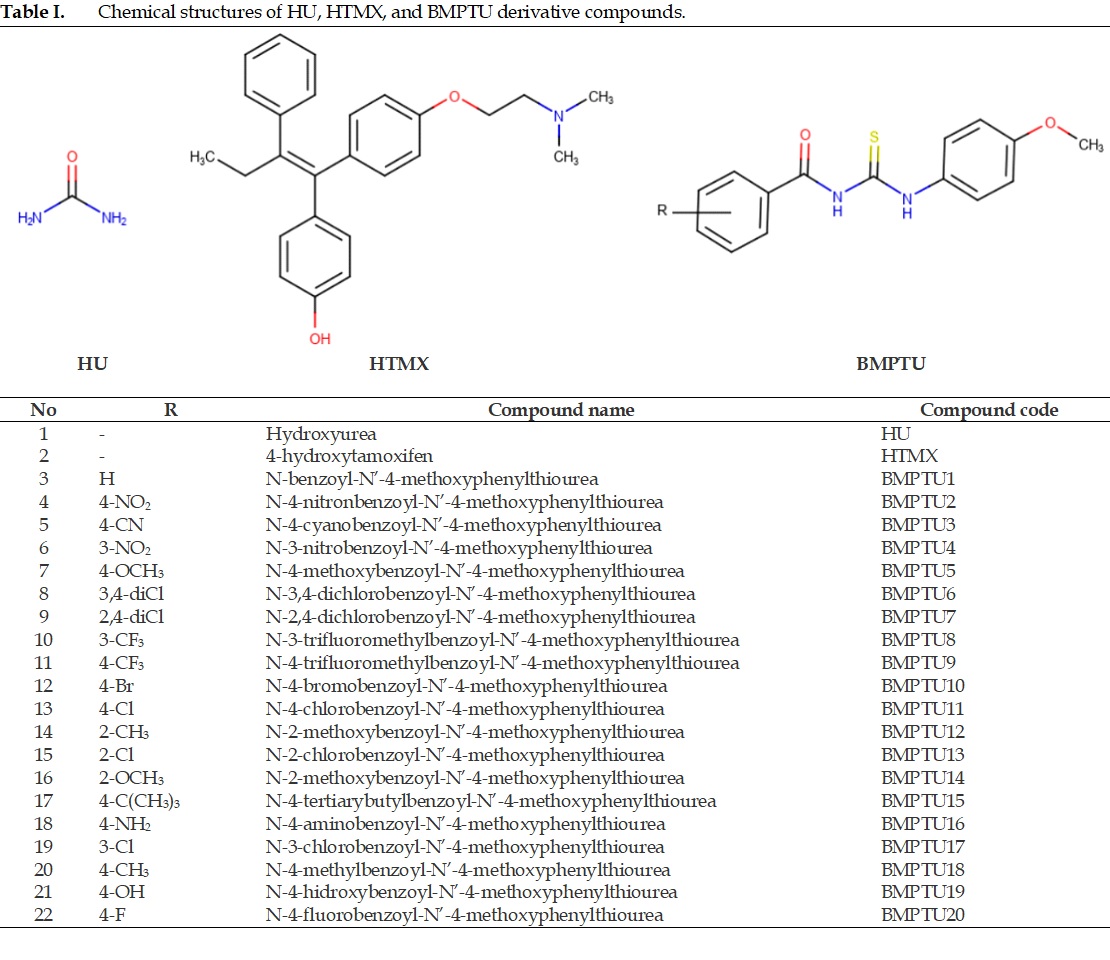
Breast cancer remains a significant public health concern, necessitating the discovery of novel therapeutic agents. This study investigates the potential of thiourea derivatives, specifically HU, HTMX, and BMPTU compounds, as estrogen receptor alpha (ERα) inhibitors using computational approaches. Drug-likeness assessments using Lipinski's Ro5 confirmed the oral bioavailability of all compounds. Additionally, ADMET analysis indicated favorable pharmacokinetic properties, with minimal metabolic interactions and acceptable safety profiles, except for BMPTU2, which showed potential hepatotoxicity. Molecular docking simulations revealed strong binding affinities between BMPTU derivatives, particularly BMPTU2, BMPTU3, and BMPTU4, and key ERα residues. These interactions suggest their potential as ERα modulators, warranting further in silico and experimental validation. In conclusion, the findings highlight the potential of BMPTU derivatives, especially BMPTU2, BMPTU3, and BMPTU4, as promising lead compounds for developing novel ERα-targeted breast cancer therapies. Further optimization and validation are crucial to fully elucidate their therapeutic potential.
Downloads
References
Basu P, Zhang L, Hariprasad R, Carvalho A, Barchuk A. A pragmatic approach to tackle the rising burden of breast cancer through prevention & early detection in countries 'in transition'. Indian J Med Res. 2020;152(4):343-55. DOI: 10.4103/ijmr.ijmr_1868_19; PMCID: PMC8061594; PMID: 33380699
Liu YP, Zheng CC, Huang YN, He ML, Xu WW, Li B. Molecular mechanisms of chemo- and radiotherapy resistance and the potential implications for cancer treatment. MedComm. 2021;2(3):315–40. DOI: 10.1002/mco2.55; PMCID: PMC8554658; PMID: 34766149
Kemp JA, Shim MS, Heo CY, Kwon YJ. "Combo" nanomedicine: Co-delivery of multi-modal therapeutics for efficient, targeted, and safe cancer therapy. Adv Drug Deliv Rev. 2016;98:3–18. DOI: 10.1016/j.addr.2015.10.019; PMID: 26546465
Naeem M, Iqbal MO, Khan H, Ahmed MM, Farooq M, Aadil MM, et al. A Review of Twenty Years of Research on the Regulation of Signaling Pathways by Natural Products in Breast Cancer. Molecules. 2022;27(11):3412. DOI: 10.3390/molecules27113412; PMCID: PMC9182524; PMID: 35684353
Budiati T, Hardjono S, Sulistyowaty MI. Synthesis and molecular docking study of 4-chlorophenylquinazoline-4-[3h]-one derivatives as COX-2 inhibitor. Int J Pharm Clin Res. 2016;8(12):1605–9.
Widiandani T, Meiyanto E, Sulistyowaty MI, Purwanto BT, Hardjono S. New N-allylthiourea derivatives: Synthesis, molecular docking and in vitro cytotoxicity studies. Trop J Pharm Res. 2018;17(8):1607–13. DOI: 10.4314/tjpr.v17i8.20
Purwanto BT, Kesuma D, Widiandani T, Siswanto I. Molecular modeling, admet prediction, synthesis and the cytotoxic activity from the novel n-(4-tert-butylphenylcarbamoyl) benzamide against hela. Rasayan J Chem. 2021;14(2):1341–50. DOI: 10.31788/RJC.2021.1426196
Kesuma D, Siswandono, Kirtishanti A. Molecular Docking and Biological Activity of N-(4-Methoxy)-Benzoyl-N’-Phenylthiourea and N-(4-Trifluoro)-Benzoyl-N’-Phenylthiourea as Anti-Breast Cancer Candidates. Rasayan J Chem. 2022;15(2):1503–8. DOI: 10.31788/RJC.2022.1526836
Strzyga-Lach P, Chrzanowska A, Podsadni K, Bielenica A. Investigation of the mechanisms of cytotoxic activity of 1,3-disubstituted thiourea derivatives. Pharmaceuticals. 2021;14(11):1097. DOI: 10.3390/ph14111097; PMCID: PMC8623398; PMID: 34832881
Abbas SY, Al-Harbi RAK, El-Sharief MAMS. Synthesis and anticancer activity of thiourea derivatives bearing a benzodioxole moiety with EGFR inhibitory activity, apoptosis assay and molecular docking study. Eur J Med Chem. 2020;198:112363. DOI: 10.1016/j.ejmech.2020.112363; PMID: 32361329
Almeida CF, Oliveira A, Ramos MJ, Fernandes PA, Teixeira N, Amaral C. Estrogen receptor-positive (ER+) breast cancer treatment: Are multi-target compounds the next promising approach? Biochem Pharmacol. 2020;177:113989. DOI: 10.1016/j.bcp.2020.113989; PMID: 32330493
Liu Y, Ma H, Yao J. ERα, a key target for cancer therapy: A review. Onco Targets Ther. 2020;13:2183–91. DOI: 10.2147/ott.s236532; PMCID: PMC7073439; PMID: 32210584
Saha T, Makar S, Swetha R, Gutti G, Singh SK. Estrogen signaling: An emanating therapeutic target for breast cancer treatment. Eur J Med Chem. 2019;177:116–43. DOI: 10.1016/j.ejmech.2019.05.023; PMID: 31129450
Zou H. Abstract 2090: Targeting estrogen receptor negative breast cancer cells using diarylthiourea analogs of SHetA2. Cancer Res. 2017;77(Suppl 13):2090. DOI: 10.1158/1538-7445.AM2017-2090
Kesuma D, Makayasa CHA, Suhud F, Yuniarta TA, Sumartha IGA, Risthanti RR, et al. Structure Modification: Effect of Lipophilic, Electronic, and Steric Parameters of N-Benzoyl-N’-Phenylthiourea Compounds on Antiviral Activity of Covid-19 by In Silico. Rasayan J Chem. 2022;15(2):1445–9. DOI: 10.31788/RJC.2022.1526809
Lin X, Li X, Lin X. A review on applications of computational methods in drug screening and design. Molecules. 2020;25(6):1375. DOI: 10.3390/molecules25061375; PMCID: PMC7144386; PMID: 32197324
Shaker B, Ahmad S, Lee J, Jung C, Na D. In silico methods and tools for drug discovery. Comput Biol Med. 2021;137:104851. DOI: 10.1016/j.compbiomed.2021.104851; PMID: 34520990
de Souza Neto LR, Moreira-Filho JT, Neves BJ, Maidana RLBR, Guimarães ACR, Furnham N, et al. In silico Strategies to Support Fragment-to-Lead Optimization in Drug Discovery. Front Chem. 2020;8:93. DOI: 10.3389/fchem.2020.00093; PMCID: PMC7040036; PMID: 32133344
Du J, Guo J, Kang D, Li Z, Wang G, Wu J, et al. New techniques and strategies in drug discovery. Chinese Chem Lett. 2020;31(7):1695–708. DOI: 10.1016/j.cclet.2020.03.028
Chang Y, Hawkins BA, Du JJ, Groundwater PW, Hibbs DE, Lai F. A Guide to In Silico Drug Design. Pharmaceutics. 2023;15(1):49. DOI: 10.3390/pharmaceutics15010049; PMCID: PMC9867171; PMID: 36678678
Shiau AK, Barstad D, Loria PM, Cheng L, Kushner PJ, Agard DA, et al. The structural basis of estrogen receptor/coactivator recognition and the antagonism of this interaction by tamoxifen. Cell. 1998;95(7):927–37. DOI: 10.1016/s0092-8674(00)81717-1; PMID: 9875847
Muchtaridi M, Dermawan D, Yusuf M. Molecular docking, 3D structure-based pharmacophore modeling, and ADME prediction of alpha mangostin and its derivatives against estrogen receptor alpha. J Young Pharm. 2018;10(3):252–9. DOI: 10.5530/jyp.2018.10.58
Purwanto BT, Hardjono S, Widiandani T, Nasyanka AL, Siswanto I. In Silico Study and ADMET prediction of N-(4-fluorophenylcarbamothioyl) Benzamide Derivatives as Cytotoxic Agents. J Hunan Univ Nat Sci. 2021;48(2):78–85.
Khoirunnisa A, Jamil AS, Muchlisin MA. Analisis Keterkaitan Network Phamacology Senyawa Metabolit Sekunder Abrus precatorius L. secara In Silico. J Penelitian Farm Herb. 2024;6(2):15–22. DOI: 10.36656/jpfh.v6i2.1686
Datta J, Willingham N, Manouchehri JM, Schnell P, Sheth M, David JJ, et al. Activity of Estrogen Receptor β Agonists in Therapy-Resistant Estrogen Receptor-Positive Breast Cancer. Front Oncol. 2022;12:857590. DOI: 10.3389/fonc.2022.857590; PMCID: PMC9097292; PMID: 35574319
Agoni C, Olotu FA, Ramharack P, Soliman ME. Druggability and drug-likeness concepts in drug design: are biomodelling and predictive tools having their say? J Mol Model. 2020;26(6):120. DOI: 10.1007/s00894-020-04385-6
Lipinski CA. Rule of five in 2015 and beyond: Target and ligand structural limitations, ligand chemistry structure and drug discovery project decisions. Adv Drug Deliv Rev. 2016;101:34–41. DOI: 10.1016/j.addr.2016.04.029; PMID: 27154268
Ruswanto R, Mardianingrum R, Siswandono S, Kesuma D. Reverse Docking, Molecular Docking, Absorption, Distribution, and Toxicity Prediction of Artemisinin as an Anti-diabetic Candidate. Molekul. 2020;15(2):88–96. DOI: 10.20884/1.jm.2020.15.2.579
Lee K, Jang J, Seo S, Lim J, Kim WY. Drug-likeness scoring based on unsupervised learning. Chem Sci. 2022;13(2):554–65. DOI: 10.1039/d1sc05248a; PMCID: PMC8729801; PMID: 35126987
Kesuma D, Siswandono S, Purwanto BT, Hardjono S. Uji in silico Aktivitas Sitotoksik dan Toksisitas Senyawa Turunan N-(Benzoil)-N’- feniltiourea Sebagai Calon Obat Antikanker. J Pharm Sci Clin Res. 2018;3(1):1-11. DOI: 10.20961/jpscr.v3i1.16266
Durán-Iturbide NA, Díaz-Eufracio BI, Medina-Franco JL. In Silico ADME/Tox Profiling of Natural Products: A Focus on BIOFACQUIM. ACS Omega. 2020;5(26):16076–84. DOI: 10.1021/acsomega.0c01581; PMCID: PMC7346235; PMID: 32656429
Ahmad I, Kuznetsov AE, Pirzada AS, Alsharif KF, Daglia M, Khan H. Computational pharmacology and computational chemistry of 4-hydroxyisoleucine: Physicochemical, pharmacokinetic, and DFT-based approaches. Front Chem. 2023;11:1145974. DOI: 10.3389/fchem.2023.1145974; PMCID: PMC10133580; PMID: 37123881
Liu H, Dong K, Zhang W, Summerfield SG, Terstappen GC. Prediction of brain:blood unbound concentration ratios in CNS drug discovery employing in silico and in vitro model systems. Drug Discov Today. 2018;23(7):1357–72. DOI: 10.1016/j.drudis.2018.03.002; PMID: 29548981
Bahar MA, Setiawan D, Hak E, Wilffert B. Pharmacogenetics of drug-drug interaction and drug-drug-gene interaction: A systematic review on CYP2C9, CYP2C19 and CYP2D6. Pharmacogenomics. 2017;18(7):701–39. DOI: 10.2217/pgs-2017-0194; PMID: 28480783
Cheung KWK, Hsueh CH, Zhao P, Meyer TW, Zhang L, Huang SM, et al. The Effect of Uremic Solutes on the Organic Cation Transporter 2. J Pharm Sci. 2017;106(9):2551–7. DOI: 10.1016/j.xphs.2017.04.076; PMID: 28483424
Pires DEV, Blundell TL, Ascher DB. pkCSM: Predicting small-molecule pharmacokinetic and toxicity properties using graph-based signatures. J Med Chem. 2015;58(9):4066–72. DOI: 10.1021/acs.jmedchem.5b00104; PMCID: PMC4434528; PMID: 25860834
Muchlisin MA, Firdausiyah W, Astuti EJ, Rafikayanti A. Prediksi Bioavailabilitas dan Interaksi Senyawa Metabolit Sekunder Buah Plum (Prunus domestica) terhadap HMG-CoA Reduktase secara In Silico. J Pharmacopolium. 2022;5(1):1–8. DOI: 10.36465/jop.v5i1.875
Purwanto BT, Siswandono, Hardjono S, Widiandani T. Rational Design, Synthesis and Cytotoxic Activity of N-(Phenylcarbamoyl)Benzamide on HeLa Cell Lines. J Math Fundam Sci. 2020;52(2):174–88. DOI: 10.5614/j.math.fund.sci.2020.52.2.3
Chen D, Oezguen N, Urvil P, Ferguson C, Dann SM, Savidge TC. Regulation of protein-ligand binding affinity by hydrogen bond pairing. Sci Adv. 2016;2(3):e1501240. DOI: 10.1126/sciadv.1501240; PMCID: PMC4820369; PMID: 27051863
Biason-Lauber A, Lang-Muritano M. Estrogens: Two nuclear receptors, multiple possibilities. Mol Cell Endocrinol. 2022;554:111710. DOI: 10.1016/j.mce.2022.111710; PMID: 35787463
Ma’arif B, Mirza DM, Suryadinata A, Muchlisin MA, Agil M. Metabolite Profiling of 96% Ethanol Extract from Marsilea crenata Presl. Leaves Using UPLC-QToF-MS/MS and Anti-Neuroinflammatory Predicition Activity with Molecular Docking Burhan. J Trop Pharm Chem. 2019;4(6):261–70. DOI: 10.25026/jtpc.v4i6.213
Sinyani A, Idowu K, Shunmugam L, Kumalo HM, Khan R. A molecular dynamics perspective into estrogen receptor inhibition by selective flavonoids as alternative therapeutic options. J Biomol Struct Dyn. 2023;41(9):4093-105. DOI: 10.1080/07391102.2022.2062786; PMID: 35477414
Downloads
Published
Issue
Section
Categories
License
Copyright (c) 2024 Hestining Puspaweni, Bambang Tri Purwanto, Tri Widiandani, Siswandono Siswodihardjo, M. Artabah Muchlisin

This work is licensed under a Creative Commons Attribution-ShareAlike 4.0 International License.
This work is licensed under a Creative Commons Attribution-ShareAlike 4.0 International License.
Authors continue to retain the copyright to the article if the article is published in the Borneo Journal of Pharmacy. They will also retain the publishing rights to the article without any restrictions.
Authors who publish in this journal agree to the following terms:
- Any article on the copyright is retained by the author(s).
- The author grants the journal the right of first publication with the work simultaneously licensed under a Creative Commons Attribution License that allows others to share work with an acknowledgment of the work authors and initial publications in this journal.
- Authors can enter into separate, additional contractual arrangements for the non-exclusive distribution of published articles (e.g., post-institutional repository) or publish them in a book, with acknowledgment of their initial publication in this journal.
- Authors are permitted and encouraged to post their work online (e.g., in institutional repositories or on their websites) prior to and during the submission process. This can lead to productive exchanges and earlier and greater citations of published work.
- The article and any associated published material are distributed under the Creative Commons Attribution-ShareAlike 4.0 International License.