Enhanced Antioxidant Gel Formulation with Papaya Leaf Extract and Virgin Coconut Oil: Optimization Approach

Article Sidebar
-
Gel, Papaya Leaf Extract, Virgin Coconut Oil, Antioxidant
Abstract
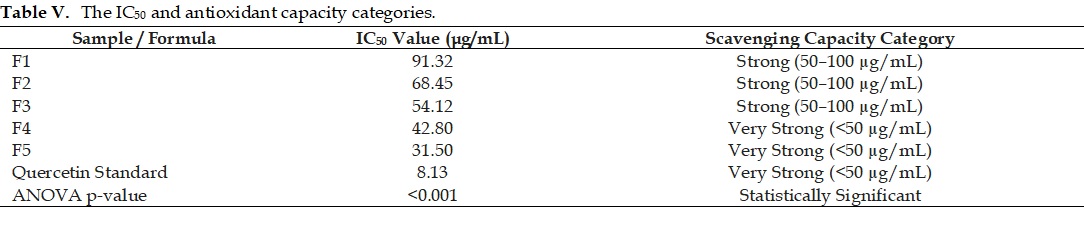
Redness, pigmentation, premature aging, xerosis, and even the risk of cancer can result from excessive exposure to free radicals in the form of ultraviolet (UV) radiation, which can cause skin damage. Antioxidants, including β-carotene, α-tocopherol, ascorbic acid, and flavonoids, are present in papaya (Carica papaya) leaves and Virgin Coconut Oil (VCO). Therefore, these two components may mitigate skin imperfections caused by premature aging. This study aims to formulate and determine the antioxidant activity contained in C. papaya leaf extract gel and VCO. A laboratory-based experimental approach was implemented in this study. Using the infusion method, C. papaya leaves were extracted for 15 minutes to initiate the gel formation. The C. papaya leaf extract gel with VCO was divided into five formulations, with varying amounts of each ingredient. Organoleptic, homogeneity, viscosity, pH, spreadability, and antioxidant activity tests, conducted using the DPPH method, are included in the preparation testing process. The antioxidant activity test of C. papaya leaf extract gel with VCO in each formula yielded values of 91.32 ppm, 121.21 ppm, 80.19 ppm, 67.04 ppm, and 55.31 ppm, respectively. The results indicated that the quality of the gel preparation and the IC50 value of the C. papaya leaf extract gel were influenced by variations in VCO concentration.
Full text article
References
2. Jiang N, Quan T, Li R, Chen Y, Gao T. Role of Nutritional Elements in Skin Homeostasis: A Review. Biomolecules. 2025;15(6):808. DOI: 10.3390/biom15060808; PMID: 40563448; PMCID: PMC12190690.
3. Addor FAS. Antioxidants in dermatology. An Bras Dermatol. 2017;92(3):356-62. DOI: 10.1590/abd1806-4841.20175697; PMID: 29186248; PMCID: PMC5514576.
4. Jeon YA, Natraj P, Park JY, Kim SC, Park CS, Lee YJ. Neuroprotective and antioxidant potential of papaya leaf extract and its active compounds via Nrf-2 activation. Food Sci Biotechnol. 2025;34(11):2611-23. DOI: 10.1007/s10068-025-01873-4; PMID: 40492051; PMCID: PMC12145406.
5. Himaniarwati H, Lolok N, Nasir NH, Chulaifah D. Optimasi Sediaan Krim Dari Ekstrak Etanol Daun Muda Pepaya (Carica papaya L.) Sebagai Antioksidan. J Mandala Pharmacon Indones. 2019;5(1):1–9. DOI: 10.35311/jmpi.v5i01.32.
6. Slavkova M, Tzankov B, Popova T, Voycheva C. Gel Formulations for Topical Treatment of Skin Cancer: A Review. Gels. 2023;9(5):352. DOI: 10.3390/gels9050352; PMID: 37232944; PMCID: PMC10216957.
7. Kawee-Ai A. Advancing Gel Systems with Natural Extracts: Antioxidant, Antimicrobial Applications, and Sustainable Innovations. Gels. 2025;11(2):125. DOI: 10.3390/gels11020125; PMID: 39996668; PMCID: PMC11855317.
8. Varma SR, Sivaprakasam TO, Arumugam I, Dilip N, Raghuraman M, Pavan KB, et al. In vitro anti-inflammatory and skin protective properties of Virgin coconut oil. J Tradit Complement Med. 2018;9(1):5-14. DOI: 10.1016/j.jtcme.2017.06.012; PMID: 30671361; PMCID: PMC6335493.
9. Hariyadi DM, Fitri A, Sudarma S, Purwanti T, Erawati T. Optimization of microspheres containing virgin coconut oil and hydrolyzed virgin coconut oil as antimicrobial. J Adv Pharm Technol Res. 2022;13(3):238-42. DOI: 10.4103/japtr.japtr_99_22; PMID: 35935685; PMCID: PMC9355055.
10. Harimurti S, Susanawati, Sukamdi DP, Krisridwany A, Widada H, Nadhifa N, et al. Green Technology on the Virgin Coconut Oil Production Using Enzyme from Pineapple Waste. Indones J Pharm. 2022;33(3):412-21. DOI: 10.22146/ijp.1133.
11. Romelli HQ, Darsono FL, Soegianto L. Formulasi Sediaan Antijerawat Ekstrak Daun Pepaya (Carica papaya L.) dalam Bentuk Gel. J Farmasi Sains Terapan J Pharm Sci Pract. 2020;7(1):43-54. DOI: 10.33508/jfst.v7i1.2395.
12. Dantas MG, Reis SA, Damasceno CM, Rolim LA, Rolim-Neto PJ, Carvalho FO, et al. Development and Evaluation of Stability of a Gel Formulation Containing the Monoterpene Borneol. ScientificWorldJournal. 2016;2016:7394685. DOI: 10.1155/2016/7394685; PMID: 27247965; PMCID: PMC4876256.
13. Saputri D, Cahyani IM, Kristantri RS, Pebriani TH, Sari WK. Optimization of Propylene Glycol and Na CMC in Gel Serum Preparations of Chicken Bone Collagen Antioxidant (Gallus gallus domesticus). J Food Pharm Sci. 2025;13(3):166-74. DOI: 10.22146/jfps.19932.
14. Baliyan S, Mukherjee R, Priyadarshini A, Vibhuti A, Gupta A, Pandey RP, et al. Determination of Antioxidants by DPPH Radical Scavenging Activity and Quantitative Phytochemical Analysis of Ficus religiosa. Molecules. 2022;27(4):1326. DOI: 10.3390/molecules27041326; PMID: 35209118; PMCID: PMC8878429.
15. Vlad RA, Pintea A, Pintea C, Rédai EM, Antonoaea P, Bîrsan M, et al. Hydroxypropyl Methylcellulose-A Key Excipient in Pharmaceutical Drug Delivery Systems. Pharmaceutics. 2025;17(6):784. DOI: 10.3390/pharmaceutics17060784; PMID: 40574096; PMCID: PMC12196896.
16. Rahmani SIP, Zulkarnain AK. Optimization of HPMC and Na-CMC as Gelling Agents on Physical Properties and Stability in Sunflower Seed Oil Gel Formulation. J Food Pharm Sci. 2023;11(2):812-9. DOI: 10.22146/jfps.8227.
17. Tiwari N, Teotia UVS, Singh Y. Development and validation of RP-HPLC method for simultaneous determination of paraben preservatives in pharmaceutical liquid dosage. J Pharmacogn Phytochem. 2018;7(2):1243–5.
18. Hanum SF, Sihombing PN, Ginting EE, Shufyani F, Naldi J. Combination of Virgin Coconut Oil (VCO) and Ethanol Extract Kepok (Musa paradisiaca L.) Banana Haert Petals Use as a Pomade Formulation. J Pharm Sci. 2023;6(1):52–9. DOI: 10.36490/journal-jps.com.v6i1.33.
19. Hwang JH, Lee S, Lee HG, Choi D, Lim KM. Evaluation of Skin Irritation of Acids Commonly Used in Cleaners in 3D-Reconstructed Human Epidermis Model, KeraSkinTM. Toxics. 2022;10(10):558. DOI: 10.3390/toxics10100558; PMID: 36287839; PMCID: PMC9610857.
20. Nurminah M, Lubis LM, Munthe RM. Comparison of Virgin Coconut Oil (VCO) quality with fermentation and centrifugation methods from genjah and hybrid variety of coconut based on Indonesian local environment resources. IOP Conf Ser Earth Environ Sci. 2023;1241:012090. DOI: 10.1088/1755-1315/1241/1/012090.
21. Liu Y, Li M, Xie D, Chen G, Zhao N, Luo Z. Research progress of penetration enhancers in transdermal drug delivery systems: Multidimensional exploration from mechanisms to clinical application. Int J Pharm X. 2025;10:100468. DOI: 10.1016/j.ijpx.2025.100468; PMID: 41492279; PMCID: PMC12765129.
22. Hitlamani V, Huded P, Kumar GS, Chetana R. Development of high-fiber and high-protein virgin coconut oil-based spread and its physico-chemical, and sensory qualities. J Food Sci Technol. 2024;61(11):2196-204. DOI: 10.1007/s13197-024-05990-6; PMID: 39574540; PMCID: PMC11576680.
23. Akar Z, Küçük M, Doğan H. A new colorimetric DPPH• scavenging activity method with no need for a spectrophotometer applied on synthetic and natural antioxidants and medicinal herbs. J Enzyme Inhib Med Chem. 2017;32(1):640-7. DOI: 10.1080/14756366.2017.1284068; PMID: 28262029; PMCID: PMC6009954.
24. Gulcin I, Alwasel SH. DPPH Radical Scavenging Assay. Processes. 2023;11(8):2248. DOI: 10.3390/pr11082248.
25. Carrillo-Martinez EJ, Flores-Hernández FY, Salazar-Montes AM, Nario-Chaidez HF, Hernández-Ortega LD. Quercetin, a Flavonoid with Great Pharmacological Capacity. Molecules. 2024;29(5):1000. DOI: 10.3390/molecules29051000; PMID: 38474512; PMCID: PMC10935205.
26. Miazek K, Beton K, Śliwińska A, Brożek-Płuska B. The Effect of β-Carotene, Tocopherols and Ascorbic Acid as Anti-Oxidant Molecules on Human and Animal In Vitro/In Vivo Studies: A Review of Research Design and Analytical Techniques Used. Biomolecules. 2022;12(8):1087. DOI: 10.3390/biom12081087; PMID: 36008981; PMCID: PMC9406122.
27. Maury GL, Rodríguez DM, Hendrix S, Arranz JCE, Boix YF, Pacheco AO, et al. Antioxidants in Plants: A Valorization Potential Emphasizing the Need for the Conservation of Plant Biodiversity in Cuba. Antioxidants. 2020;9(11):1048. DOI: 10.3390/antiox9111048; PMID: 33121046; PMCID: PMC7693031.
28. Shahidi F, Samarasinghe A. How to assess antioxidant activity? Advances, limitations, and applications of in vitro, in vivo, and ex vivo approaches. Food Prod Process Nutr. 2025;7(1):50. DOI: 10.1186/s43014-025-00326-z; PMID: 41178997; PMCID: PMC12572074.
Authors
Copyright (c) 2026 Dyani Primasari Sukamdi, Sophia Farra Ileina, Rima Erviana, Vella Lailli Damarwati, Sabtanti Harimurti, Azura Amid

This work is licensed under a Creative Commons Attribution-ShareAlike 4.0 International License.
This work is licensed under a Creative Commons Attribution-ShareAlike 4.0 International License.
Authors continue to retain the copyright to the article if the article is published in the Borneo Journal of Pharmacy. They will also retain the publishing rights to the article without any restrictions.
Authors who publish in this journal agree to the following terms:
- Any article on the copyright is retained by the author(s).
- The author grants the journal the right of first publication with the work simultaneously licensed under a Creative Commons Attribution License that allows others to share work with an acknowledgment of the work authors and initial publications in this journal.
- Authors can enter into separate, additional contractual arrangements for the non-exclusive distribution of published articles (e.g., post-institutional repository) or publish them in a book, with acknowledgment of their initial publication in this journal.
- Authors are permitted and encouraged to post their work online (e.g., in institutional repositories or on their websites) prior to and during the submission process. This can lead to productive exchanges and earlier and greater citations of published work.
- The article and any associated published material are distributed under the Creative Commons Attribution-ShareAlike 4.0 International License.
Article Details